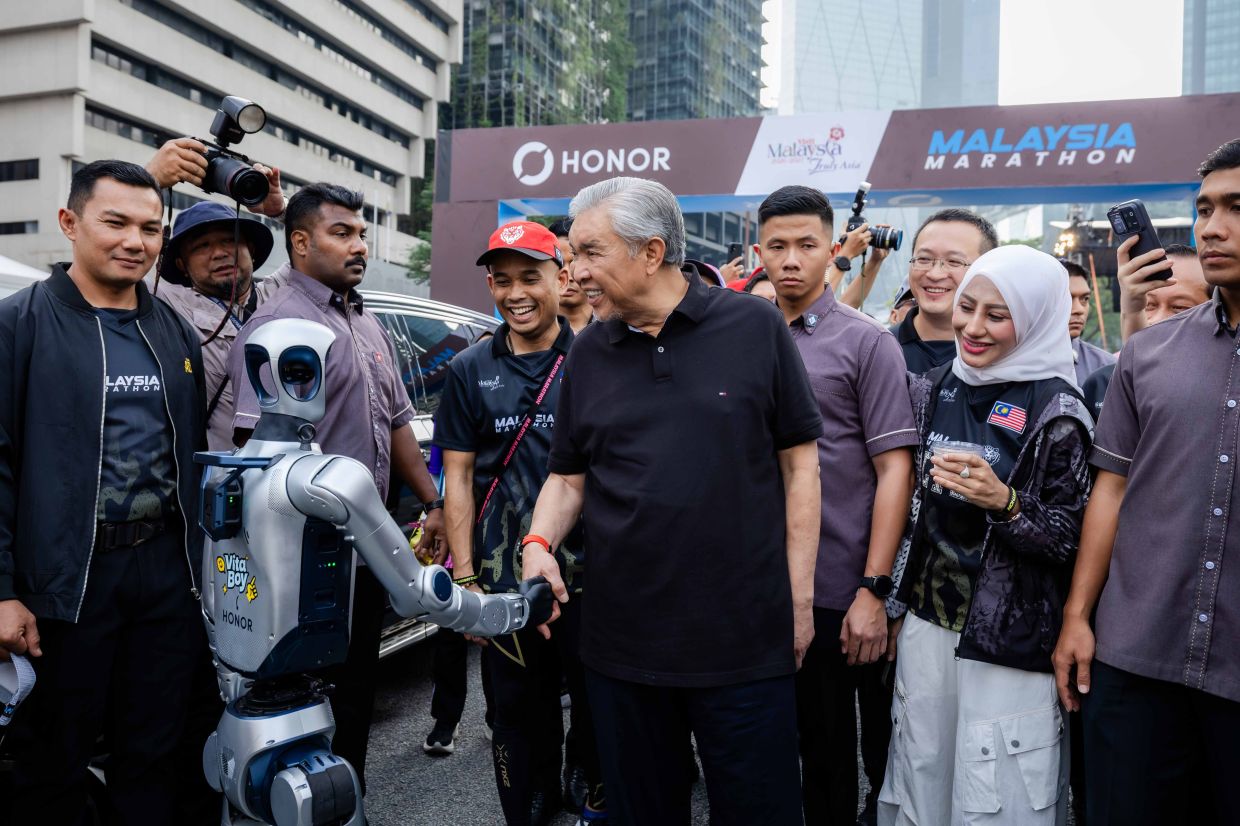
HONOR has crossed a significant technological and geographical milestone by deploying its advanced humanoid robots outside China for the first time, choosing Malaysia Marathon 2026 in Kuala Lumpur as the launching pad for this international expansion. The event represented not merely a sporting exhibition but a strategic demonstration of how far robotics engineering has advanced, with two distinct robotic systems performing simultaneously across different race distances while Malaysian Deputy Prime Minister Datuk Seri Dr Ahmad Zahid Hamidi and other government officials looked on.
The headline-grabbing HONOR Robotics D1 model that took the 10km challenge carries impressive credentials from its domestic testing ground. At the Beijing Yizhuang Humanoid Robot Half Marathon held earlier, this robot demonstrated extraordinary performance by completing a half-marathon distance in 50 minutes and 26 seconds, achieving peak velocities of 14.5 metres per second. That prior achievement had already established the D1 as a formidable autonomous system capable of sustained physical exertion, yet performing at an international venue under completely different environmental conditions presented fresh engineering challenges.
The transition from Beijing's climate to Malaysia's tropical environment fundamentally altered the operational parameters facing the D1 robot. Whereas the earlier half-marathon took place in more temperate conditions familiar to the technology's designers, Malaysia's sustained heat and humidity tested whether the robot's battery systems, mechanical joints, thermal management, and motor controllers could maintain reliable performance across extended outdoor exertion. The 10km distance in Kuala Lumpur's equatorial climate essentially served as a rigorous real-world validation of the robot's engineering robustness, demonstrating whether laboratory-tested specifications translated into consistent performance when deployed beyond controlled environments.
Accompanying the D1 model was the HONOR Robotics A1, which participated in the shorter 5km category during the morning's festivities. The presence of two distinct robotic platforms suggests HONOR's deliberate strategy to showcase different technological implementations suited to varying performance demands. While media attention naturally concentrated on the D1's longer-distance feat, the A1's participation in a route flagged off by the Deputy Prime Minister highlighted the company's commitment to introducing humanoid robotics to Malaysian public consciousness across multiple platforms and capability levels.
The timing of this deployment carried symbolic significance extending beyond pure technological spectacle. The marathon coincided with National Day celebrations, and organizers incorporated the robots into a broader patriotic tableau by having them march alongside approximately 1,000 local students carrying what was promoted as the nation's longest Jalur Gemilang flag. This integration embedded cutting-edge technology into a nationalist narrative, positioning robotics advancement as a shared achievement that transcended commercial branding to touch upon Malaysian pride and technological aspiration.
HONOR's messaging around the event articulated a philosophical shift in how the company views its technological role. Rather than presenting robotics as replacing human capability, the company framed the initiative as demonstrating technology's potential to amplify and complement human achievement. The statement that robots should evolve from "serving people" to "moving alongside people" suggests a deliberate repositioning away from the sometimes-dystopian narratives surrounding automation toward a vision of collaborative human-technology interaction. For Malaysian audiences increasingly concerned about automation's labour market implications, this messaging carries particular resonance.
The company's market performance in Malaysia adds commercial substance to its technological demonstration. HONOR reported holding the number one market share position during the first quarter of 2026 according to Counterpoint Research data, indicating that the brand has successfully established consumer preference in the region's competitive smartphone and smart device market. This ranking demonstrates that HONOR's presence in Malaysia extends well beyond publicity-generating engineering projects; the company maintains a substantial customer base whose trust and purchasing decisions reflect broader confidence in the brand's quality and innovation trajectory.
The robot deployment strategy reflects how technology companies increasingly leverage major public events as platforms for advancing brand positioning and market narratives. By placing humanoid robots at a national marathon attended by government officials, media, and thousands of spectators, HONOR engineered simultaneous exposure across multiple stakeholder groups. The spectacle satisfied technology enthusiasts, conveyed market dominance to competitors, demonstrated commitment to Malaysian consumers, and provided officials with a visible symbol of the nation's technological modernization.
For the broader Southeast Asian technology landscape, HONOR's Malaysian deployment represents a test case for how advanced robotics might be introduced to regional markets. As Chinese technology companies increasingly seek to establish presence and credibility beyond their domestic market, Malaysia's selection as a launch location for this initiative suggests the company views the Malaysian market as sufficiently sophisticated and receptive to absorb and appreciate advanced humanoid robotics. The success or failure of public acceptance during this marathon event will likely influence how aggressively HONOR and competing firms pursue similar demonstrations across Southeast Asia.
The engineering achievement of maintaining robot performance across different climatic zones carries implications extending beyond HONOR's immediate competitive positioning. Tropical regions present distinct challenges for autonomous systems, particularly regarding battery chemistry performance, moisture-resistant electronics, and mechanical lubrication under heat stress. If HONOR's robots performed reliably under Malaysian conditions, the company can market this capability to other tropical markets across Asia, Africa, and Latin America where humanoid robotics deployment has previously been limited by environmental constraints.
Looking forward, the Malaysia Marathon debut establishes a precedent that may shape how robotics firms approach market entry and consumer engagement in Southeast Asia. Rather than introducing robots through laboratory exhibitions or controlled industrial environments, placing them in highly public, aspirational contexts like marathons normalizes the technology while generating authentic performance data from real-world conditions. Malaysian spectators witnessed not a theoretical demonstration but tangible evidence of robotic systems completing physical challenges in their country's actual environment.
HONOR's articulation of continued commitment to bringing "warmer, more human-centred technology" to Malaysia positions the company's trajectory from conventional smart devices through artificial intelligence toward humanoid robotics as a logical progression rather than a radical departure. For Malaysian consumers and policymakers monitoring technological advancement, the company's presence at Malaysia Marathon 2026 signals that the transition from smartphone dominance toward embodied robotics represents an ongoing evolution within mainstream consumer technology rather than a speculative future frontier. The robots that crossed Malaysia's marathon finish line embodied not merely engineering achievement but a particular vision of technology's relationship with human society.

