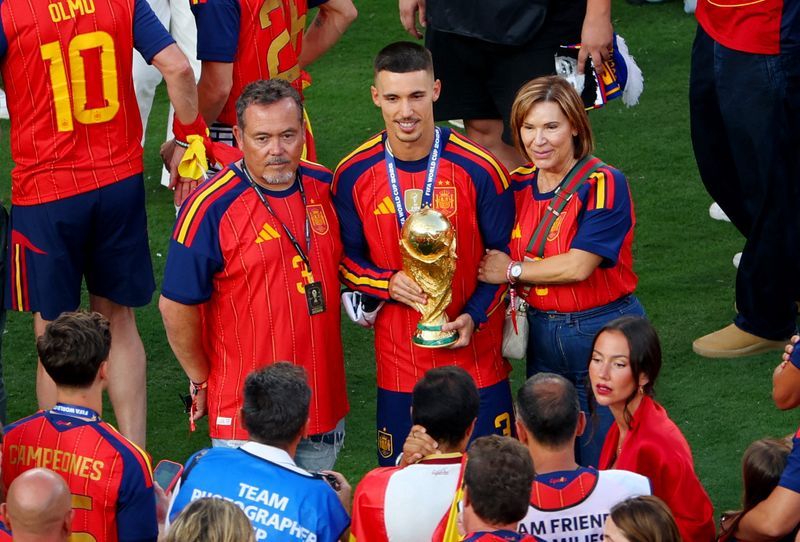
Spain's journey to World Cup victory in East Rutherford, New Jersey, on July 19 represented far more than a single match outcome. The Spanish side's 1-0 triumph over Argentina encapsulated a complete footballing cycle—from technical refinement to grinding determination—yet the team emerged precisely where its philosophy had always aimed them: as global champions with possession of the ball and unshakeable conviction in their methods. This was not a dramatic reinvention of Spanish identity but rather a hardened, purposeful restatement of everything the national program has built over the past decade.
Luis de la Fuente's squad remained faithful to the foundational principles that have defined Spanish football since their 2008 emergence as a continental force. The team moved the ball with meticulous precision, controlled territory with suffocating efficiency, and refused to deviate from their blueprint even as Argentina mounted defensive resistance and regulation time surrendered to extra periods. Spain's approach reflected an almost obsessive reverence for possession itself—treating the ball not as a tool for quick profit but as a sacred instrument to be maintained, protected, and circulated among eleven minds operating as a singular organism. The statistics told this story with unmistakable clarity: the Spanish side commanded over 65 percent possession, registered 12 shots on target, and completed twice as many passes as their opponents, whose opening attempt on goal arrived only near the conclusion of extra time and missed its target entirely.
Yet dominance need not mean demolition, and Spain's performance carried that nuance throughout. The Spanish unit created numerous scoring opportunities yet frequently stumbled in the final execution, a recurring reminder that the absence of a traditional, prolific centre forward remains their most glaring vulnerability. This weakness, however, represented almost the only chink in an otherwise comprehensively constructed defensive and possession fortress. When the decisive moment arrived, it arrived not through the established hierarchy but through the bench—substitutes Nico Williams and Ferran Torres combining to unlock the Argentine rearguard and secure the trophy. This outcome proved deeply emblematic of de la Fuente's entire philosophy: no individual transcends the collective, and those summoned from reserve status possess the same tactical literacy and technical competence as those who began the contest.
The distribution of tournament honors reinforced this emphasis on structural completeness. Spain claimed the awards for Best Young Player (Pau Cubarsi), Best Goalkeeper (Unai Simon), and the tournament's Most Valuable Player (Rodri), leaving only the Golden Boot to Kylian Mbappé of France. Rather than representing a shortcoming, this pattern validated the Spanish approach. Their eight goals across eight matches originated from eight different scorers, a stunning dispersion that mirrored their European Championship success in 2024, when ten different players combined to score a tournament-record 16 goals. This was football designed to function without dependency on any singular talent, a collective enterprise where responsibility and reward diffused across the entire squad.
The triumph extended Spain's unbeaten streak to 38 matches, a run that now surpasses Italy's previous record and underlines a period of three years marked by sustained international dominance. This consistency—stretching across qualifying campaigns, tournament play, and competitive friendlies—demonstrates that Spain's success rests on embedded principles rather than temporary brilliance or fortunate circumstances. De la Fuente's elevation to the sport's highest prize carried particular personal resonance, representing vindication for a coach once dismissed as Luis de la "Who" following decades spent cultivating talent within the Spanish Football Association's academy structures. His patience in those developmental ranks had prepared him with profound understanding of how to build a team around technical foundation and positional intelligence rather than established reputation.
Beyond football's technical dimensions, Spain's victory carried profound national significance within the Spanish context itself. The squad assembled for this tournament embodied the nation's internal diversity in ways that transcended the usual platitudes about multicultural unity. Players emerged from distinct geographic and cultural regions: the Basque territories contributed Mikel Oyarzabal, Unai Simon, and Mikel Merino; Galicia sent Borja Iglesias; Valencia provided Ferran Torres; Madrid supplied Rodri; Andalucia contributed Fabian Ruiz and Gavi; the Canary Islands offered Pedri. Catalonia alone produced nine members of the squad, including Cubarsi and Marc Cucurella. Meanwhile, Lamine Yamal and Nico Williams represented Spain's newer demographic reality—the successful integration of immigrant families into the national fabric.
Historically, Spain's strength has always resided in its composition as a confederation of distinct smaller nations, each possessing separate histories, languages, and cultural traditions. The regional identities that have occasionally generated political tension within Spain did not disappear during the tournament. Instead, they became subsumed within a larger footballing project where differences enriched rather than fractured the collective enterprise. For one extended evening, football accomplished what political institutions frequently struggle to achieve: it rendered the nation feeling genuinely unified, transcending the divisions that typically define Spanish public discourse.
For Malaysian observers and Southeast Asian readers, Spain's victory illuminates important lessons about organizational culture and collective function. In a region where national teams draw talent from diverse ethnic and geographic communities, Spain's model demonstrates how technical systems and shared principles can accommodate—even celebrate—internal plurality while maintaining institutional cohesion. The Spanish approach privileged structure and methodology over personality, creating an environment where substitutes contributed with equivalent competence to established figures, and where eight different goal scorers negated the need for dominant individual performances.

