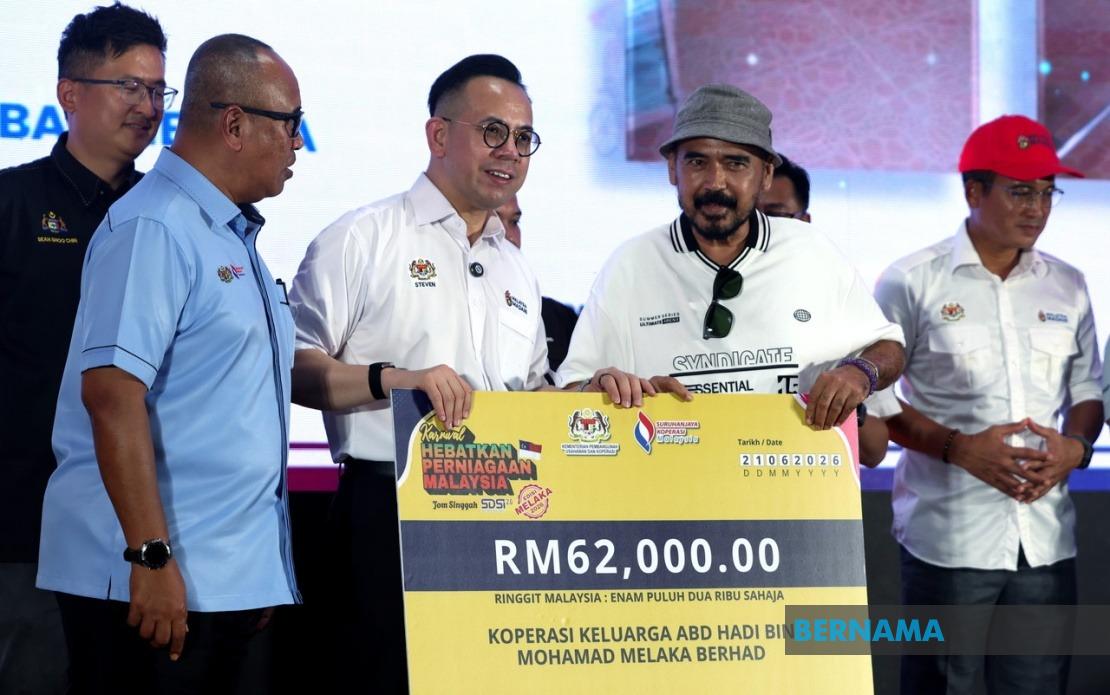
The 2026 Empowering Malaysian Businesses Carnival, held in Melaka from June 19 to 21, has emerged as a significant platform for bolstering entrepreneurial activity across the country. Organised by the Ministry of Entrepreneur Development and Cooperatives (KUSKOP), the three-day event successfully generated a combined business matching value and financing potential of RM8.45 million, signalling strong momentum in Malaysia's push to strengthen its small and medium-sized enterprise sector.
The carnival's impact extended beyond financial metrics. The event drew 70,000 visitors over the three-day period, with direct sales of entrepreneur products totalling RM532,802.77, providing immediate revenue opportunities for participating vendors and indicating genuine market interest in locally-produced goods and services. This foot traffic underscores the growing appetite among Malaysian consumers and business participants for events that facilitate direct engagement with emerging enterprises.
One of the carnival's core mechanisms—business matching sessions—proved particularly effective. Across 72 dedicated matching sessions, organisers successfully facilitated connections between 25 potential entrepreneurs and established business partners or investors, resulting in RM6.4 million in identifiable business opportunities. These structured interactions address a longstanding challenge within Malaysia's entrepreneurial ecosystem: the gap between promising business concepts and access to experienced mentors, partners, and growth networks that can accelerate scaling.
Financial accessibility, another critical bottleneck for small enterprises in the region, was tackled through a dedicated financing interaction session. The event brought together 55 micro, small and medium enterprises with financial institutions and lending specialists, generating RM2.05 million in potential financing commitments. For MSMEs operating in Malaysia's competitive landscape, access to affordable capital often determines survival and expansion prospects, making this component particularly valuable for participants seeking growth capital without prohibitive terms.
The Melaka carnival represents the third instalment in the broader HPM 2026 Carnival series, part of KUSKOP Minister Steven Sim Chee Keong's Hebatkan Perniagaan Malaysia (Empowering Malaysian Business) agenda. This initiative aligns with the government's strategic ABCD framework—focusing on accelerating productivity, reducing bureaucratic friction, improving capital accessibility, and developing market access. By creating experiential platforms where these policy objectives translate into tangible business outcomes, the carnival approach bridges the gap between high-level policy and ground-level entrepreneurial reality.
The initiative's integrated design addresses multiple pain points simultaneously. Rather than isolating entrepreneurs from financiers, suppliers, or potential buyers, the carnival environment encourages organic networking and discovery. SMEs and cooperatives gain exposure to capacity-building resources, potential strategic partners, and new market segments, all within a structured yet accessible setting. This holistic approach resonates with international best practices in entrepreneurship support, where ecosystem building trumps isolated interventions.
Looking forward, the HPM Carnival roadmap extends the momentum beyond Melaka. The fourth edition is scheduled for Penang from July 17 to 19 at the Penang Waterfront Convention Centre (PWCC), signalling a deliberate geographic strategy to engage entrepreneurial communities across different Malaysian states. Penang, with its established business infrastructure and economic diversity, represents a natural expansion point that could attract different sectors and scale of enterprises than those drawn to Melaka.
The geographic rotation strategy carries broader implications for regional economic development. By bringing these activation events to multiple hubs rather than concentrating them in the capital, KUSKOP acknowledges that entrepreneurial potential exists throughout Malaysia, not merely in Kuala Lumpur. For participants in Penang and other states, reduced travel costs and locally-relevant business ecosystems increase accessibility and relevance compared to centralised initiatives.
The carnival's focus on cooperatives alongside traditional SMEs reflects Malaysia's institutional approach to inclusive enterprise development. Cooperatives represent an important alternative vehicle for small business operators seeking shared resources, collective bargaining power, and mutual support structures. Their inclusion in the HPM platform ensures that cooperative models—particularly relevant for agricultural, retail, and service-sector enterprises—receive equivalent visibility and support.
For Malaysian readers and business stakeholders, the Melaka carnival results suggest that structured, multi-stakeholder events can generate meaningful economic activity and connections. The RM8.45 million in matchmaking value and financing potential, while modest in absolute terms, represents real business relationships and capital flows that would likely not have materialised without the carnival's convening power. For entrepreneurs struggling to break through visibility barriers or secure finance, such events offer practical pathways to growth.
The success metrics also underscore persistent challenges in Malaysia's entrepreneurial landscape. The requirement for state-level carnivals to unlock business matching and financing suggests that normal market mechanisms or existing support infrastructure are insufficient. The RM532,802.77 in direct sales, while positive, remains relatively modest given the 70,000 visitor base, hinting at a gap between foot traffic interest and actual purchasing capacity or intent.
As the HPM Carnival series continues throughout 2026, its cumulative impact on Malaysia's MSME sector will become clearer. Each event generates discrete business relationships and financial commitments, but the broader value lies in normalising entrepreneurial activity, demonstrating accessible support pathways, and building confidence among potential business owners. For Southeast Asia's diverse entrepreneurial ecosystem, Malaysia's structured approach to carnival-based business activation offers a replicable model worth observing.