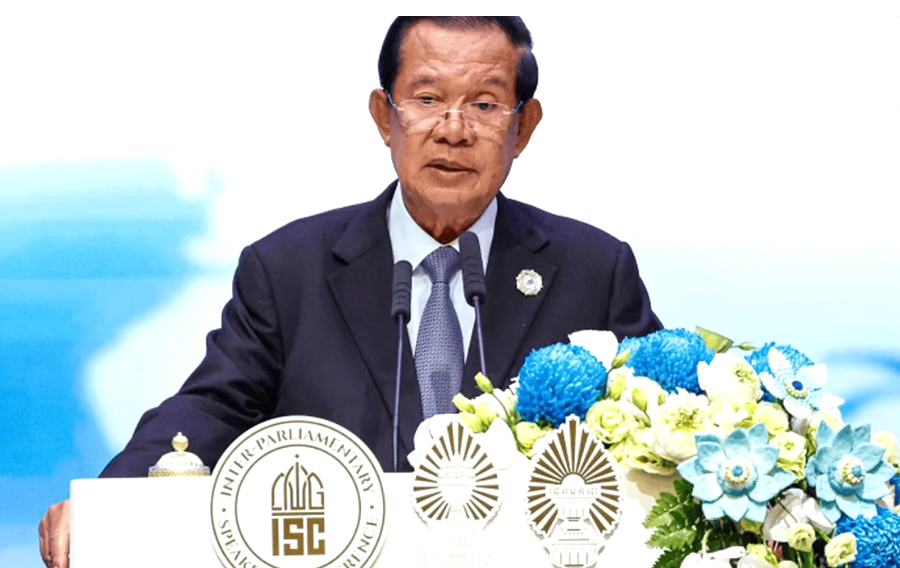
Cambodia's Senate president Hun Sen has levelled serious accusations against Thailand, asserting that the neighbouring country has deliberately weaponised international concerns about cross-border online scam operations to justify the occupation of Cambodian sovereign territory. Speaking before parliamentary delegations from across Asia and beyond at the 2nd Inter-Parliamentary Speakers' Conference in Phnom Penh on Thursday, Hun Sen characterised Thailand's actions as a deliberate distortion of legitimate security concerns, framing the territorial dispute as symptomatic of a broader erosion of international norms.
The conference, which convened legislators and parliamentary leaders from nations including Pakistan, Malaysia, Myanmar, Australia and Russia, provided Hun Sen with a regional platform to articulate Cambodia's position on the contested border. His remarks reflect deepening frustration in Phnom Penh over the presence of Thai military and civilian personnel in disputed areas, particularly around temple complexes and archaeological sites that both nations claim. Hun Sen's framing of the dispute as an abuse of extraterritorial jurisdiction over crime represents a significant rhetorical escalation, moving beyond conventional border rhetoric to situate the territorial question within a critique of how powerful states manipulate international law.
Hun Sen argued that contemporary conflict has evolved beyond traditional military confrontation, manifesting instead through multiple overlapping domains that collectively undermine state capacity and public welfare. He identified online scam operations as merely one instrument among several through which stronger nations impose their will on weaker neighbours, citing also the use of trade wars, customs barriers, and the selective withdrawal of trade preferences as mechanisms of economic coercion. This analysis reflects a growing Southeast Asian perspective that globalisation has created new vulnerabilities for developing nations, who lack the institutional capacity to resist coordinated pressure from economically dominant states.
The Senate president accused Thailand of breaching previously negotiated ceasefire agreements, suggesting that Bangkok treats such commitments as superficial diplomatic gestures rather than binding legal instruments. Hun Sen's language implied that the Thai government views written agreements as temporary conveniences rather than enforceable obligations, a characterisation that extends beyond the bilateral dispute to underscore broader concerns about the reliability of international commitments. For Malaysian observers, Hun Sen's critique resonates with ongoing anxieties about how larger regional powers interpret and implement agreements involving smaller neighbours, particularly in maritime and land boundary contexts.
Beyond the immediate Cambodia-Thailand situation, Hun Sen articulated a sweeping indictment of how the international system has fractured under pressure from powerful actors who selectively invoke international law while simultaneously violating its fundamental principles. He highlighted what he termed a dangerous pattern whereby technologically advanced nations claim exclusive rights to self-defence while conducting preemptive military strikes against perceived threats, actions that contradict the UN Charter's framework for collective security. This critique carries particular weight in Southeast Asia, where nations have historically depended on international law and multilateral institutions to constrain the behaviour of more powerful states.
Hun Sen warned that this systemic insecurity has triggered a destabilising global arms race, as vulnerable nations increasingly abandon faith in treaty-based protection mechanisms and instead pursue military capabilities to deter aggression independently. He cautioned that this security spiral threatens the collapse of the international non-proliferation framework, a concern of direct relevance to the region given ongoing North Korean weapons development and the strategic military competition between China and the United States across Southeast Asian waters. The accumulation of conventional and nuclear weapons in the hands of insecure states fundamentally alters regional stability calculations.
The Cambodian leader argued that developing nations face systematic discrimination through the selective application of international standards, particularly regarding human rights, environmental protection, and law enforcement. He contended that wealthy nations impose rigorous criteria on weaker states while exempting themselves from equivalent scrutiny, creating a double standard that delegitimises the entire framework of international accountability. Hun Sen's grievance reflects a sentiment widespread across Southeast Asia, where governments feel that external pressure on governance issues often ignores the structural constraints facing post-conflict societies still rebuilding institutions and infrastructure.
Hun Sen emphasised that economic and trade relationships have increasingly become weapons in great power competition, with rules changing unpredictably and bilateral arrangements subject to reversal based on shifting political calculations. This observation has immediate relevance for Malaysia and other ASEAN members, whose prosperity depends on stable, predictable trade relationships and access to global markets. The unpredictability Hun Sen describes creates planning difficulties for businesses and governments attempting to construct long-term economic strategies, undermining the investment climate across the region.
The Senate president called for restoration of the rules-based international order, invoking the UN Charter, the ASEAN Charter, and other multilateral frameworks as essential correctives to the current trajectory. His framing presents the Cambodia-Thailand dispute not as an isolated border quarrel but as a microcosm of systemic international dysfunction. This rhetorical strategy situates Cambodia's grievance within larger debates about whether the post-Cold War international architecture can survive pressure from major powers pursuing narrowly defined national interests without regard for collective stability.
Hun Sen's address signals Cambodia's determination to internationalise the border dispute, bringing it before regional parliamentary bodies and invoking collective ASEAN and UN principles as counterweights to bilateral pressure. By characterising Thailand's actions as emblematic of broader decay in international norms, Hun Sen attempts to mobilise support from other developing nations who share similar vulnerabilities. The success of this diplomatic strategy will largely depend on whether ASEAN states, including Malaysia, perceive sufficient common interest in defending multilateral principles against the unilateral actions of any regional member, regardless of historical alignments.
For Malaysia and other ASEAN neighbours, Hun Sen's warnings about the weaponisation of ostensibly legitimate concerns such as cross-border crime merit serious consideration. The precedent that allows one state to occupy another's territory under the guise of addressing transnational criminal activity could establish dangerous precedents for future regional disputes. As Southeast Asia navigates competition between China and Western powers while simultaneously managing internal ASEAN disputes, the durability of the multilateral framework that has provided relative stability becomes increasingly consequential for all member states.

