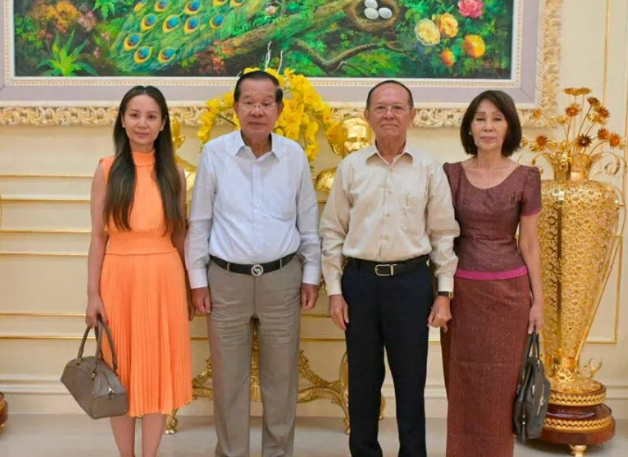
Cambodia's political landscape appears to be shifting as Senate president Hun Sen hosted former opposition leader Kem Sokha at his private residence on Sunday, August 16, for a three-hour meeting that underscores an evolving relationship between two figures who once represented opposing poles of the country's governance divide. The engagement, which Hun Sen disclosed via social media, included Sokha's wife and daughter, and represents another step in the gradual rehabilitation of the former Cambodia National Rescue Party chief following his recent release from legal constraints.
The meeting itself carries symbolic weight given the decades-long animosity that defined Hun Sen and Sokha's political rivalry. Sokha, who co-founded and led the CNRP, emerged as the ruling Cambodian People's Party's most credible challenger during the 2013 national election and subsequent commune elections in 2017. The opposition party's dissolution by Cambodia's Supreme Court in November 2017—just months after Sokha's arrest—effectively removed a primary competing force from the political arena. That Hun Sen now welcomes this former adversary into his home signals either a significant shift in confidence or a calculated political manoeuvre aimed at further marginalising residual opposition elements through co-option.
What makes this encounter particularly noteworthy is Hun Sen's specific commendation of Sokha's daughter, Kem Monovithya, whom the Senate president described as "an excellent human resource for the nation." Coming from someone of Hun Sen's stature and political experience, such praise carries implications that extend beyond mere pleasantries. Monovithya had been closely associated with her father's political activities and the CNRP's organisational structures, making her a potential political asset if the current leadership were to facilitate her entry into Cambodia's political establishment. Hun Sen's public acknowledgement of her capabilities suggests that doors previously shut to the Sokha family may now be opening, though neither camp has confirmed any formal arrangement.
Sokha's journey back to public life has been measured and carefully managed over recent months. In 2023, he received a 27-year prison sentence on treason charges related to alleged conspiracy with foreign powers—accusations that his supporters have consistently characterised as politically motivated. A royal pardon granted on May 25 terminated his remaining prison time and house arrest, though restrictions preventing political participation initially remained intact. A subsequent royal decree issued on July 24 further eased constraints by lifting his five-year overseas travel ban, demonstrating a deliberate process of incrementally restoring his freedom of movement and opportunity for public engagement.
The timing of these escalating privileges coincides with Sokha's renewed visibility. On July 28, just days after the travel restriction was lifted, he travelled to Banteay Meanchey province to visit displaced Cambodian families affected by cross-border tensions with Thailand. During that visit, Sokha carefully positioned himself as a private citizen rather than a political representative, yet his engagement with international contacts regarding displaced Cambodians' circumstances suggests he remains actively concerned with national affairs. This nuanced positioning—maintaining private advocacy while respecting formal prohibitions—may represent a template for how the former opposition leader intends to operate in Cambodia's current political environment.
For Malaysian and Southeast Asian observers, Sokha's situation illuminates broader regional patterns of how ruling parties manage former political opponents. Unlike some neighbouring jurisdictions where opposition figures face sustained persecution or exile, Cambodia's approach involves graduated reintegration coupled with sustained restrictions. This model permits the appearance of political pluralism and reconciliation while preserving government control over formal political participation. The strategic rehabilitation of figures like Sokha, particularly when combined with integration of family members into establishment circles, can serve ruling parties by neutralising potential opposition rallying points and absorbing capable individuals into their own networks.
The lack of any official announcement regarding political agreements or formal reconciliation processes suggests that both Hun Sen and Sokha are proceeding tactfully. The three-hour conversation that occurred at Hun Sen's residence remains undisclosed in terms of substantive content, leaving observers to interpret the meeting's significance through contextual clues rather than explicit statements. This discretion may reflect an understanding that publicly framing such encounters as formal political reconciliation could provoke reactions from various factions within both the ruling party and remaining opposition circles who maintain hardline positions toward their counterparts.
Sokha's gradual reintegration into Cambodian public life also reflects changing international and domestic calculations regarding opposition figures. The international community, including key regional partners, has maintained interest in Cambodia's democratic trajectory, and completely marginalising figures like Sokha carries reputational costs. By permitting his measured return to public engagement while maintaining formal political restrictions, the Cambodian government can satisfy international concerns about democratic space while preserving substantive political control. This calibrated approach differs markedly from complete suppression, yet it falls short of genuine political liberalisation.
The question of whether Monovithya might eventually assume a formal political or public role remains open. Hun Sen's praise could be exploratory, testing public and party reactions to the notion of integrating Sokha family members into Cambodia's establishment. Alternatively, it may simply reflect pragmatic recognition that individuals of talent and organisational experience represent national assets regardless of their previous political affiliations. In either case, the comment suggests that the Sokha family's exclusion from Cambodian public life may not be permanent or absolute.
The evolution of Hun Sen and Sokha's relationship has broader implications for Cambodia's political trajectory. If this warming of ties presages more substantial integration of former opposition elements into the broader political and social fabric, it could represent a maturation of Cambodia's political system away from zero-sum competition. Conversely, if the process serves primarily to neutralise remaining opposition potential through selective co-option, it may actually entrench ruling party dominance by removing alternative focal points for political organisation and dissent. The coming months will likely provide clearer indication of which interpretation proves more accurate as Sokha continues his public re-emergence and any potential political roles for family members become apparent or remain unfulfilled.
For regional observers monitoring Cambodia's political health, these developments warrant careful attention. The treatment of former opposition leaders and the mechanisms through which they are either marginalised or reintegrated offer insights into the broader health of democratic institutions and political competition. Cambodia's approach to Sokha's reintegration—balanced between reconciliation and control—represents one model for managing post-conflict or post-suppression political transitions, a pattern that resonates across Southeast Asia where many nations contend with similar tensions between stability, legitimacy, and genuine political pluralism.

