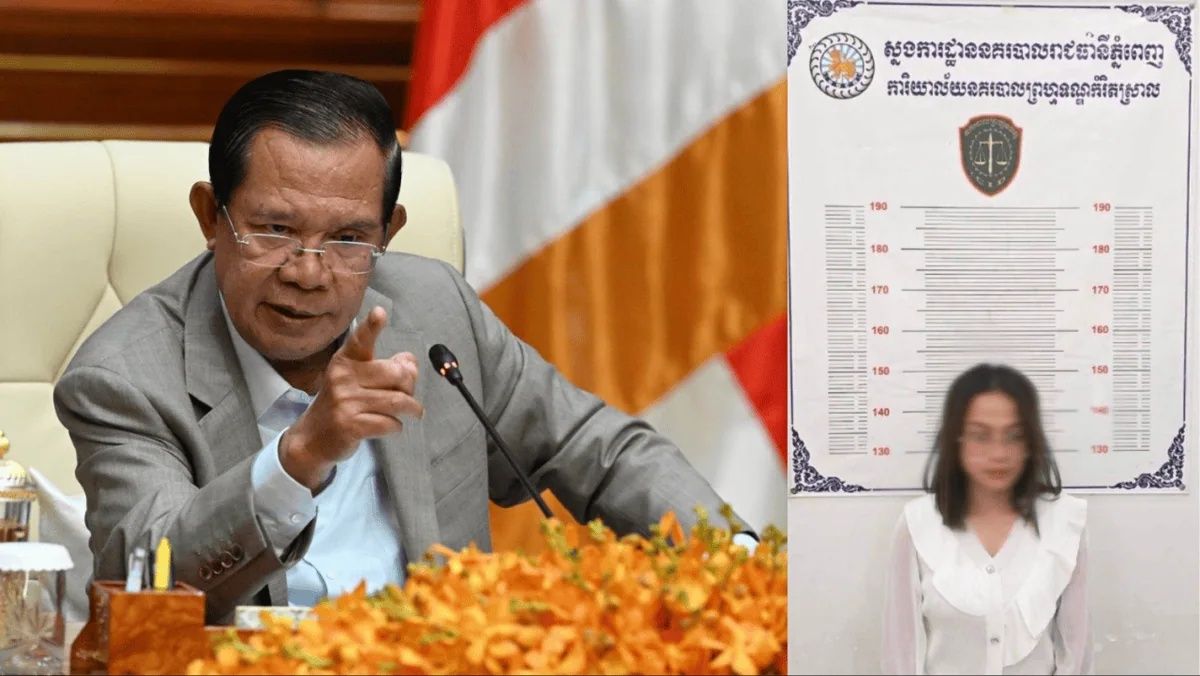
Cambodia's Senate president Hun Sen has instructed the National Council for Women to initiate legal proceedings against individuals whose language and conduct violate what he characterizes as fundamental standards of respect for women and national social values. During a Friday meeting with a delegation from the council, Hun Sen directed the body to function as a plaintiff in court cases targeting speech and behaviour deemed offensive to women and civil institutions, marking a significant expansion of state oversight into public discourse on matters relating to gender and social conduct.
The directive emerged from Hun Sen's concerns about recent incidents in which individuals, particularly women, have allegedly engaged in verbal abuse that he views as corrosive to both institutional respect and broader social norms. He referenced an unnamed woman who had reportedly used profanity directed at government bodies and their personnel, noting that authorities had already intervened by requiring the woman and her husband to submit a formal written apology. This case exemplifies the kind of conduct Hun Sen believes warrants formal legal intervention, framing such incidents not as isolated disputes but as threats to national dignity.
A second case illustrating Hun Sen's concerns involves a woman identified as Chenda Sovannary, who allegedly insulted a soldier following a disagreement over a mobile phone transaction. Hun Sen's remarks on this matter reveal his broader perspective on acceptable public conduct, questioning why any person, regardless of social standing, should face verbal abuse. His rhetorical questioning — emphasizing that soldiers, construction workers, and other citizens equally deserve protection from insults — frames the legal initiative as a universal standard rather than selective enforcement.
The directive carries significant implications for free speech in Cambodia, as it establishes a mechanism through which state institutions can pursue individuals whose verbal conduct, even in private disputes or on social media, may be classified as damaging to women's dignity or social morality. Hun Sen explicitly acknowledged that monitoring online spaces, particularly Facebook, would form part of this enforcement strategy, indicating that digital platforms will face increased scrutiny for content deemed offensive. This expansion into social media monitoring represents a notable shift in state regulation of public discourse.
Hun Sen's framing of the initiative as consistent with democratic governance and corporate ethics practices suggests an attempt to normalize such interventions. He drew parallels to content moderation policies enforced by major social media companies, arguing that states have equivalent rights to establish and enforce community standards. However, this comparison obscures the fundamental difference between private platform governance and state-mandated legal action backed by criminal or civil sanctions, raising questions about the boundary between legitimate social protection and potential suppression of dissent.
The implementation structure designated by Hun Sen involves collaboration across multiple state ministries, including the Ministry of Interior, Ministry of Information, Ministry of Culture and Fine Arts, and Ministry of Post and Telecommunications. This inter-ministerial coordination suggests a comprehensive, coordinated approach to identifying and prosecuting individuals whose speech falls within the targeted categories. The scale and coordination of this mechanism indicate that Hun Sen views the initiative as a priority warranting institutional resources and high-level attention.
Hun Sen's insistence that these measures do not constitute authoritarian restriction of rights, but rather necessary safeguards for national dignity, reflects a recurring tension in governance discourse across Southeast Asia. Governments frequently justify speech restrictions by invoking cultural protection, social stability, or institutional respect, positioning limitations on expression as defensive rather than oppressive. The framing emphasizes that protecting women's values and social morality represents a positive state function rather than an infringement on fundamental freedoms.
For Malaysian observers, this Cambodian development carries instructive lessons about the trajectory of speech regulation in the region. Southeast Asian democracies have increasingly witnessed the expansion of legal mechanisms targeting speech deemed offensive, insulting to officials, or corrosive to social values. Cambodia's explicit institutionalization of state prosecution for such speech reflects a pattern seen elsewhere in the region, where broadly-defined offenses related to respect for institutions or social harmony can encompass significant portions of public discourse.
The gendered dimension of Hun Sen's directive — framing women's dignity as a justification for speech regulation — adds another layer of complexity. While protecting women from abuse and harassment represents a legitimate policy objective, instrumentalizing gender protection to expand state authority over speech sets concerning precedent. The category of speech deemed harmful to women's values becomes subject to state interpretation and prosecution, potentially restricting women's own capacity to voice criticism or dissent without their speech being classified as corrosive to feminine dignity.
The initiative also raises questions about definitional clarity and consistent application. Terms such as "social morality" and "women's values" remain undefined in Hun Sen's directive, granting enforcement authorities substantial discretion in determining which incidents warrant prosecution. This discretion could facilitate selective enforcement, with politically disfavored speech more readily classified as violations than similar conduct by government supporters, creating a chilling effect on public discourse beyond the stated targets.
Cambodia's approach signals an expanding regional trend toward state management of online discourse and social interaction through legal mechanisms. As Southeast Asian populations increasingly organize and communicate via digital platforms, governments have begun establishing legal frameworks to regulate this activity, often justified through appeals to cultural protection, social stability, or institutional respect. Hun Sen's directive formalizes this regulatory impulse, establishing institutions and procedures specifically designed to monitor and prosecute online speech.
Looking forward, the practical implementation of this directive will prove consequential for Cambodia's information environment and civil society. If enforcement proceeds broadly, the legal threat to individuals who engage in verbal criticism or heated public discourse could significantly narrow the space for political expression and social commentary. Conversely, selective or limited enforcement might suggest that the initiative serves primarily symbolic or occasional purposes rather than systematic speech control, though even limited application would establish precedent for future expansion.

