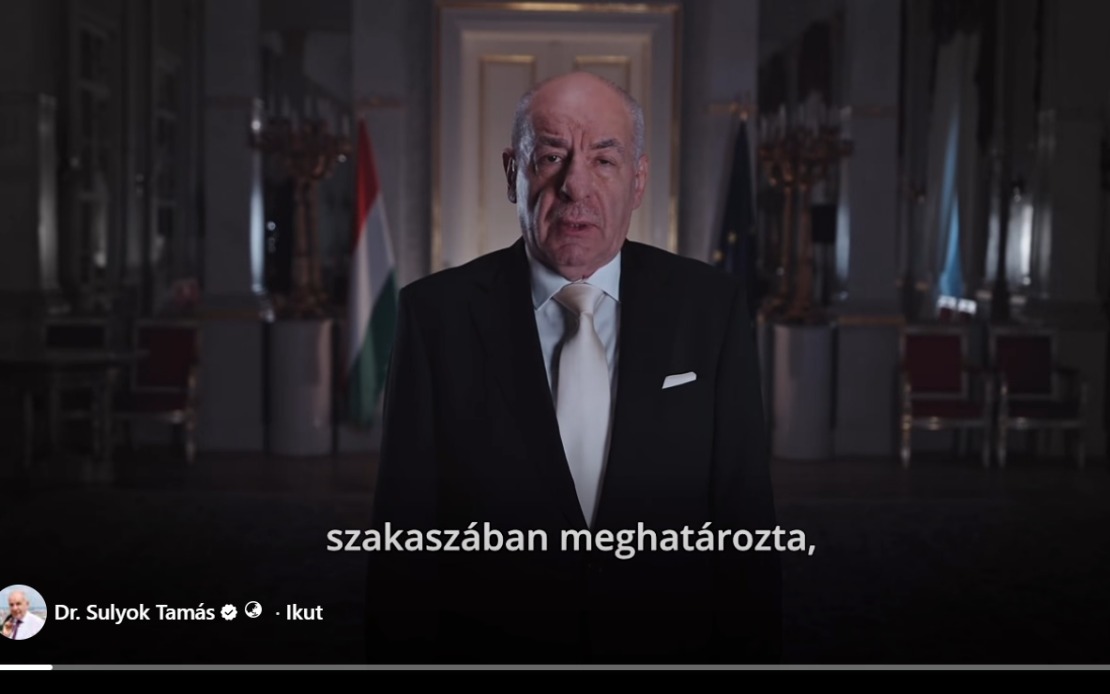
After days of deliberation, Hungarian President Tamás Sulyok has relented and approved constitutional changes that will force him from office, clearing the way for a dramatic reshaping of Hungary's political landscape under newly-installed Prime Minister Péter Magyar. Sulyok's decision to countersign the amendment came after parliament passed the legislation earlier in the week, and Magyar had issued an ultimatum: ratify the changes within five days or face impeachment proceedings. With Sulyok's consent formally granted, his presidency will effectively end on Monday as the constitutional framework undergoes substantial revision.
The situation reflects the turbulent aftermath of April's political upheaval when Viktor Orbán was voted out, fundamentally disrupting the power structure that had dominated Hungarian politics for years. Sulyok, who had been viewed as an Orbán loyalist, found himself caught between the new political forces reshaping the country's institutions and his own precarious constitutional position. Rather than attempt a protracted legal battle or impeachment process, he ultimately capitulated, acknowledging that resistance would prove futile even as he contested the legitimacy of parliament's action.
While the presidency formally transitions to parliamentary speaker Agnes Forsthoffer until a successor is elected within thirty days, the real significance lies in the constitutional amendments themselves. These changes represent a comprehensive effort by Magyar's administration to dismantle institutional mechanisms that critics argue the Orbán regime exploited to consolidate executive power. The reforms underscore a fundamental principle that Magyar emphasised: restoring limitations on political authority and ensuring that state institutions serve citizens rather than narrow political interests.
Magyar's Facebook statement framing the constitutional overhaul as returning agency to the Hungarian people reflects the new government's narrative of institutional restoration rather than revolutionary change. The reforms specifically target what the new administration identifies as democratic deficits created during Orbán's tenure. By reclaiming what it characterises as common institutional property, the government positions itself as rescuing the state apparatus from partisan capture. This messaging carries particular weight in a Central European context where concerns about executive overreach and institutional degradation remain acute.
Sulyok's own reflections on his position reveal the deeper constitutional anxieties underpinning recent events. His complaint that Hungarian presidents now operate entirely at the discretion of executive and parliamentary forces, lacking genuine oversight capacity, highlights a structural vulnerability that the new amendments seek to address. By removing a president explicitly linked to the previous regime and implementing constitutional constraints on presidential authority, Magyar's government aims to recalibrate the balance of institutional powers.
The constitutional court's limited capacity to challenge parliament's decision underscores the concentration of legislative power within the Hungarian system. Constitutional experts noted that courts could potentially object to procedural irregularities but possessed no substantive grounds to reverse parliament's determination. This institutional configuration meant Sulyok ultimately faced a choice between ceremonial compliance or politically untenable resistance that would accomplish nothing.
For regional observers, particularly in Southeast Asia where democratic resilience remains contested, Hungary's constitutional recalibration offers instructive parallels. The ease with which institutional safeguards can erode under concentrated executive authority, and the corresponding difficulty in restoring democratic equilibrium once compromise occurs, resonates across diverse political contexts. The case demonstrates that removing authoritarian-leaning leadership represents only a preliminary step; reconstructing institutional constraints requires sustained political commitment and constitutional revision.
The timing of Sulyok's capitulation also reflects broader European considerations. As Hungary navigates its relationship with EU institutions and international democratic standards, swift institutional reform signals compliance with external expectations regarding democratic governance. The constitutional amendments enable Magyar to demonstrate substantive commitment to democratic renewal rather than merely rhetorical appeals.
Looking forward, the selection of Sulyok's successor will further clarify Magyar's vision for presidential authority in post-Orbán Hungary. Whether the new president represents continuity with traditional constitutional functions or embodies further reform remains unclear. Nevertheless, the current transition period with Agnes Forsthoffer wielding presidential powers allows the government to implement planned changes without a sitting president potentially complicating legislative proceedings.
The entire episode illustrates how constitutional crises often resolve not through legal confrontation but through strategic capitulation and negotiated transitions. Sulyok's decision, while publicly criticising the constitutionality of his removal, pragmatically acknowledges political reality. For Hungary's democratic future, the constitutional amendments now taking effect represent the government's attempt to institutionalise constraints that prevent any future executive from replicating Orbán-era institutional consolidation. Whether these reforms successfully rebalance power or merely redistribute it within still-concentrated structures will define Hungary's democratic trajectory for years ahead.

