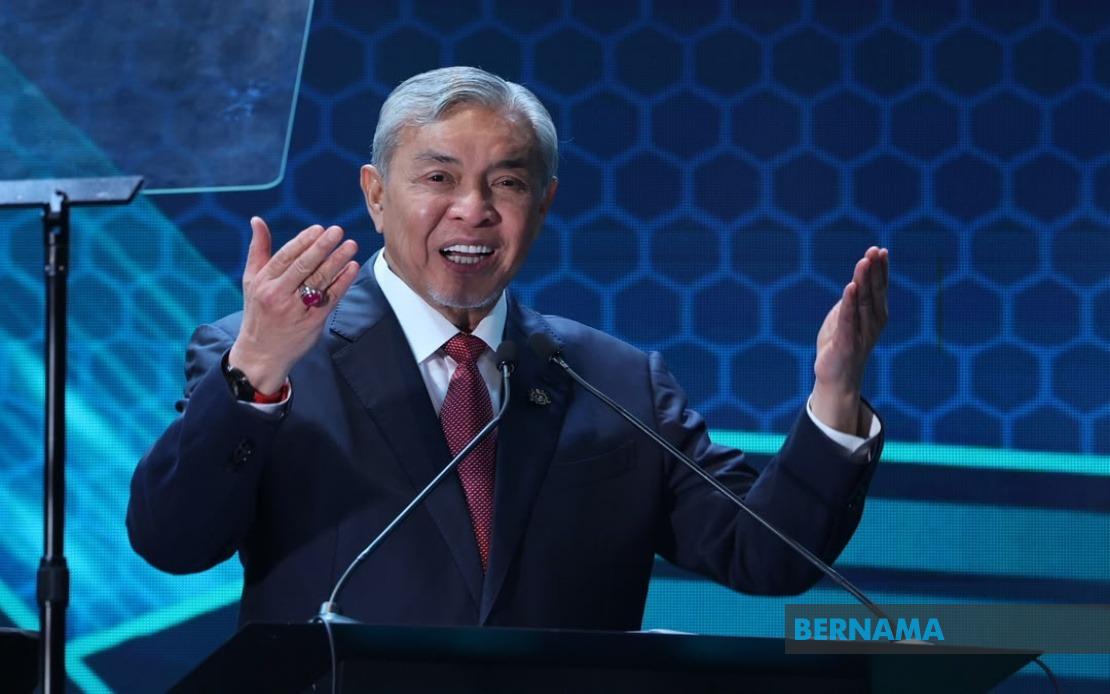
Malaysia's Immigration Department must transcend its conventional gatekeeping function to become an engine of national economic expansion, Deputy Prime Minister Datuk Seri Dr Ahmad Zahid Hamidi declared during the 2026 Immigration Day celebration in Cyberjaya. Speaking before senior government officials including Chief Secretary to the Government Tan Sri Shamsul Azri Abu Bakar and Immigration Director-General Datuk Zakaria Shaaban, Ahmad Zahid presented a comprehensive four-point mandate intended to fundamentally reshape how the department operates and contributes to national objectives.
The transformation blueprint rests on four interconnected pillars that Ahmad Zahid characterised as essential for modernising an institution historically defined by border control and passport issuance. Beyond facilitating economic growth, the mandate encompasses strengthening national security and sovereignty, accelerating digital transformation with innovative service delivery, and reinforcing institutional integrity alongside professional and humanitarian standards. Ahmad Zahid stressed that this overhaul cannot succeed through piecemeal approaches or ad-hoc adjustments, requiring instead a unified philosophical framework embedded across every operational level.
On the economic dimension, Ahmad Zahid challenged prevailing assumptions about immigration administration's proper scope. He contended that bureaucratic friction—unnecessary delays, convoluted procedures, excessive red tape—directly undermines Malaysia's competitive positioning in attracting international investment and skilled talent. The Deputy Prime Minister cited the United Arab Emirates as an instructive model, highlighting how that nation integrated immigration reform with strategic foreign investment attraction, notably through its ten-year Golden Visa programme. This integrated approach yielded remarkable results: the UAE attracted RM196.6 billion in foreign direct investment during 2025, securing ninth position globally as an investment destination for the fourth consecutive year running.
The implication for Malaysia is stark. As Southeast Asia's second-largest economy, Malaysia competes against neighbouring nations and global alternatives for capital, expertise and expatriate professionals. An immigration apparatus perceived as burdensome rather than facilitatory risks redirecting foreign investment flows and high-skilled migration toward more welcoming jurisdictions. Ahmad Zahid's framing suggests that streamlining visa processing, reducing documentation requirements and simplifying work permit procedures directly correlates with macroeconomic performance and job creation domestically.
Concerning security and sovereignty, Ahmad Zahid outlined a paradigm shift from reactive enforcement toward intelligence-driven, technology-enabled border management. Contemporary transnational threats—migrant smuggling networks operating with increasing sophistication, human trafficking becoming structurally complex, terrorism and organised crime—transcend traditional enforcement methodologies. These challenges demand anticipatory capabilities rather than post-incident responses. Ahmad Zahid indicated that Malaysia's immigration authorities must coordinate more tightly with other national enforcement agencies, creating a unified security posture rather than operating within departmental silos.
The technological transformation component represents perhaps the most consequential element of Ahmad Zahid's mandate. He advocated deploying big data analytics, artificial intelligence, predictive analytics systems, digital identity frameworks, biometric identification and intelligent border infrastructure. These technologies enable faster decision-making, enhanced accuracy and elevated security standards. Critically, Ahmad Zahid reframed technology adoption beyond mere efficiency gains—not simply working faster, but thinking smarter and acting with greater precision. This distinction matters for Malaysian policymakers: technology integration must fundamentally restructure institutional logic, not merely automate existing processes.
For Malaysian businesses and international investors, such technological modernisation promises tangible benefits. Streamlined entry procedures powered by biometric systems and digital identity frameworks reduce transaction times and costs. Predictive analytics identifying genuine commercial travellers expedites legitimate movement while strengthening security screening. Regional businesses engaging cross-border operations across Southeast Asia would particularly benefit from faster, more transparent border procedures coordinated through technological systems.
Ahmad Zahid's emphasis on institutional integrity and professional conduct addresses longstanding concerns about corruption and discretionary decision-making within Malaysian immigration administration. By anchoring operational decisions in procedural compliance, sound judgment and unwavering ethical commitment, he signalled that the department's transformation includes cultural and behavioural dimensions alongside structural and technological reforms. Personnel must exercise independence and moral courage in upholding standards despite potential institutional or external pressures.
The Deputy Prime Minister characterised the collective implementation of this four-point mandate as constructing not merely a more efficient department, but a strategically significant institution functioning simultaneously as a national security bulwark, economic competitiveness catalyst and symbol of public institutional trustworthiness. This articulation reflects broader Malaysian governance ambitions: positioning the state apparatus as development facilitator rather than merely regulatory authority.
Regional dimensions warrant consideration. Southeast Asian nations increasingly recognise immigration policy's salience for achieving regional integration objectives. ASEAN frameworks emphasising facilitated movement of skilled workers, investment capital and legitimate travellers require member states' immigration institutions to operate as development partners. Malaysia's repositioning of its Immigration Department aligns with these emerging regional priorities, potentially enhancing Malaysia's attractiveness within ASEAN's competitive landscape for foreign investment and human capital.
Implementing this mandate presents substantial institutional challenges. Reshaping departmental culture, retraining personnel in technology-enabled operations, upgrading IT infrastructure and establishing genuine inter-agency cooperation require sustained commitment and substantial resource allocation. Public sector transformation initiatives frequently encounter resistance from entrenched interests and bureaucratic inertia. Ahmad Zahid's rhetoric suggests senior political commitment, yet successful execution depends on translating ministerial directives into concrete departmental practices.
The timing carries significance amid evolving global geopolitical and economic conditions. Post-pandemic recovery trajectories, intensifying great power competition for Southeast Asian influence and shifting patterns of international migration create both urgency and opportunity for Malaysian institutional modernisation. Nations that successfully position immigration administration as development infrastructure rather than merely security apparatus may gain competitive advantage in attracting investment, talent and regional influence.
Ahmad Zahid's articulation of immigration reform as strategic national priority rather than routine administrative matter signals recognition that contemporary institutional effectiveness requires holistic recalibration. Whether this transformation mandate translates into measurable improvements in business competitiveness, security outcomes and public trust will substantially influence Malaysia's trajectory in regional and global competition.

