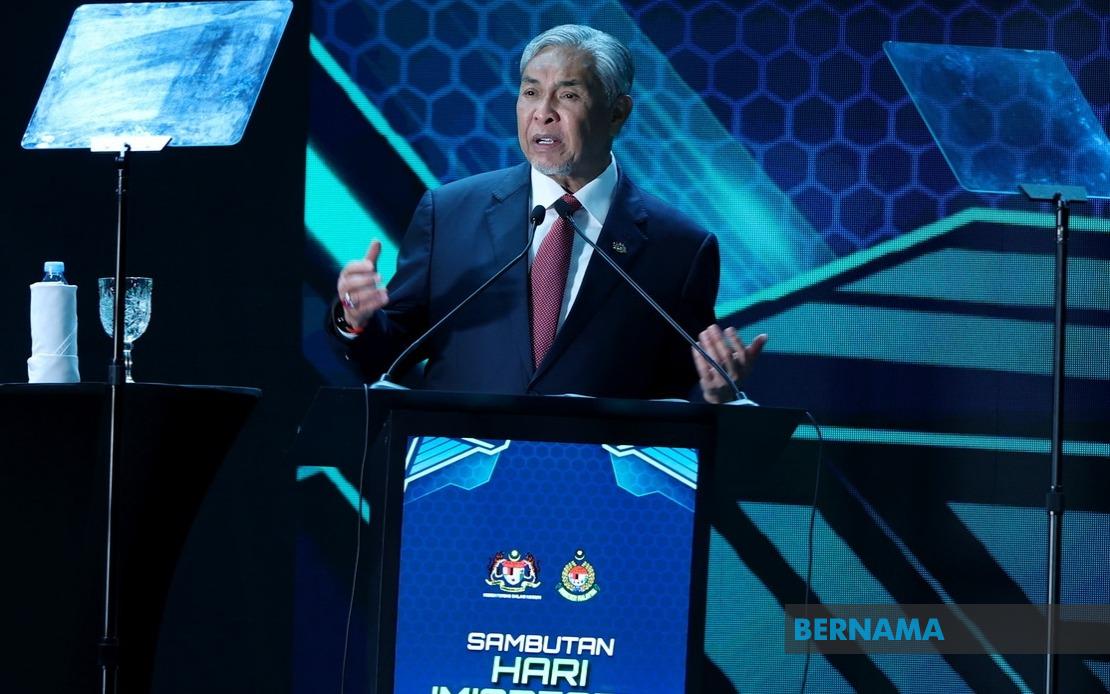
Deputy Prime Minister Datuk Seri Dr Ahmad Zahid Hamidi has thrown his weight behind efforts to overhaul the Immigration Officer Service Scheme, emphasising that personnel managing Malaysia's borders deserve improved employment conditions and career advancement opportunities. Speaking at the 2026 Immigration Day celebration in Cyberjaya on July 21, Zahid voiced strong backing for Home Minister Datuk Seri Saifuddin Nasution Ismail's earlier call to restructure senior positions within the agency and create expanded pathways for professional development.
The Deputy Prime Minister's public endorsement signals high-level political commitment to addressing longstanding concerns about service conditions affecting the Immigration Department's workforce. By connecting improved terms to the department's operational demands, Zahid framed the issue as one of institutional sustainability rather than mere administrative reform. His remarks suggest that cabinet-level discussions on the matter have already matured beyond preliminary stages, with implementation now dependent on formal consideration by the Chief Secretary to the Government Tan Sri Shamsul Azri Abu Bakar and Public Service director-general Tan Sri Wan Ahmad Dahlan Abdul Aziz.
Central to Zahid's advocacy is recognition of the Immigration Department's outsized economic importance. By identifying it as the country's third-largest revenue-generating agency, the Deputy PM elevated the conversation beyond routine civil service improvements to a matter affecting national finances. Immigration-related fees, visa processing charges, and penalties contribute substantially to government coffers, yet frontline officers responsible for these operations have historically faced service conditions lagging behind comparable security and enforcement agencies. This disparity, officials argue, undermines morale and creates incentives for experienced personnel to seek employment elsewhere.
The restructuring proposal specifically addresses the architecture of senior posts within the department, suggesting that current hierarchical arrangements may not optimally utilise talent or reflect growing operational complexity. Malaysian immigration agencies have expanded responsibilities in recent years, from traditional border management to combating human trafficking, managing refugee populations, and coordinating with international partners on security matters. Senior officers increasingly require competencies spanning diplomacy, intelligence coordination, and advanced data analytics—capabilities that current classification schemes may not properly recognise or compensate.
Career pathway expansion represents another critical dimension of the proposed reforms. Currently, immigration officers may perceive limited advancement opportunities compared to their counterparts in the Royal Malaysian Police or armed forces, where hierarchical progression is more transparent and competitive. Widening pathways would create intermediate roles and specialised tracks allowing officers to develop expertise in technical areas such as biometric systems, cybersecurity, and intelligence analysis without necessarily pursuing traditional management positions. Such differentiation reflects modern best practices in security sector employment.
Zahid's comments reveal underlying tensions within Malaysia's public service regarding resource allocation and employee retention. The Immigration Department operates under chronic resource constraints despite its revenue-generating capacity and critical national security function. Officers frequently work extended hours, manage high-stress interactions with diverse populations, and bear personal security risks. These operational realities, coupled with relatively modest compensation, create recruitment and retention challenges affecting service quality and institutional effectiveness.
The timing of this initiative reflects broader government awareness that border security remains strategically vital in Southeast Asia's evolving security landscape. With transnational criminal networks, irregular migration patterns, and terrorism concerns persisting across the region, Malaysia's immigration apparatus requires sustained institutional capacity. Investing in personnel conditions represents a pragmatic acknowledgment that operational excellence depends ultimately on the commitment and capability of frontline workers.
Zahid's exhortation to immigration personnel emphasised the moral dimension of their role beyond compensation or career advancement. He urged officers to discharge their duties with integrity while avoiding controversies that could compromise national sovereignty. This framing—positioning immigration work as a sacred public trust—carries implicit acknowledgment that personnel motivation extends beyond material incentives. Yet his simultaneous advocacy for improved service schemes suggests recognition that institutional trust requires mutual investment, with government obligation matching employee dedication.
The Deputy Prime Minister's remarks positioned immigration officers as essential national guardians deserving of systemic support commensurate with their responsibilities. By publicly championing service improvements before the Immigration Department's own institutional gathering, Zahid signalled that reform enjoys executive-level political backing. Implementation now depends on whether the Chief Secretary and Public Service director-general prioritise the proposal within competing demands for civil service restructuring across multiple agencies.
For Malaysian readers concerned with public sector efficiency and security, these developments carry practical implications. Enhanced immigration services depend directly on personnel conditions and morale affecting operational performance at airports, sea ports, and land borders. Improved career structures and restructured positions may translate into faster processing, better security screening, and more professional interactions with travellers and businesses. For Southeast Asian countries facing similar immigration management challenges, Malaysia's institutional discussions potentially offer models for strengthening border security workforce capacity.

