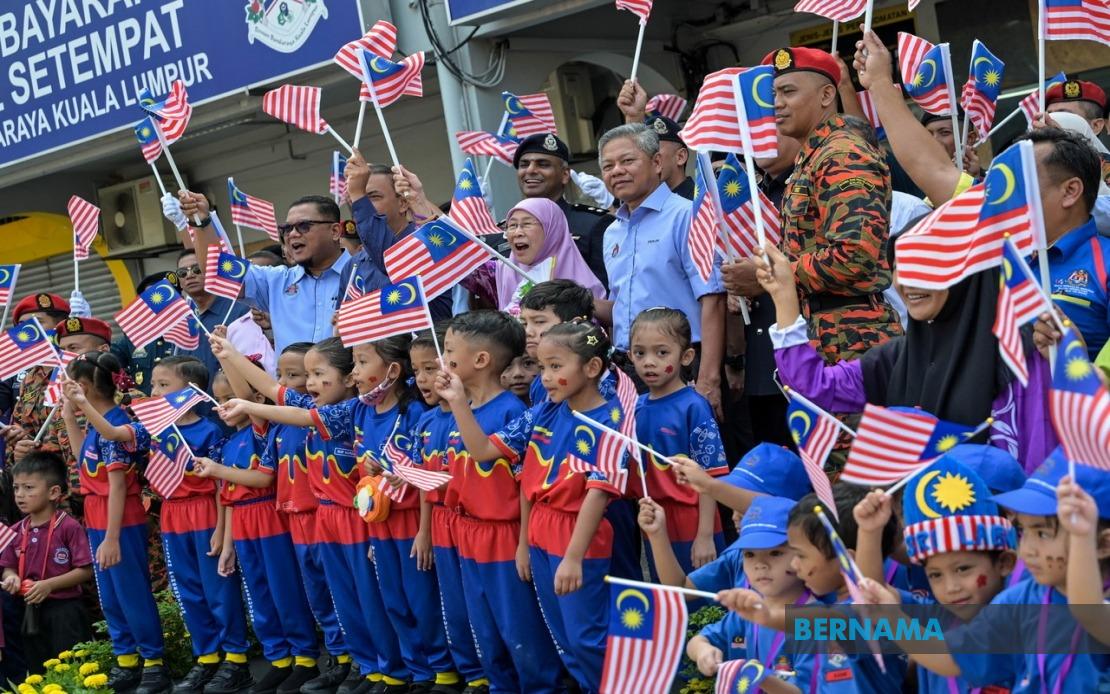
The meaning of national independence extends far beyond flags and patriotic slogans, according to Datuk Seri Dr Wan Azizah Wan Ismail, wife of the Prime Minister and Member of Parliament for Bandar Tun Razak. Speaking at the Semarak Merdeka Programme in Kuala Lumpur on August 12, she reframed the conversation around Malaysia's independence, urging citizens to recognise it as a shared responsibility that underpins the nation's continued peace, unity and harmony. Her remarks, delivered alongside Prime Minister's political secretary Datuk Azman Abidin, underscored an important distinction between superficial celebration and substantive engagement with the country's foundational values.
Dr Wan Azizah articulated that independence carries profound meaning rooted in the freedoms secured and the extraordinary efforts exerted by earlier generations who forged Malaysia's sovereignty. Rather than treating Merdeka purely as an occasion for ceremonial displays of the Jalur Gemilang, she called for a deeper, more contemplative approach that acknowledges the historical context and personal sacrifices embedded in the nation's establishment. This perspective resonates with ongoing efforts to cultivate a citizenry that understands independence not as a historical event concluded decades ago, but as an active commitment requiring continual nurturing across generations.
The Prime Minister's wife framed Bandar Tun Razak's independence observance as an opportunity to pivot focus toward building community cohesion and shared prosperity. She suggested that the celebration should function as a platform enabling residents to collectively appreciate the essence of freedom whilst honouring those who struggled for Malaysia's formation. Critically, she positioned this reflection as foundational to constructing a united, prosperous and progressive community—linking patriotic sentiment directly to tangible improvements in residents' daily lives and mutual advancement.
The thematic alignment with this year's National Day campaign, "Malaysia Madani: Jiwa Merdeka," further contextualises Dr Wan Azizah's message within broader governmental initiatives. This theme explicitly connects independence sentiment to contemporary policy objectives centred on elevating living standards, distributing opportunities equitably across populations, and consolidating national unity. For Malaysian readers and policymakers, this framing suggests that independence Day commemorations increasingly serve as anchors for addressing socioeconomic aspirations rather than functioning solely as historical remembrances.
Dr Wan Azizah highlighted Bandar Tun Razak's demographic composition as exemplifying Malaysia's pluralistic character and capacity for harmonious coexistence. With approximately 191,000 residents according to Malaysian Population and Housing Census data—60 per cent Malay, 24 per cent Chinese, and eight per cent Indian—the constituency embodies the multicultural foundations upon which Malaysia's identity rests. By presenting this diversity as evidence of a dynamic and balanced community, she implicitly argued that independence's true value manifests in the successful maintenance of these interethnic relationships and the inclusive development they necessitate.
Beyond rhetorical emphasis, Dr Wan Azizah translated her independence message into immediate welfare interventions. She visited three families residing in the Seri Pulau Pinang and Desa Tun Razak People's Housing Projects, delivering assistance packages coordinated through the Social Security Organisation (PERKESO) and the Federal Territories Islamic Religious Council (MAIWP). These visits demonstrated how independence discourse connects to grassroots social support systems, particularly for vulnerable households experiencing sudden financial hardship.
One beneficiary, K. Moganavalli, a 39-year-old housewife, received critical financial support following her husband Edwin Anthony Dass's unexpected death on August 2. As the sole caregiver for three young children, Moganavalli faced immediate economic instability after losing her spouse's income from lorry and ride-hailing services. PERKESO provided a one-time funeral management benefit of RM3,000 and a monthly survivor's pension of RM1,118.33, with additional assistance through the Kotak Prihatin scheme. Her testimony—expressing profound gratitude and describing her emotional disorientation following the loss—illustrated how social safety nets become expressions of national solidarity during personal crises.
Another recipient, Khalijah Binti Nazir, a 64-year-old single mother, exemplified the structural vulnerabilities facing elderly caregivers managing dependent children with special needs. Khalijah abandoned employment to provide full-time care for two children, one of whom experiences hearing impairment, placing her entirely dependent on government assistance schemes. She receives RM800 monthly through Baitulmal assistance, RM300 via Boost eWallet, and RM150 under the Sumbangan Asas Rahmah (SARA) programme, with her son receiving an additional RM100 monthly support. Her circumstances reveal how independence's promise of collective welfare remains incomplete without comprehensive safety nets addressing caregiving responsibilities and disability support.
The connection between Dr Wan Azizah's independence messaging and these welfare interventions suggests a sophisticated understanding of how national unity translates into institutional practice. Rather than confining independence commemoration to abstract patriotic sentiment, the programme demonstrated that celebrating national freedom simultaneously requires implementing mechanisms ensuring vulnerable populations experience tangible security. For Malaysian policymakers and civil society, this integration offers instructive models for embedding social cohesion within national observances.
These welfare distributions also illuminate regional patterns relevant to Southeast Asian readers. Malaysia's multicommunal character demands ongoing demonstration that independence benefits accrue across ethnic and religious lines. By delivering assistance from Islamic religious institutions alongside secular social security bodies to recipients of diverse backgrounds, the programme modelled institutional pluralism reinforcing Dr Wan Azizah's earlier claims about harmonious coexistence grounded in material reality rather than rhetorical flourish.
Looking beyond the immediate initiative, Dr Wan Azizah's emphasis on independence as shared responsibility carries implications for how Malaysia addresses emerging governance challenges. As Southeast Asian nations navigate increasingly complex social, economic and political pressures, viewing independence as an ongoing collective commitment—rather than a completed historical achievement—positions the country to adapt institutional responses to evolving citizen needs. Her framing suggests that genuine independence preservation requires continuous recalibration of how national resources and institutional capacity serve all residents equitably.
The Semarak Merdeka Programme ultimately embodied a particular vision of independence relevance: one grounded in recognising historical struggles whilst addressing present vulnerabilities through institutionalised social support. For Malaysia's diverse population, this approach potentially offers a foundation for imagining national unity not as demographic fact but as deliberate, ongoing institutional practice requiring political commitment and resource allocation. Whether this vision proves sustainable and scalable across the broader society remains an open question demanding sustained policy attention and public engagement.

