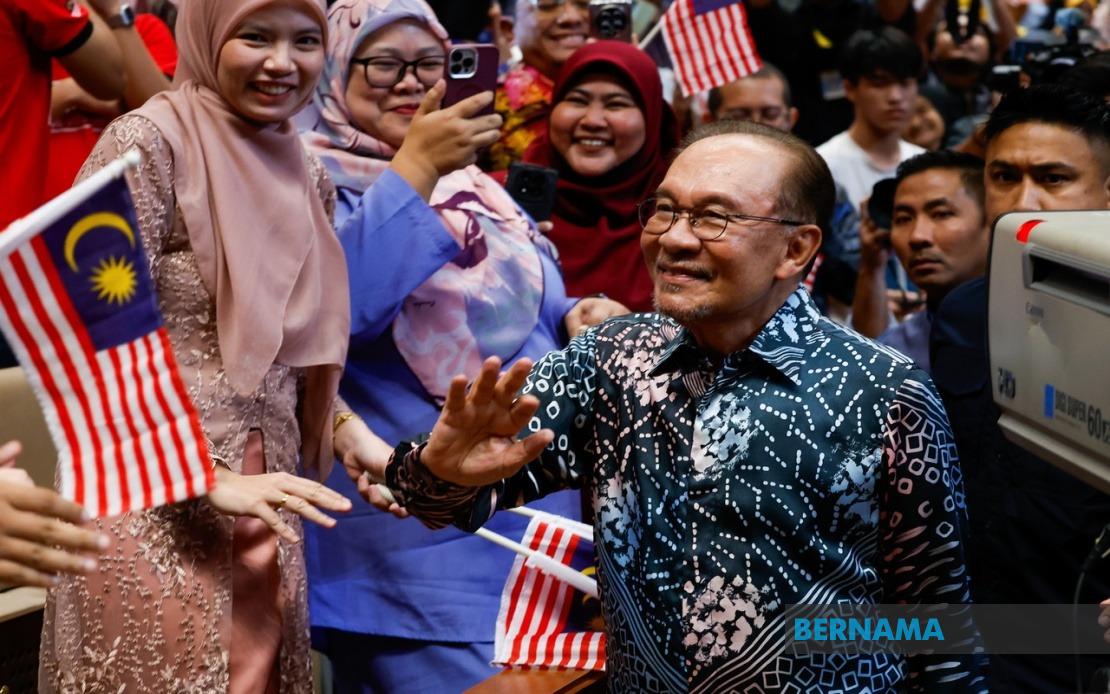
Prime Minister Datuk Seri Anwar Ibrahim has delivered a clarion call for Malaysians to cultivate and sustain the spirit of independence within themselves, framing this internal commitment as far more consequential than mere institutional or structural independence. Speaking at the Putrajaya International Convention Centre during the National Day address, Anwar positioned the psychological and moral dimensions of freedom as the true foundation upon which the nation's future stability and progress must rest. His remarks underscore a philosophical approach to nation-building that extends beyond formal sovereignty to encompass the mindset and values each citizen carries.
The Prime Minister articulated a vision where independence transcends the conventional understanding of political autonomy from colonial rule. Instead, he presented it as a lived experience embedded in the consciousness of every Malaysian, regardless of background or circumstance. This reframing suggests an attempt to reconnect contemporary Malaysians with the foundational ideals that animated the independence movement, at a moment when the nation faces internal divisions and questions about social cohesion. By positioning independence as a matter of individual and collective spirit rather than merely historical fact, Anwar appears to be addressing concerns about whether Malaysians fully appreciate or actively practice the values for which previous generations struggled.
Central to Anwar's message was an emphasis on unity that explicitly transcends racial and geographic boundaries. He referenced the vision of the nation's founding fathers, who he suggested had always envisioned integration based not on ethnicity, district, or region, but rather on a commitment shared across every generation of citizens. This historical interpretation carries particular weight in Malaysia's contemporary political landscape, where communal divisions and competing claims about constitutional protections frequently generate friction. By invoking the founders' intentions, the Prime Minister attempted to position multiethnic cooperation as an original and foundational Malaysian principle rather than a later development or compromise.
The inclusive framing of national unity in Anwar's address acknowledged the special position of Malays and Bumiputeras within the constitutional order while simultaneously insisting on the essential participation and contribution of all communities. This balancing act reflects the delicate political terrain navigating Malaysia's social contract, where constitutional provisions grant certain groups defined rights and privileges whilst the modern nation requires harmonious coexistence and shared national purpose. By characterising these elements not as competing but as complementary, Anwar sought to demonstrate that honouring constitutional arrangements need not obstruct broader national solidarity.
Anwar framed the cultivation of independence spirit as essential to rebuilding from existing difficulties, implicitly acknowledging that Malaysia faces challenges requiring fundamental renewal rather than incremental adjustment. The language of reconstruction suggests recognition that current institutional and social arrangements may be inadequate to the moment's demands. This positioning allowed him to propose a more ambitious vision than mere maintenance of the status quo, appealing particularly to Malaysians concerned about national direction and institutional effectiveness. The emphasis on spiritual and psychological renewal complements practical governance challenges by addressing the underlying values and commitments that enable institutions to function effectively.
The specific invocation of "defending rights and upholding justice" as dual national purposes reveals Anwar's attempt to frame the independence spirit in terms that resonate across Malaysia's diverse communities. These concepts encompass both the constitutional protections of particular groups and the universal aspirations for fair treatment and rule of law that motivate citizens across ethnic divides. By presenting rights protection and justice as mutually reinforcing rather than competing priorities, the Prime Minister signalled an effort to build consensus around a vision where communal and universal values coexist within a coherent national framework.
The ceremonial context of the National Day address at the Putrajaya International Convention Centre, with attendance by senior government figures including Deputy Prime Minister Datuk Seri Dr Ahmad Zahid Hamidi and Communications Minister Datuk Seri Fahmi Fadzil, underscored the official importance of the message. Such occasions typically serve both to commemorate national achievement and to articulate contemporary priorities through the language of historical continuity. By delivering remarks about independence spirit during this formal state occasion, Anwar positioned his vision as emanating from the highest levels of government and demanding broad-based acceptance and implementation.
For Malaysian audiences, the address carries implications extending beyond ceremonial commemoration into practical governance. The emphasis on embedded independence spirit suggests that institutional reform and policy adjustments alone cannot address national challenges; instead, transformation in how citizens understand and practice their relationship to the nation becomes essential. This framing places responsibility on individuals and communities to engage more consciously with their role in national life, rather than positioning change as something government imposes from above. Such an approach potentially mobilises citizen agency but also implicitly acknowledges limits to what state action alone can accomplish.
The regional significance of Anwar's message lies in its resonance with broader Southeast Asian concerns about national cohesion amidst diversity and the sustainability of post-colonial political orders. Malaysia's experience navigating multiethnic democracy, constitutional federalism, and regional economic integration offers lessons and cautionary examples for other ASEAN nations managing similar tensions. By explicitly articulating how independence spirit must operate across generational and communal lines, Anwar contributed to regional conversations about the foundations of legitimate and stable governance in diverse societies. His emphasis on continuous renewal of commitment to shared national purposes, rather than reliance on inherited arrangements, addresses persistent questions about how postcolonial nations sustain legitimacy across changing circumstances and populations.

