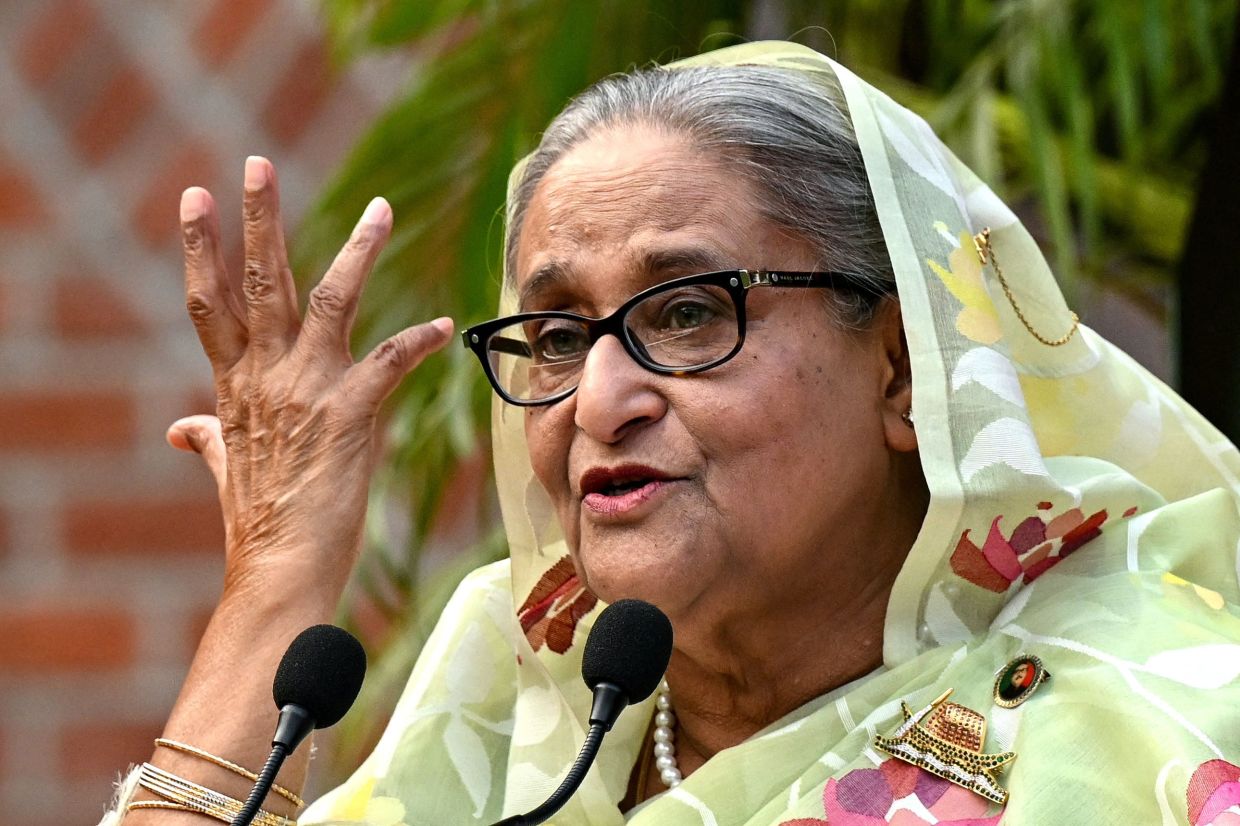
India's government has stepped back from any involvement in a planned virtual address by Bangladesh's exiled former Prime Minister Sheikh Hasina, as tensions simmer between the neighbouring countries over the fugitive politician's presence on Indian soil. During a routine media briefing on Wednesday, India's foreign ministry spokesperson Randhir Jaiswal clarified that the event scheduled for August 5 in New Delhi is being organised entirely by a private media entity, with no official Indian government participation or endorsement of any statements that may be delivered. This public distancing marks an attempt by New Delhi to manage the diplomatic friction that has emerged around Hasina's exile and continued political activities from within Indian territory.
The clarification came after Bangladesh formally requested that India explain its position regarding Hasina's appearance at an event hosted by the Foreign Correspondents' Club of South Asia. Dhaka had expressed concern that permitting political activities by a fugitive on Indian soil could undermine the two countries' efforts to normalise relations following the tumultuous period that began with Hasina's ouster in 2024. The timing of this diplomatic exchange reflects deeper anxieties within Bangladesh's government about the potential for anti-establishment sentiment to organise and propagate from abroad, particularly as Hasina maintains her political profile despite facing serious charges at home.
Meanwhile, Bangladesh has moved aggressively to prevent domestic audiences from hearing Hasina's message. The country's Information Adviser Zahed Ur Rahman issued a formal warning to all Bangladeshi media outlets on Tuesday, cautioning that any broadcast or publication of Hasina's forthcoming remarks would violate a December 2024 directive issued by Bangladesh's International Crimes Tribunal. This tribunal order explicitly prohibits media organisations and social media platforms from disseminating any of Hasina's speeches, statements, interviews, or recorded messages, effectively creating a near-total communications blackout around the former prime minister within Bangladesh's borders. The breadth of this prohibition underscores the current government's determination to prevent Hasina from maintaining any public voice or influence domestically.
Hashina, now 78 years old, has remained in India since the student-led uprising that toppled her government roughly a year ago. Since her departure from Dhaka, she has been convicted of crimes against humanity in absentia by Bangladesh's International Crimes Tribunal and sentenced to death for her administration's brutal crackdown on the demonstrations that led to her downfall. The former premier has dismissed the verdict as legally void, arguing that the proceedings lack legitimacy under the current political dispensation. The virtual address on August 5 will represent her first significant public appearance since fleeing the country, though her participation will be conducted remotely rather than in person, underlining her continued exile status.
Hashina's son, Sajeeb Wazed Joy, and other speakers will join her at the New Delhi event marking the second anniversary of the uprising that removed her from power. Details about the content of her remarks have not been disclosed by her aides, though the former prime minister revealed to Reuters last month that she and other members of her Awami League party are planning to return from exile around December and present themselves in Bangladesh's court system. This announcement suggests a calculated political strategy, positioning Hasina as willing to face the judicial process and potentially testing whether the current government under Prime Minister Tarique Rahman will pursue prosecution or adopt a reconciliatory approach toward the previous regime's leaders.
Abu Obaidha Arin, an aide close to Hasina, responded defiantly to Bangladesh's efforts at suppression, declaring that the August 5 event will proceed as scheduled despite Dhaka's objections. Arin characterised Bangladesh's attempts to restrict Hasina's communications as efforts to silence dissent and suggested that such measures ultimately fail when the target operates beyond the country's territorial jurisdiction. This statement reflects the widening gulf between Bangladesh's government and the exiled former administration, with little prospect of reconciliation as long as death sentences and ongoing prosecutions remain in place.
Bangladesh's State Minister for Foreign Affairs Shama Obaed Islam has reported that Dhaka has repeatedly raised concerns with India regarding the presence of Hasina and other senior Awami League figures making political statements from Indian soil. These representations highlight how Hasina's exile has become not merely a domestic Bangladeshi issue but also a point of bilateral friction between two countries that share borders, significant economic ties, and complex historical relationships. Bangladesh's requests for India to curtail Hasina's political activities implicitly seek to treat the exiled leader's presence as a matter of Indian responsibility, though New Delhi has carefully avoided any such framing.
The bilateral relationship between India and Bangladesh has faced considerable strain since Hasina's ouster, though both governments have signalled a desire to improve ties in recent months. The administration of Prime Minister Tarique Rahman, which assumed office following February's elections, appears more inclined toward normalisation with New Delhi than the immediate post-transition period allowed. Despite this emerging pragmatism, the question of Hasina's status remains unresolved, with Bangladesh continuing to seek her extradition from India while simultaneously attempting to prevent her from exercising any political voice within Bangladeshi territory or reaching Bangladeshi audiences.
The situation reflects a broader challenge facing countries across South Asia as exiled political leaders attempt to maintain influence from abroad while their home governments seek to prevent such remote participation in domestic politics. India's careful neutrality—insisting that private organisations retain the right to host speakers while the government itself maintains distance—offers a middle path that respects press freedom and free speech principles while technically honouring Bangladesh's concerns about state involvement. However, this formula may satisfy neither party, as Bangladesh sees the event as inherently political and Hasina's supporters view the restrictions as illegitimate suppressions of legitimate speech.
The August 5 address thus carries significance beyond the immediate remarks Hasina is likely to deliver. It tests the boundaries of India's willingness to provide sanctuary to exiled South Asian political figures, the extent of Bangladesh's ability to project enforcement of its restrictions beyond its borders, and the broader question of how contemporary democracies balance press freedom with the diplomatic sensitivities surrounding fugitive leaders. For Malaysian observers, the episode illustrates how exile politics can create persistent bilateral tensions in the region and how governments attempt to manage the presence of neighbouring states' fugitives within their territory.

