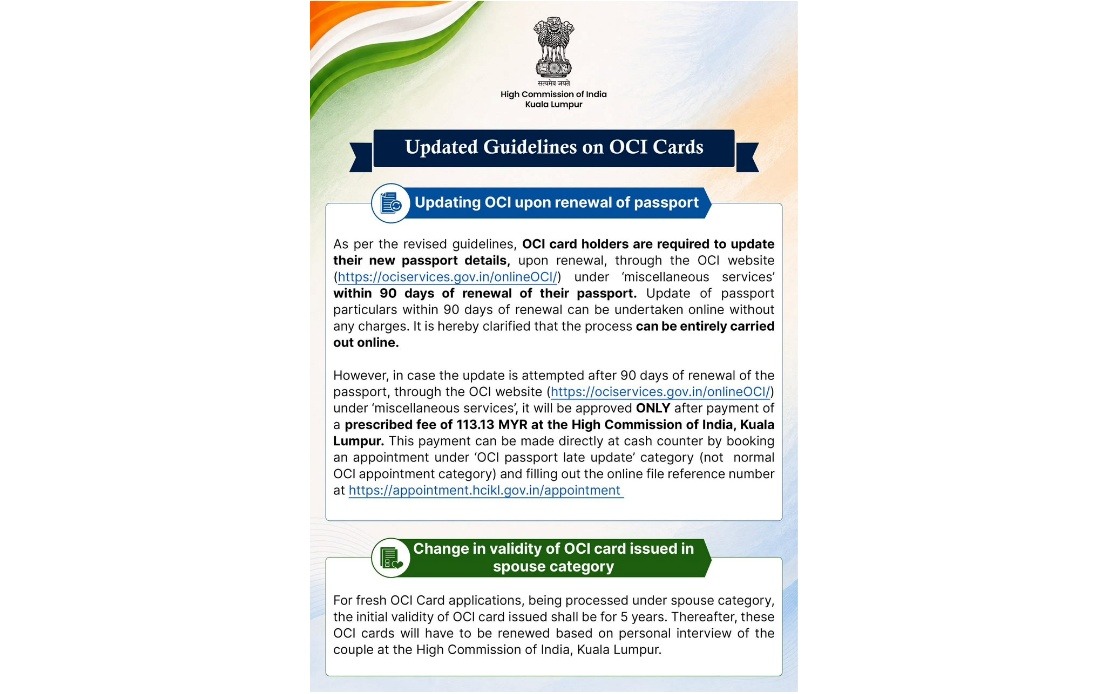
The High Commission of India in Kuala Lumpur has rolled out fresh administrative requirements for Overseas Citizen of India (OCI) cardholders that carry significant implications for the large Indian diaspora community in Malaysia. The most consequential change mandates that OCI card holders update their passport information within a 90-day window following passport renewal, a measure designed to maintain accurate personal records across Indian government systems. Those who complete this update online through the official OCI portal within the prescribed timeframe will incur no fees, making timely compliance financially advantageous for cardholders.
The streamlined digital process represents a modernisation effort by the High Commission to reduce administrative burden on applicants. The update mechanism operates entirely through the OCI website under the "miscellaneous services" category, eliminating the need for physical office visits during the grace period. This online-first approach aligns with broader digitalisation trends within India's consular services across Southeast Asia and acknowledges the technical capabilities of most OCI holders in Malaysia, who typically include professionals, business owners, and affluent expatriates already familiar with digital government interfaces.
Failure to meet the 90-day deadline carries financial consequences that underscore the importance of prompt action. Applicants who submit passport update requests after the grace period expires will face a prescribed fee of RM113.13, payable at the High Commission's cash counter in Kuala Lumpur. This penalty structure, while modest in absolute terms, signals the administration's intent to encourage timely compliance and reduce processing backlogs caused by late submissions.
The payment procedure incorporates specific appointment protocols designed to handle late updates separately from routine OCI services. Applicants must book appointments specifically under the "OCI passport late update" category rather than the standard OCI appointment bracket, and they must provide their online file reference number when presenting for payment. This segregated appointment system allows the High Commission to manage workflow more efficiently and prevent queue congestion at the mission's facilities.
Parallel to the passport update rules, the High Commission has introduced structural changes affecting OCI applications lodged under the spouse category, a provision that enables Indian nationals' foreign spouses to obtain OCI status. Fresh applications processed through this spousal pathway will now receive initial validity periods of five years, representing a departure from previous arrangements and creating a defined renewal schedule rather than longer-term validity. This modification reflects the High Commission's desire to maintain regular contact with visa holders and verify ongoing eligibility circumstances.
The five-year limitation for spouse-category OCI cards introduces a consequential requirement that extends beyond simple document renewal. When the initial validity period expires, couples seeking to renew their OCI status must present themselves jointly for personal interviews conducted at the High Commission premises in Kuala Lumpur. This in-person verification mechanism introduces administrative friction compared to purely documentary renewal processes, requiring both spouses to coordinate travel to the mission and participate in face-to-face verification with officials.
For Malaysian-based Indian diaspora communities, these guidelines create practical planning imperatives. Families with recently renewed passports must identify and execute their online updates before the 90-day window closes, a requirement that demands awareness and administrative attention during a period when individuals may still be adjusting to new travel documents. Professional advisors serving the Indian expat community, including immigration consultants and corporate HR departments, will likely need to incorporate OCI update compliance into their client advisory processes to prevent unintended non-compliance.
The spouse category modifications carry broader relational implications. By instituting mandatory joint interviews every five years, the High Commission effectively conducts periodic verification that spousal relationships remain intact and that both parties continue to satisfy OCI eligibility criteria. While presenting as a straightforward administrative check, this requirement potentially affects family privacy and imposes travel obligations that some couples may find burdensome, particularly if either partner faces mobility constraints or international travel difficulties.
Accessibility to detailed implementation information has been prioritised through digital channels. The High Commission has published comprehensive guidance on both the official OCI portal and its dedicated appointment booking website, ensuring that affected cardholders and prospective applicants can access requirements without requiring email inquiries or office visits. This transparency approach contrasts with historical patterns where consular procedures were sometimes opaque, and represents a shift toward accessible governance.
Regional context enhances understanding of these administrative developments. Malaysia hosts one of Southeast Asia's largest Indian expatriate populations, encompassing professionals in petroleum, finance, manufacturing, and technology sectors alongside significant student and merchant communities. The OCI framework provides these individuals with enhanced mobility and property ownership rights within India while maintaining Malaysian residency or citizenship status, making it an attractive option for long-term diaspora members. Updated compliance requirements thus ripple across this substantial demographic cohort.
The timing and sequencing of these guideline revisions reflect broader Indian administrative modernisation occurring across multiple overseas posts. As India's consular network expands digital capabilities and standardises procedures internationally, individual missions like Kuala Lumpur implement localized versions of system-wide directives. The 90-day window and spouse interview protocols likely represent India-wide policy decisions disseminated to missions across Asia, Africa, Europe, and the Americas as part of coordinated bureaucratic reform.
For Malaysian policymakers and community leaders engaging with the Indian diaspora, these developments underscore the dynamic nature of bilateral consular relations. While originating from New Delhi, OCI card policies directly shape the lived experience of Malaysian residents and affect family dynamics, business planning, and travel arrangements for a substantial foreign national population. Maintaining dialogue channels between Malaysia's government and the High Commission regarding implementation challenges ensures that administrative burden does not inadvertently encourage non-compliance or generate friction within the expatriate community.

