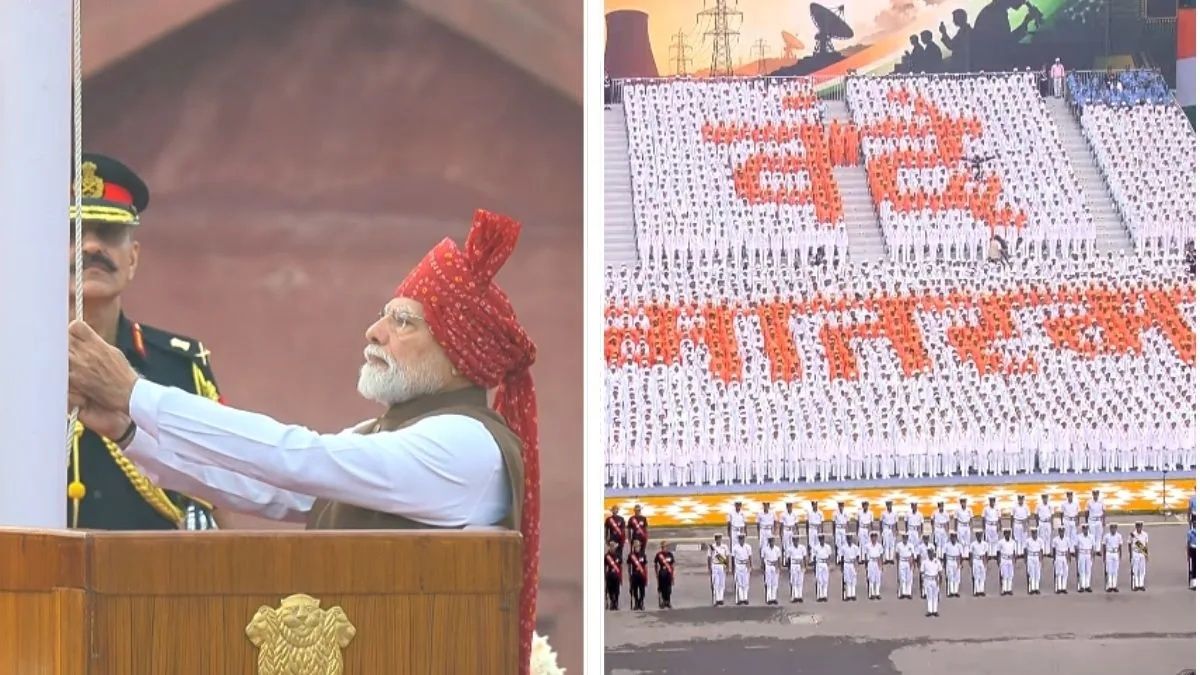
Prime Minister Narendra Modi has set forth an ambitious blueprint for India's future, declaring that the nation will achieve developed country status by 2047 during his Independence Day address at the Red Fort on Saturday. The announcement, made on the occasion of India's 80th independence celebration, represents a pivotal moment in the country's post-colonial trajectory and signals New Delhi's determination to reshape its global standing within the next two decades.
The articulation of 'Viksit Bharat'—or developed India—as a binding national objective carries profound implications not merely for India but for the entire South Asian region and global geopolitics. By establishing 2047 as the target year, Modi has effectively linked India's development aspirations to a meaningful historical milestone: the completion of a century since independence. This temporal framing transforms economic modernisation from a technocratic exercise into a matter of national pride and collective endeavour, appealing to citizens' sense of historical agency and generational responsibility.
Modi's rhetoric emphasised the necessity of transcending conventional thinking and embracing expansive ambitions. His assertion that "small dreams will no longer suffice" represents an ideological repositioning, urging the nation to abandon conservative developmental targets in favour of transformative goals. This messaging extends beyond mere motivation; it reflects a deliberate strategy to reframe India's self-perception from a developing nation facing structural constraints to an emerging superpower with untapped potential. The psychological dimension of this approach should not be underestimated, particularly in shaping public expectations and political mobilisation across India's vast and diverse population.
The Prime Minister's retrospective analysis of India's economic transformation underscores the foundation upon which this 2047 vision rests. He highlighted India's escape from the "Fragile Five" classification—a designation that once grouped India alongside Brazil, Mexico, South Africa and Turkey as economies vulnerable to capital flight and external shocks. This recovery narrative serves as both historical justification and confidence-building evidence that strategic economic management can produce tangible results, lending credibility to the developed nation aspiration.
The statistics cited by Modi across critical manufacturing sectors reveal the scale of structural transformation attempted over the past twelve years. Defence production's fourfold increase reflects India's strategic push toward self-reliance in military hardware, a crucial dimension of national security and technological sovereignty. Similarly, the sevenfold expansion in electronic manufacturing and 100% growth in digital transactions demonstrate a fundamental reorientation toward technology-enabled development. These sectoral achievements, while impressive in percentage terms, also highlight the numerical base from which improvement began—underscoring both progress made and the distance remaining to achieve genuinely competitive global standing in advanced sectors.
For Malaysian and Southeast Asian observers, India's developmental trajectory carries significant regional consequences. A more economically robust and technologically advanced India will reshape regional trade dynamics, investment patterns, and geopolitical influence throughout the ASEAN space. The emphasis on digital infrastructure and electronic manufacturing directly competes with Malaysia's positioning in regional electronics supply chains, potentially intensifying competition for Foreign Direct Investment and technology partnerships. Conversely, India's development could create expanded markets for regional exports and strengthen the economic interdependencies that underpin regional stability.
The ceremonial aspects of the Independence Day observance merit analytical attention, particularly the full rendition of 'Vande Mataram' at the Red Fort—described as occurring for the first time since independence. This symbolism reinforces Modi's narrative of national reclamation and cultural reassertion, positioning economic development within a broader framework of civilisational renewal. The synchronisation of flag hoisting with a 21-gun salute using indigenously produced 105mm Light Field Guns further emphasises the administration's commitment to manufacturing self-sufficiency and defence sector development as cornerstones of the 2047 vision.
The practical feasibility of the 2047 target warrants critical examination. Transforming a nation of India's scale and demographic complexity—with its vast regional disparities, infrastructure deficits, and persistent poverty alongside pockets of technological excellence—demands sustained institutional coherence, substantial capital investment, and favourable external circumstances. The historical precedent of East Asian developmental states suggests that such transformations remain possible, yet India's federal structure, electoral dynamics, and social heterogeneity present distinct challenges absent in the more centrally coordinated models of South Korea or Taiwan.
Modi's acknowledgment of recent flood disasters that affected multiple regions demonstrates the tension between aspirational long-term planning and immediate humanitarian exigencies. The assurance that "the whole country stands by" affected families reflects the political necessity of balancing transformative vision with responsive governance. This duality—simultaneously projecting confidence in India's future capabilities whilst acknowledging current vulnerabilities—characterises much of contemporary Indian political discourse and reflects the genuine contradictions inherent in rapid developmental transition.
The 2047 vision fundamentally reshapes India's engagement with the international community by establishing a specific temporal endpoint for aspirational status improvement. This declaration implicitly invites global scrutiny and establishes benchmarks against which future governments will be measured. For investors, technology partners, and regional competitors alike, the announcement signals India's intentions whilst creating both opportunities and competitive pressures across multiple economic sectors and geopolitical domains throughout Asia and beyond.

