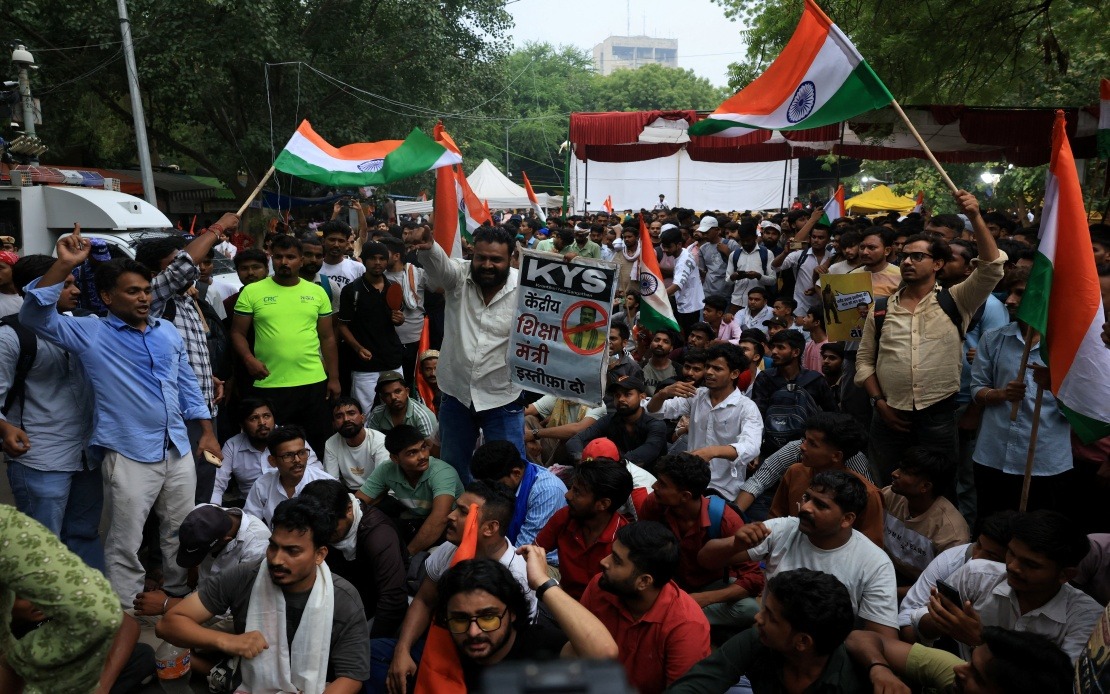
Tens of thousands of demonstrators converged on New Delhi on Monday in a high-stakes confrontation with police, attempting to reach the parliament building as part of a major youth-led movement demanding comprehensive overhaul of India's academic framework. The demonstration, organised under the "Sansad Chalo" banner—a Hindi phrase meaning "march to parliament"—drew supporters from across India who sought to deliver their grievances directly to lawmakers gathered for the Monsoon Session. Police responded to the attempted breach of security cordons with standard crowd-control procedures, creating a tense standoff in the nation's capital as security forces sought to maintain order around sensitive government areas.
The protest reflects growing discontent among India's younger generation with the existing education system, which activists argue fails to prepare students for contemporary employment challenges and neglects crucial skill development. The movement behind Monday's rally represents a new breed of youth-centred activism, leveraging digital platforms to mobilise support; organisers claim to command millions of followers across social media networks. This online-to-offline mobilisation strategy has become increasingly common in Indian politics, allowing movements to coordinate large-scale demonstrations with minimal traditional infrastructure. The accessibility of these communication channels has fundamentally altered the dynamics of political organising, enabling marginal movements to rapidly scale up to street-level visibility.
The timing of the march coincided deliberately with the commencement of Parliament's Monsoon Session, when lawmakers return from their summer recess to address pressing national matters. By targeting this moment, protesters aimed to maximise attention from parliamentarians and media coverage. Prime Minister Narendra Modi was reportedly present at the parliament complex during the morning but departed via convoy as police managed the growing crowds in surrounding areas. The security apparatus response underscored the sensitivity surrounding major public gatherings near legislative premises, particularly given India's recent history of political unrest and occasional violence associated with mass demonstrations.
The education system has emerged as a focal point of political discourse in India, with multiple stakeholders—from students and parents to economists and civil society groups—calling for substantial reforms. Current criticisms centre on issues including the relevance of curricula to modern labour markets, the heavy emphasis on rote memorisation in examinations, inadequate infrastructure in rural schools, and limited integration of technology and practical skill-building. These concerns resonate particularly strongly among India's massive youth population, where unemployment and underemployment persist despite formal educational credentials. The movement's focus on education reform taps into genuine anxieties about economic mobility and future prospects.
For Malaysian observers, the Indian protest carries instructive parallels and contrasts. Southeast Asia's largest neighbour continues grappling with education accessibility and quality challenges similar to those confronting Malaysia, though at considerably larger scale given India's population of 1.4 billion. Both nations have faced comparable critiques regarding examination-focused pedagogy that may not adequately develop critical thinking or practical competencies. However, India's demonstrated capacity to mobilise millions through youth movements underscores the region's evolving political dynamics, where education—long treated as a technical policy domain—has become a legitimate arena for street-level activism. Malaysian policymakers observing Indian developments may note how education reform increasingly connects to broader anxieties about social mobility and economic opportunity.
The police response in New Delhi reflected constraints that authorities across democracies face when managing large political gatherings. Officials must simultaneously protect public order, facilitate legitimate expression, and avoid excessive force that might provoke international criticism or escalate tensions. The deployment of crowd-control measures rather than more forceful interventions suggested security forces sought graduated response options. However, restrictions on public gatherings—noted in local reporting—raise questions about the boundaries of democratic space in India, particularly concerning whether authorities employ permit systems or other regulatory mechanisms to limit or channel dissent.
Security heightening across New Delhi's key zones following Monday's events represents routine precautionary measures but also signals official concern about potential escalation. Police typically increase presence and surveillance in sensitive areas after large demonstrations to prevent spontaneous secondary gatherings or confrontations. Such security postures become normalised during periods of political turbulence, creating visible reminders of state authority that paradoxically can fuel grievances among protesters who perceive them as excessive or intimidating.
The Monsoon Session itself will determine whether parliamentary attention translates into substantive engagement with education reform demands. Indian legislators receive numerous petition-driven requests during major sessions, and transforming street-level pressure into legislative action requires sustained momentum, political will, and consensus-building across parliamentary factions. The movement's success will partly depend on whether its digital mobilisation capacity translates into sustained institutional pressure or whether momentum dissipates after the immediate confrontation concludes.
For regional observers, Monday's demonstration illustrates how India's youthful demographic—with over half its population under thirty—increasingly channels political engagement beyond traditional voting patterns. This generational shift toward direct action and online-coordinated activism characterises not only India but broader South and Southeast Asian trends. Young people across the region increasingly perceive formal political channels as insufficiently responsive, prompting recourse to streets and digital platforms. Understanding these dynamics becomes essential for policymakers throughout Asia seeking to address legitimate grievances while maintaining stability.
Looking forward, India's political establishment will navigate whether education reform demands can be substantively addressed through legislative and administrative channels or whether the demonstration represents merely the opening salvo of sustained youth agitation. The movement's ability to convert parliamentary pressure into policy outcomes will significantly influence both the education sector's future trajectory and the broader trajectory of youth activism in contemporary Indian politics.

