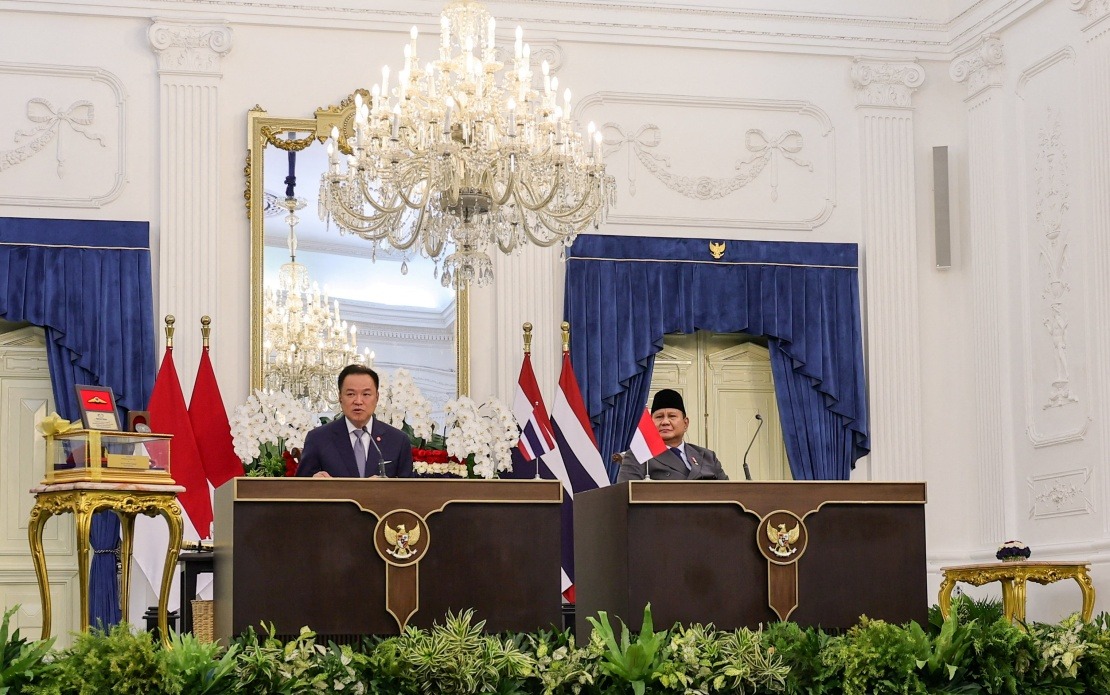
Indonesia and Thailand have reaffirmed their shared commitment to ASEAN-led peace efforts in Myanmar, pledging continued support for the Five-Point Consensus through mechanisms designed to foster inclusive dialogue, curtail violence, and expand humanitarian assistance. The undertaking emerged during the second Leaders' Consultation between Indonesian President Prabowo Subianto and Thai Prime Minister Anutin Charnvirakul at Jakarta's Merdeka Palace on Monday, signalling that Southeast Asia's two largest military powers remain focused on regional stability despite the Myanmar crisis entering its third year of civil strife.
The bilateral meeting underscored Indonesia and Thailand's conviction that ASEAN unity and centrality must remain the cornerstone of efforts to restore peace and stability across the region. Prabowo emphasised at the joint press conference that both nations would sustain their collaborative push to position ASEAN as a constructive force capable of achieving enduring peace in Myanmar. This framing reflects growing recognition among ASEAN capitals that the organisation's credibility as a regional arbiter depends on demonstrating tangible progress in Myanmar, where the military junta's grip has only tightened since the February 2021 coup.
Beyond the Myanmar question, the two countries unveiled an ambitious framework for deepening defence and security cooperation amid what Prabowo characterised as an era of mounting global uncertainty and increasingly intricate non-traditional security threats. The partnership encompasses expanded intelligence sharing, joint investigations, financial tracking mechanisms, and enhanced law enforcement coordination, all focused on dismantling transnational criminal networks that have proliferated across Southeast Asia. The emphasis on these concrete operational measures suggests that both Jakarta and Bangkok view security cooperation as essential to maintaining domestic stability and strengthening ASEAN's broader resilience.
Online scam syndicates have emerged as a particular flashpoint in bilateral relations and represent a mounting crisis across the region. The two nations specifically committed to intensifying efforts against such operations, recognising that criminal networks exploiting digital platforms pose threats that transcend traditional borders and demand sophisticated cross-border responses. Prabowo acknowledged Thailand's crucial role in facilitating the repatriation of nearly 1,000 Indonesians victimised by online scam operations, highlighting how this transnational crime category has evolved into a diplomatic and humanitarian concern that demands sustained high-level attention.
The bilateral partnership will further advance through establishment of a Transnational Referral Mechanism designed to accelerate identification, protection, and dignified repatriation of crime victims. This institutional framework represents a pragmatic recognition that ad hoc responses prove insufficient when confronting organised criminal enterprises operating across multiple jurisdictions. The mechanism signals intent to professionalise victim support systems and create standardised protocols that can be replicated across ASEAN, potentially strengthening the bloc's collective capacity to address transnational human trafficking and related crimes.
Thai Prime Minister Anutin brought to the table expanded proposals for defence industry collaboration, most notably the supply of 36 amphibious wheeled armoured vehicles to Indonesia. This concrete procurement proposal demonstrates Thailand's interest in deepening operational integration with the Indonesian military and reflects broader regional trends whereby Southeast Asian defence establishments increasingly source equipment and expertise from neighbouring countries rather than external powers. Such partnerships signal growing confidence in indigenous defence industrial capabilities and reduce reliance on traditional suppliers.
The broader security agenda encompassed human trafficking and drug trafficking, categories that demand enhanced law enforcement coordination and intelligence exchange. Anutin proposed accelerating capacity-building initiatives that would enable both nations' security forces to develop more sophisticated investigative and interdiction capabilities. He also highlighted Thailand's readiness to strengthen regional cooperation within ASEAN specifically targeting online scam networks and transnational wildlife trafficking, placing Southeast Asian security challenges within a comprehensive framework rather than treating them as discrete problems.
The visit itself carries symbolic weight as Anutin's maiden official trip to Indonesia since assuming office as Thailand's 32nd prime minister in September 2025. The timing of this bilateral engagement—occurring during Prabowo's early presidency—suggests both countries recognise the importance of establishing strong interpersonal and institutional relationships during this transitional period. For Malaysian observers, the deepening Indonesia-Thailand security partnership underscores how major regional powers are actively building coalitions around shared concerns, a development with implications for ASEAN's internal balance and decision-making dynamics.
This represents the first Thai prime ministerial visit to Indonesia in 15 years, a hiatus that itself reflects the evolving nature of bilateral relations and differing political trajectories within the two countries. The restoration of high-level diplomatic momentum suggests that both Jakarta and Bangkok perceive value in reinvigorating engagement, particularly given the overlapping security challenges they confront. The long interval between such visits highlights how Southeast Asian bilateral relationships can experience periods of dormancy despite fundamental geographic and strategic proximity.
For the broader region, the Indonesia-Thailand consolidation carries consequential implications. These two nations jointly command substantial military resources, diplomatic influence, and economic heft within ASEAN. When they coordinate on regional issues including Myanmar, their partnership creates gravitational pull within ASEAN deliberations. The emphasis on implementing the Five-Point Consensus suggests neither country has abandoned hope that incremental pressure might yet yield negotiated solutions, even as the Myanmar situation deteriorates on the ground. This measured optimism contrasts sharply with more pessimistic assessments emerging from some international quarters.
The focus on transnational crime also reflects a pragmatic acknowledgment that traditional interstate security concerns have evolved in Southeast Asia. Online scam operations, human trafficking networks, and wildlife trafficking syndicates impose tangible costs on civilian populations and governments alike. By positioning these challenges as central to bilateral security agendas, Indonesia and Thailand signal that modern regional partnerships must address multifaceted threats extending far beyond conventional military considerations. This approach aligns with evolving ASEAN doctrine emphasising comprehensive security frameworks.
Moving forward, the institutional mechanisms established during this consultation—particularly the Transnational Referral Mechanism and enhanced intelligence-sharing protocols—will require sustained commitment from both governments to achieve meaningful results. Implementation success will depend on whether respective security bureaucracies translate political declarations into operational procedures and resource allocation. The consultation also provides a template for how other ASEAN pairs might structure bilateral security partnerships, potentially strengthening the bloc's collective capacity to address transnational challenges that resist individual national solutions.

