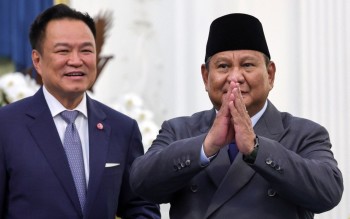
Indonesia and Thailand are setting ambitious economic targets after formally adopting a comprehensive strategic partnership roadmap designed to more than double their bilateral trade volume by the end of the decade. President Prabowo Subianto announced on Monday that the two nations aim to reach US$20 billion in annual trade under the Indonesia-Thailand Strategic Partnership Roadmap 2026-2030, which was endorsed during the second Leaders' Consultation with Thai Prime Minister Anutin Charnvirakul at the Merdeka Palace in Jakarta. The roadmap represents a significant escalation in economic engagement between Southeast Asia's two largest economies by GDP and reflects growing recognition that their current trade relationship underperforms relative to their combined economic heft and geographic proximity.
Anutin's visit to Jakarta marked a historic milestone for bilateral relations, constituting the first official visit by a Thai prime minister to Indonesia in 15 years and his inaugural trip to the country since assuming office in September 2025. The timing underscores Thailand's strategic pivot towards deepening engagement with Indonesia as both nations navigate shifting regional economic dynamics and seek to strengthen their respective positions within ASEAN. During his opening remarks, Anutin acknowledged that Indonesia ranked as Thailand's fourth-largest trading partner within the association, a ranking that both leaders implicitly recognised as insufficient given the scale and potential of their respective economies and overlapping strategic interests.
Central to the new framework is the establishment of the first-ever Joint Trade Commission operating at the commerce minister level, a structural innovation designed to systematically address trade barriers and identify business opportunities that have historically gone unexplored. This institutional mechanism will function as a formal dialogue platform where both governments can negotiate tariff reduction, harmonise standards, and facilitate direct engagement between private sector actors in both countries. By creating dedicated institutional space for trade discussion, the JTC addresses a long-standing gap in bilateral economic architecture and signals commitment to removing bureaucratic impediments that have constrained growth in bilateral commerce.
Food security emerged as a priority pillar within the roadmap, reflecting both countries' vulnerability to global agricultural volatility and their complementary agricultural strengths. Thailand positioned itself as a reliable supplier of premium rice to Indonesian consumers while simultaneously seeking greater market access for Thai agricultural products, meat, dairy goods, and farming machinery into Indonesia. More notably, Bangkok expressed interest in dramatically scaling imports of Indonesian urea fertiliser from the current baseline of approximately 60,000 tonnes annually to several hundred thousand tonnes, a shift that would unlock significant revenue for Indonesian fertiliser producers and strengthen agricultural productivity across Thailand's farming sector.
Energy cooperation constitutes another strategic dimension of the partnership. Both nations committed to establishing the Indonesia-Thailand Energy Forum as a mechanism to fortify energy security and accelerate the transition towards renewable energy sources through coordinated government and business initiatives. This cooperation takes on particular significance given Indonesia's substantial coal and natural gas reserves alongside its emerging renewable energy potential, while Thailand grapples with energy supply constraints and rising demand. The forum framework enables both countries to explore joint ventures in renewable infrastructure, technology transfer arrangements, and supply chain integration that could reduce energy costs and enhance regional energy independence.
The digital economy represents a forward-looking area of collaboration, with both governments prioritising the promotion of local currency transactions to streamline bilateral trade and investment flows. By reducing dependence on third-currency intermediaries, direct rupiah-baht transactions can diminish transaction costs, accelerate settlement times, and strengthen financial ties between Indonesian and Thai firms. This initiative also carries broader implications for regional financial integration and positions both countries to potentially lead ASEAN in developing sustainable local currency trading mechanisms that could eventually extend to other member states.
Both leaders identified the halal industry as a significant opportunity for developing integrated regional and global value chains. Indonesia's position as the world's largest Muslim-majority nation combined with Thailand's substantial halal certification infrastructure and manufacturing capacity creates natural complementarities. Notably, Anutin emphasised the urgency of renewing the mutual recognition agreement on halal certification before its November expiration, a renewal that would prevent disruption in halal product trade and maintain harmonised standards across both markets. The halal sector offers particular appeal for both economies given growing global demand from Muslim-majority populations and the sector's labour-intensive nature, which aligns with both countries' development priorities.
The Leaders' Consultation also yielded several subsidiary agreements demonstrating concrete momentum beyond the strategic framework. A memorandum of understanding on education reflects recognition that human capital development underpins sustained economic growth and bilateral competitiveness. Separately, agreements between the Tourism Authority of Thailand and TransNusa on tourism and connectivity initiatives, coupled with a collaboration between Bio-Axel and Pro Konsilium on organic waste processing, illustrate how the strategic partnership is already catalysing private sector linkages across multiple sectors.
For Malaysian and wider Southeast Asian observers, the Indonesia-Thailand economic alignment carries significant implications. As the region's two largest economies increasingly coordinate their economic strategies, they establish de facto standards that influence ASEAN-wide policy direction and market conditions affecting neighbouring economies including Malaysia. The emphasis on food security cooperation may have ripple effects on regional agricultural pricing and supply dynamics. Additionally, the development of bilateral digital payment systems and energy frameworks could eventually expand to include other ASEAN members, reshaping regional economic infrastructure.
Prabowo's characterisation of the roadmap as a shared framework reflects Indonesia's vision of the partnership as foundational rather than transactional. By elevating the bilateral relationship beyond episodic transactions to strategic coordination across multiple sectors, Jakarta signals its intent to position Indonesia as the indispensable economic anchor within Southeast Asia. Thailand's parallel willingness to commit resources and institutional capacity to the partnership suggests Bangkok similarly views the relationship as essential to its regional economic strategy.
The US$20 billion trade target, while ambitious, remains achievable given the baseline of existing bilateral commerce and the structural improvements the roadmap introduces. Current trade volumes between Indonesia and Thailand likely hover around US$15-18 billion annually, suggesting the target represents meaningful but non-utopian growth. Achievement will depend on effective implementation of the JTC framework, tangible reduction in non-tariff barriers, and sustained political commitment from both governments to prioritise the partnership amid competing economic pressures.
Looking forward, the success of this strategic partnership will be measured not merely by trade volume statistics but by whether the institutional mechanisms introduced—particularly the JTC—generate consistent value for businesses in both countries and create momentum for deeper sectoral integration. The roadmap's emphasis on complementary strengths across agriculture, energy, and emerging sectors suggests both countries have undertaken serious analysis of mutual economic interests rather than pursuing generic bilateral cooperation frameworks. For Malaysia and other ASEAN members, monitoring the implementation trajectory of the Indonesia-Thailand partnership will provide valuable insights into evolving regional economic architecture and competitive dynamics within Southeast Asia's economic hierarchy.

