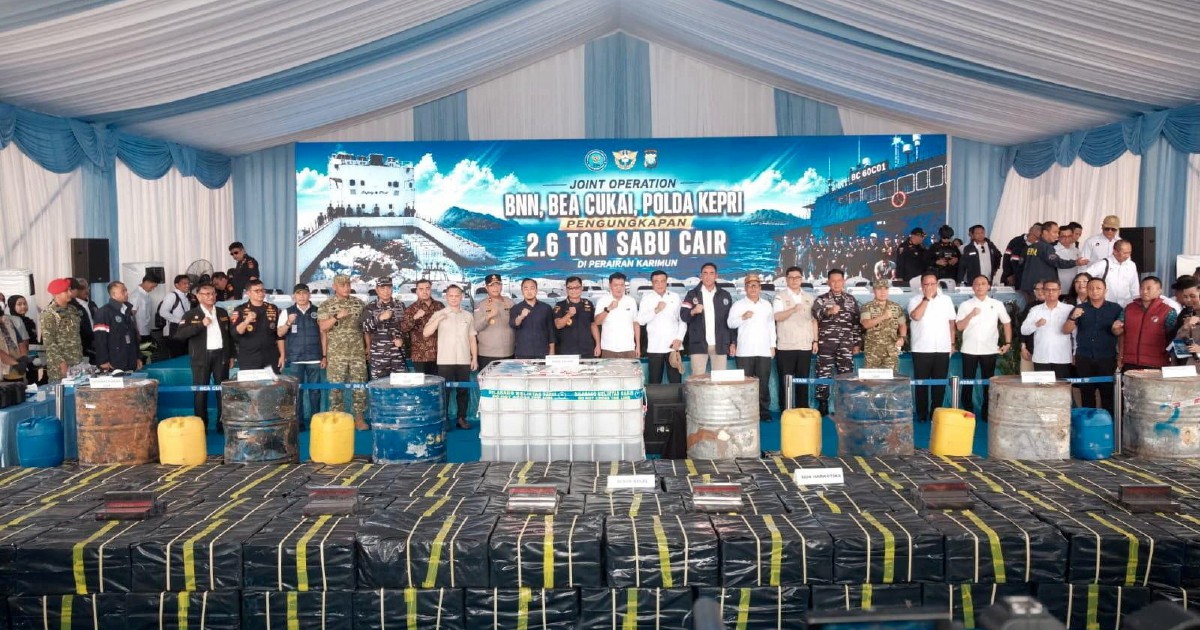
Indonesian law enforcement agencies have made a significant narcotics interception, apprehending 10 Myanmar nationals connected to the discovery of 2.6 metric tonnes of liquid methamphetamine aboard a commercial vessel flagged in Tanzania. The arrests were announced during an official briefing held by authorities on Friday, marking another substantial blow against drug trafficking operations that exploit Southeast Asian maritime routes for smuggling contraband across international waters.
The confiscation represents one of the region's larger methamphetamine seizures in recent months and underscores the expanding scale of synthetic drug production and distribution networks operating from Myanmar. Liquid methamphetamine, a concentrated form of the drug that can be easily concealed and reconstituted, has become increasingly prevalent across Southeast Asia as criminal syndicates seek to maximise profit margins and evade detection at borders. The chemical form also suggests a supply chain designed for regional distribution rather than final-market consumption, indicating the involvement of significant trafficking infrastructure.
The use of a Tanzanian-flagged ship for this operation exemplifies a common tactic employed by international drug cartels seeking anonymity and reduced scrutiny. Flag-of-convenience vessels, registered under flags from nations with less stringent maritime oversight, allow smugglers to navigate multiple jurisdictions while maintaining operational secrecy. This particular vessel's registry in Tanzania, thousands of kilometres from Southeast Asia's primary drug transit zones, represents a deliberate attempt to obscure the true origins and intended destinations of the contraband shipment.
Indonesia's capacity to detect and interdict such shipments reflects decades of building maritime surveillance capabilities and intelligence-sharing arrangements with regional partners. The Indonesian navy and coast guard have significantly expanded their patrolling presence in contested waters and established joint taskforces with various agency counterparts to monitor shipping traffic. These developments represent a response to the country's position as both a transit point and emerging consumption market for synthetic drugs, a reality that has elevated narcotics enforcement to a national security concern within Indonesian policymaking.
Myanmar's prominence in drug trafficking arrests throughout Southeast Asia reflects the country's troubled political environment and limited state capacity to govern its borderlands effectively. Since the 2021 military coup, territorial control has fragmented, with ethnic armed organisations and criminal networks exploiting administrative chaos to expand methamphetamine production facilities. The Golden Triangle region, encompassing parts of Myanmar, Laos, and Thailand, remains one of the world's primary centres for synthetic drug manufacturing, with production estimated to have surged substantially over the past three years despite international interdiction efforts.
The scale of this particular seizure carries implications for understanding broader trafficking volumes transiting the region. Law enforcement agencies in Southeast Asia typically estimate that successful interdictions represent only a fraction of total narcotics flows. If this 2.6-tonne haul represents even a modest percentage of monthly throughput, it suggests trafficking organisations are moving volumes on a scale comparable to major pharmaceutical operations, generating revenues that rival legitimate industries across multiple nations.
For Malaysia, which sits at a strategic maritime juncture between major shipping lanes and has experienced rising domestic methamphetamine consumption, the bust carries direct relevance. Malaysian authorities have reported increasing seizures of liquid meth at ports and airports, suggesting that transnational trafficking routes have begun incorporating Malaysian territory as a transshipment hub. The enforcement success in Indonesian waters indicates that coordinated regional approaches can yield tangible results, though it simultaneously highlights the persistence of illicit flows that continue despite intensified policing.
The arrest of 10 Myanmar nationals will likely trigger investigation protocols designed to map their operational connections across multiple countries and criminal organisations. Indonesian prosecutors have developed increasingly sophisticated methods for tracing financial transactions and communication networks associated with major drug busts, producing intelligence that can assist partner agencies throughout Southeast Asia. Regional judicial systems have also begun harmonising procedures for handling transnational drug cases, enabling faster prosecution and information exchange.
The incident underscores the necessity for continued investment in maritime interdiction capabilities across Southeast Asia. Shipping volumes through regional waters continue expanding, creating enormous challenges for authorities attempting to inspect suspicious vessels without disrupting legitimate commerce. Technological solutions, including advanced scanning equipment and predictive analytics powered by data integration from multiple agencies, have begun addressing this gap, though funding limitations and operational coordination challenges persist.
Indonesia's announcement of this bust occurs within a broader context of escalating enforcement activity targeting synthetic drug production and trafficking. High-profile arrests of major traffickers, increased penalties for drug offences, and enhanced cooperation with international partners represent a comprehensive strategy acknowledging that no single nation can effectively combat transnational criminal networks operating independently. The Myanmar nationals' apprehension will face subsequent court proceedings that may generate additional intelligence regarding upstream suppliers and downstream distribution networks operating throughout the region.

