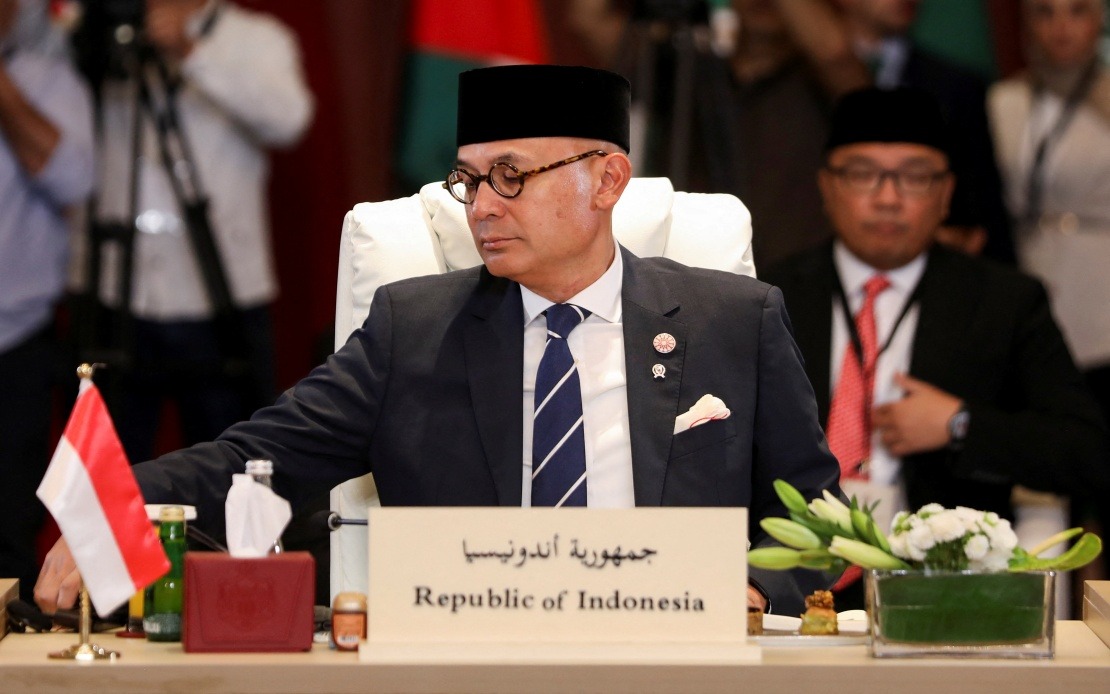
Indonesia has made an impassioned call for the international community to establish a comprehensive, coordinated coalition dedicated to supporting the Palestinian cause, arguing that such unity is essential to countering what Jakarta views as persistent violations of international law in the occupied territories. Speaking at a Ministerial Meeting on Jerusalem convened in Amman, Jordan, Deputy Foreign Minister Arrmanatha Nasir emphasised that the Palestinian question transcends religious boundaries and demands a response grounded in universal principles rather than narrow interests or identity divisions.
The Indonesian diplomat's intervention came at a gathering designed specifically to strengthen and synchronise the world's collective engagement with what participating nations characterise as Israeli actions undermining regional peace and international law. Nasir, attending on behalf of Foreign Minister Sugiono, stressed that the international community has for too long allowed responses to remain fragmented and reactive, a weakness that has historically benefited those seeking to advance territorial or political objectives without meaningful constraint. His framing of division as Israel's primary strategic advantage reflected a conviction that diplomatic coordination represents the most effective counterweight to current dynamics in the Middle East.
Indonesia put forward five actionable proposals aimed at elevating and consolidating international support for Palestine. The package begins with developing a unified strategic framework predicated on coordinated action among nations sharing concerns about the status quo. Beyond strategic alignment, Jakarta called for reinforced mechanisms to enforce international law and ensure compliance with International Court of Justice rulings, recognising that legal frameworks carry significant diplomatic weight when backed by broad consensus. The third pillar involves broadening the scope of international recognition extended to Palestine as a state, a step that would incrementally transform its diplomatic standing globally.
The remaining two components of Indonesia's platform address specific flashpoints and institutional structures. One emphasises intensified protection of Al Aqsa Mosque, a site whose religious and political significance transcends Muslim communities and carries symbolic weight across the Abrahamic faiths. The fourth measure advocates substantial international assistance for Gaza's reconstruction, acknowledging the humanitarian dimensions of the conflict and the economic foundations necessary for sustainable peace. Finally, Jakarta called for renewed backing of the United Nations Relief and Works Agency for Palestine Refugees in the Near East (UNRWA), an organisation that has faced mounting pressure and funding constraints yet remains central to sustaining displaced Palestinian populations across multiple countries in the region, including nations like Jordan and Lebanon that host significant refugee communities.
Nasir highlighted transformations reshaping the West Asian geopolitical landscape in ways that demand reassessment of international approaches. The expansion of Israeli settlements in the West Bank, ongoing military campaigns in Gaza, Syria, and Lebanon, and the intensifying strategic rivalry between the United States and Iran have collectively altered the calculus for regional actors and international powers. These developments, in Indonesia's assessment, underline why fragmented or passive responses prove inadequate and why a fresh commitment to coordinated diplomacy becomes essential. The acceleration of these trends suggests that windows for diplomatic resolution may continue narrowing unless major powers and regional actors adjust course.
Indonesia reaffirmed its backing for Jordan's Hashemite Custodianship over Jerusalem's sacred sites, including Al Haram Al Sharif, a position that honours the historical role of the Hashemite monarchy as guardian of Islam's third holiest sanctuary. Simultaneously, Jakarta reiterated its commitment to an independent Palestinian state established in accordance with recognised principles of international law and the rights enshrined in United Nations resolutions. This dual commitment reflects Indonesia's view that legitimacy derives from legal frameworks rather than unilateral assertions or military fait accompli.
The ministerial gathering itself drew participation from an array of nations spanning the Arab world, Muslim-majority states, and the African continent. Foreign ministers and senior officials from Malaysia, Algeria, Saudi Arabia, Iraq, Egypt, Türkiye, Tunisia, Somalia, Pakistan, Morocco, Palestine, and Qatar attended, alongside the Secretary-General of the League of Arab States. This breadth of representation underscored the Palestinian cause's status as a concern extending well beyond the immediate territorial dispute, encompassing broader questions of international order and regional stability that command attention from diverse quarters.
The assembled ministers adopted a joint statement codifying their collective positions on several contentious issues. The statement endorsed efforts to strengthen Palestinian governmental institutions specifically within Jerusalem, a strategic focus reflecting the capital's centrality to final status negotiations and Palestinian sovereignty. Participants explicitly rejected unilateral moves to relocate diplomatic missions to Jerusalem, characterising such actions as violations of international law and the consensus positions established through decades of United Nations resolutions. This rejection targeted both the principle of such relocations and the precedent they establish for circumventing multilateral decision-making.
The ministerial also committed to launching a coordinated media campaign designed to increase global awareness of Israeli actions in Palestinian territories and their ramifications for both regional peace and international security. This recognition that information and narrative management constitute legitimate diplomatic tools reflects contemporary understandings of statecraft in the media age. By proposing a unified communications strategy, participating nations aimed to counter what they perceive as asymmetrical coverage favouring Israeli narratives in some quarters and to ensure that international audiences receive balanced representations of the conflict's dimensions and implications.
For Malaysia and other ASEAN members, Indonesia's diplomatic initiative carries particular significance. As the region's largest Muslim-majority nation and a longstanding advocate for Palestinian rights within multilateral forums, Indonesia's efforts to construct broader coalitions influence how Southeast Asian states approach Middle Eastern questions. The emphasis on universal legal principles rather than religious identity suggests a framework whereby non-Muslim nations and secular states can participate in Palestinian advocacy without perceiving it as sectarian commitment. This universalist framing enhances the prospects for sustained international engagement with the Palestinian cause across ideologically and religiously diverse constituencies.
The timing of this ministerial underscores mounting international concern about the trajectory of developments in occupied Palestinian territories. The combination of settlement expansion, military operations across multiple theatres, and geopolitical competition among regional and global powers has created an environment where incremental diplomatic efforts appear insufficient to many observers. Indonesia's call for a comprehensive coalition reflects an assessment that the status quo arrangement, characterised by reactive responses and limited coordination, serves neither Palestinian interests nor broader stability objectives. Whether the international community proves capable of translating rhetorical commitments into sustained coordinated action remains an open question with profound implications for Middle Eastern peace and international relations.

