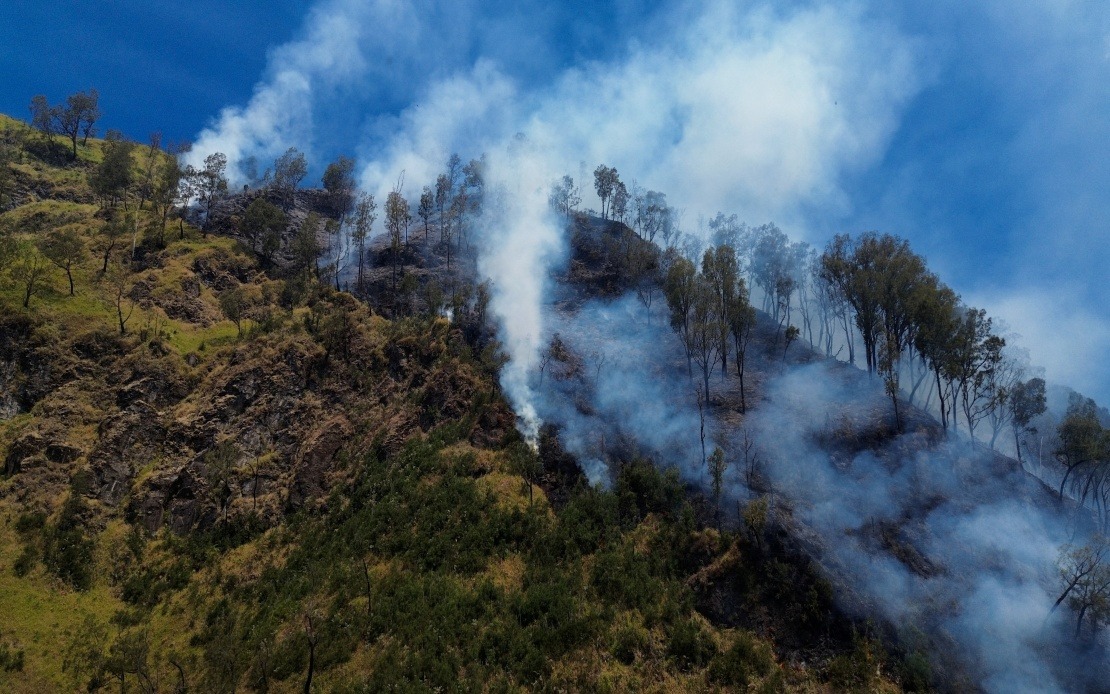
Indonesia's Mount Bromo, one of Southeast Asia's most recognisable natural landmarks, has been sealed to tourists as authorities battle intensifying forest fires across the Bromo Caldera in East Java. The Bromo Tengger Semeru National Park closed all five entry points simultaneously on Saturday evening at 10pm, halting what is typically a major source of tourism revenue and visitor activity during the peak season. The unprecedented shutdown reflects the severity of conditions on the ground and underscores the Indonesian government's prioritisation of public safety and firefighting operations over economic considerations.
The park authority designated closures affecting all established tourist access routes, including the gateways at Cemorolawang in Probolinggo Regency, Wonokitri in Pasuruan Regency, both Jemplang and Coban Trisula in Malang Regency, and Senduro in Lumajang Regency. Each of these entry points normally processes hundreds of daily visitors during normal operations, making this suspension a significant disruption to the region's tourism infrastructure. The decision to close simultaneously across multiple regencies suggests a coordinated provincial response, indicating that fire conditions had become severe enough to warrant such drastic measures across jurisdictional boundaries.
The forest fire ignited on Monday and has since consumed approximately 176.20 hectares of vegetation across the Probolinggo and Malang regency areas as of the latest official assessment. This acreage represents a substantial portion of the accessible terrain within the caldera zone, though the actual scope of damage may extend beyond what has been formally mapped. Abdul Muhari, head of the National Disaster Management Agency's Disaster Data, Information, and Communication Centre, confirmed that smoke-emitting hotspots remained active as of Saturday night, with meteorological conditions—specifically moderate wind patterns—complicating suppression efforts and potentially dispersing flames across additional territory.
Responding to the crisis, the Indonesian government deployed two specialised firefighting helicopters, each capable of dispensing 1,000 litres of water per sortie. This aerial support represents a significant commitment of national resources, as such helicopter operations demand considerable fuel expenditure and pilot expertise. The dual-aircraft deployment suggests authorities anticipated a prolonged operation rather than a brief containment scenario, reflecting concerns about the fire's trajectory and the challenging terrain of the volcanic landscape. However, helicopter operations in mountainous areas present their own logistical constraints, particularly regarding refuelling stations and visibility conditions.
For international and domestic tourists who had prepaid for entrance during the closure period, park authorities offered accommodating provisions. Visitors holding online tickets could either reschedule their visits to a future date or claim full refunds through the booking portal. This policy aimed to mitigate financial losses for travellers whilst acknowledging the indefinite nature of the suspension. The absence of a specified reopening date underscores uncertainty about how rapidly firefighting teams can establish control, suggesting conditions could deteriorate further before improvement becomes evident.
The Mount Bromo crisis is not an isolated incident in Indonesia's eastern provinces. Simultaneously, a separate forest fire erupted in the Sembalun Resort area within Mount Rinjani National Park, located in East Lombok Regency. That blaze initiated Friday evening at approximately 8pm and spread across roughly 30 hectares before teams successfully contained it early Saturday morning around 1:30am. The proximity of these two major incidents within days of each other, affecting two nationally significant protected areas, raises questions about underlying environmental conditions—possibly including drier-than-normal vegetation, insufficient ground moisture, or heightened atmospheric temperatures.
The causal factors driving both the Bromo and Rinjani fires remain under formal investigation, with authorities refraining from public attribution pending comprehensive analysis. However, Indonesia's fire seasons typically correlate with delayed monsoon onset or extended dry periods, conditions that have become more pronounced and unpredictable in recent years. The simultaneity of incidents across two separate mountain ranges in East Java and Lombok suggests either common climatic triggers or insufficient preventative measures across protected areas. Forest management practices, including controlled burns or vegetation thinning, could play roles in determining fire susceptibility.
For Malaysian travellers and regional tourism operators, the Mount Bromo closure represents a significant disruption to established itineraries. The volcano attracts substantial visitor numbers from neighbouring countries, particularly Malaysia and Singapore, as part of extended East Java tourism circuits. Many package tours coordinate Bromo visits with stops at other attractions including Mount Semeru, Ijen Crater, or coastal destinations. This closure therefore cascades beyond the immediate park, potentially affecting accommodation providers, guide services, and transport operators throughout the region.
The incident also illustrates broader challenges facing Southeast Asian nations in managing fire risk across protected areas. Climate change dynamics are altering precipitation patterns and vegetation growth cycles, creating novel challenges for park management teams accustomed to historically predictable seasonal patterns. Indonesia's experience on Bromo and Rinjani likely provides cautionary lessons for neighbouring countries managing similar volcanic landscapes and forested mountain reserves. Coordinated regional approaches to fire prevention, early warning systems, and rapid-response capabilities may become increasingly essential as fire seasons intensify across the archipelago.

