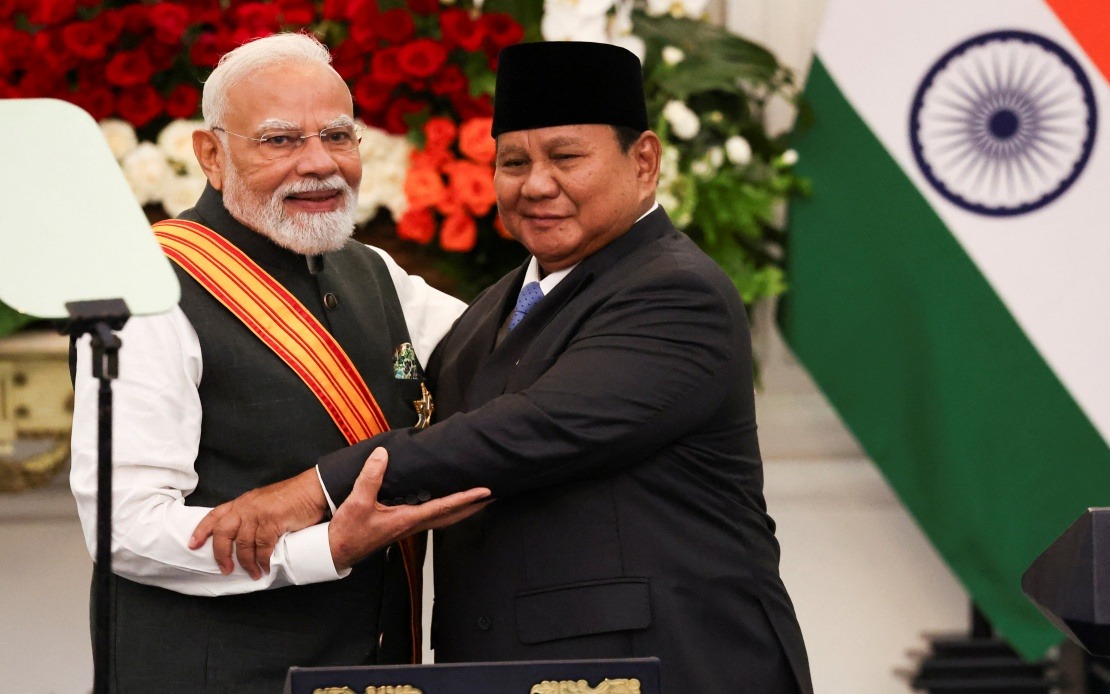
Indonesia formally conferred its most prestigious state honour on Indian Prime Minister Narendra Modi during an official state visit to Jakarta on Tuesday, marking a significant diplomatic milestone in the relationship between the two Southeast Asian and South Asian powers. The award, presented by President Prabowo Subianto at the Merdeka Palace, underscores the deepening strategic engagement between New Delhi and Jakarta at a time when both nations are navigating complex regional geopolitical dynamics.
According to Prabowo, the recognition reflects Modi's distinguished leadership and his sustained commitment to elevating Indonesia-India ties to the level of a Comprehensive Strategic Partnership. The Indonesian president emphasised that the honour acknowledged not merely political gestures, but Modi's tangible contributions through supporting development initiatives and cooperation programmes that have directly benefited Indonesia's growth trajectory. This framing suggests that bilateral relations now extend well beyond traditional diplomatic courtesies into substantive partnership across economic, infrastructure, and developmental spheres.
The timing of Modi's visit carries particular significance, as it represents reciprocal diplomacy following Prabowo's own journey to India earlier in the year. This pattern of high-level mutual visits demonstrates a deliberate effort by both capitals to maintain momentum in their strategic engagement, particularly as regional powers including China and the United States compete for influence in Southeast Asia. For Malaysian observers, this deepening Indonesia-India axis warrants attention, as it shapes broader regional alignment and cooperation frameworks that Malaysia itself participates in through organisations like ASEAN.
Historically, Prabowo drew parallels between Modi's honour and a previous award presented to Jawaharlal Nehru, India's founding prime minister. That earlier recognition acknowledged Nehru's pioneering contributions to Indonesia-India relations and his instrumental role in establishing the Non-Aligned Movement during the Cold War. By invoking this historical comparison, Prabowo positioned Modi within a continuum of transformative Indian leaders whose vision has shaped regional architecture—a powerful symbolic statement about Modi's perceived legacy in Asia.
The award also carries implications for India's broader regional strategy and its pursuit of expanded influence within Asian multilateral institutions. During the joint press conference, Prabowo specifically mentioned Indonesia's appreciation for India's backing regarding Indonesia's bid for permanent membership in BRICS, the influential bloc comprising Brazil, Russia, India, China, and South Africa. This notation reveals how bilateral partnerships increasingly interconnect with membership aspirations and positions within global and regional forums, where support from fellow aspirants or established members proves instrumental.
The designation of their relationship as a Comprehensive Strategic Partnership represents a deliberate elevation in diplomatic language, signalling that cooperation spans security, economic, cultural, and environmental dimensions rather than remaining confined to traditional bilateral trade and political engagement. For Malaysia and other ASEAN nations, such comprehensive frameworks among neighbouring powers necessitate careful calibration to ensure balanced relationships without appearing to align excessively with any single bloc.
Prabowo's emphasis on shared historical and cultural ties between Indonesia and India highlights civilisational connections that predate modern nation-states, rooted in centuries of Hindu-Buddhist cultural exchange, shared philosophical traditions, and maritime trading networks. These deep cultural foundations provide durable underpinnings for contemporary political and economic partnerships, creating constituencies in both societies favourably disposed toward cooperation. Such civilisational solidarity can transcend transactional considerations and weather periodic diplomatic turbulence.
The state visit itself demonstrated the ceremonial importance both nations attach to their bilateral relationship, with senior leadership dedicating time for substantive bilateral meetings and public display of partnership. The livestreaming of proceedings on YouTube reflected modern diplomatic practice, ensuring domestic constituencies in both countries remained informed and could perceive the tangible benefits of strengthened international partnerships.
For Malaysia and the broader ASEAN region, Indonesia's strengthening strategic partnership with India carries multifaceted implications. Indonesia remains ASEAN's largest economy and most influential voice within the bloc, and its deepening ties with India—a major power external to Southeast Asia—inevitably influences ASEAN's collective approach to regional order. India's support for Indonesia's BRICS aspirations simultaneously positions New Delhi as a supporter of Indonesia's global standing, creating reciprocal obligations and alignment incentives.
The award exemplifies how ceremonial honours serve contemporary strategic purposes, functioning as public commitments to sustained partnership and signalling to regional and global audiences the priority accorded to specific relationships. Modi's recognition represents not merely personal esteem but institutional affirmation of India's importance to Indonesia's strategic calculations and development agenda.
Looking ahead, the consolidation of Indonesia-India ties through such high-profile recognition may establish precedents influencing how other ASEAN members calibrate relationships with major Asian and global powers. As economic interdependencies deepen and security challenges become increasingly transnational, the architecture of bilateral partnerships among major regional actors will shape the institutional environment within which smaller and medium-sized powers like Malaysia operate.

