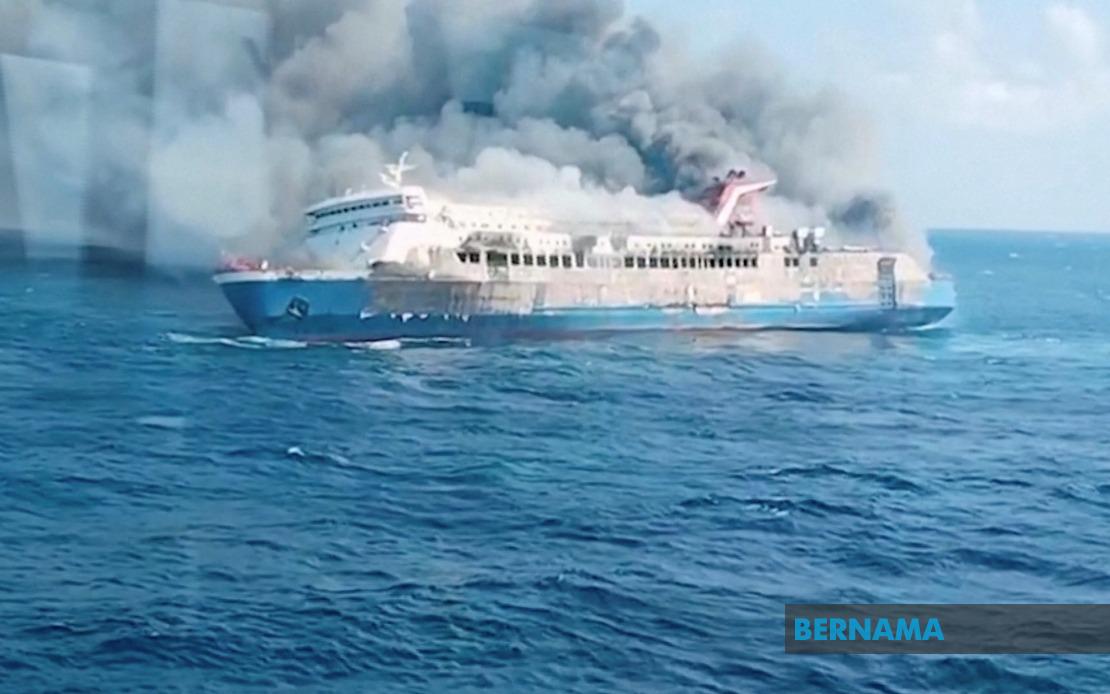
Indonesia's maritime rescue authorities have ramped up operations to locate dozens of missing passengers and crew following a catastrophic fire aboard the KMP Mutiara Sentosa II ferry in the northern waters off Madura. The disaster struck on Monday morning when the vessel, carrying 232 passengers and 39 crew members, erupted in flames at approximately 8:24 am local time in waters north of Sumenep, resulting in widespread destruction as the fire consumed much of the ship's structure. The incident has triggered a substantial coordinated response involving multiple government agencies and military assets as rescuers race against time to find survivors.
The Surabaya Search and Rescue Office, coordinating the recovery efforts, has expanded its search capabilities considerably as the operation entered its second day. Beyond standard maritime rescue vessels, authorities deployed the Indonesian National Armed Forces warship KRI Bung Hatta-370 to aid in locating the missing individuals. Additional resources mobilised included the State Ship Grantin P.211, the patrol vessel Manyar 5003, and a helicopter from the East Java Police, significantly broadening the operational scope across the affected waters. This multi-agency approach reflects the scale and urgency officials have assigned to the rescue mission, which has become increasingly challenging given the extensive damage to the vessel.
According to Nanang Sigit, the Chief of the Surabaya Search and Rescue Office, the recovery operation has already achieved substantial results despite the ongoing search for those still unaccounted for. As of the second day of operations, rescue teams had successfully evacuated 229 survivors, who were transported in staged operations to Tanjung Perak Port in Surabaya for comprehensive medical evaluations. Meanwhile, recovery teams have retrieved five bodies from the disaster scene, which have been transferred to Bhayangkara H.S. Samsoeri Mertojoso Hospital in Surabaya for identification and processing. The disparity between the known death toll and the number of missing persons—with 271 people aboard the vessel—underscores the continuing search efforts and suggests authorities remain hopeful about locating additional survivors.
The ferry fire represents a serious maritime safety incident in one of Southeast Asia's busiest shipping corridors. The waters around Madura, despite being relatively shallow and well-travelled, present unique rescue challenges given the rapid spread of fire aboard vessels in confined marine environments. The fact that much of the KMP Mutiara Sentosa II was destroyed by flames complicates recovery efforts, as rescuers must navigate wreckage while searching for survivors who may have become trapped or disoriented. The intensity of the fire and the speed at which it consumed the vessel raised immediate questions about onboard safety protocols and emergency response procedures, matters that Indonesian maritime authorities will likely examine during a formal investigation.
For Malaysian observers, this incident carries particular resonance given the substantial traffic of passenger ferries between Malaysia and Indonesia, especially across the Straits of Malacca and between Peninsular Malaysia and Sumatra. While the KMP Mutiara Sentosa II operated within Indonesian territorial waters, the disaster serves as a reminder of the risks inherent in regional maritime transport. The ferry was carrying a typical capacity load for domestic Indonesian routes, suggesting robust passenger demand on this corridor despite periodic safety concerns. Malaysian maritime authorities may use this incident to reinforce safety standards aboard vessels operating from Malaysian ports and to review emergency protocols for assisting Indonesian vessels in distress near Malaysian territorial waters.
The incident also highlights broader systemic challenges within Indonesia's maritime sector, where ferries remain the primary transportation method for millions of residents across the nation's vast archipelago. Vessel maintenance standards, crew training requirements, and fire suppression systems have historically been areas of concern on older passenger ferries operating in Indonesian waters. The KMP Mutiara Sentosa II's vulnerability to rapid fire propagation suggests potential deficiencies in fire-resistant design or insufficient fire suppression capabilities—issues that regulatory bodies in Jakarta will need to address through stricter oversight and mandatory upgrades to the aging fleet.
The rescue coordination demonstrates Indonesia's developing capacity for rapid response to maritime disasters, with multiple agencies mobilising quickly and effectively. However, the operation also exposes limitations in rescue infrastructure for a country that spans thousands of islands and experiences regular maritime incidents. The deployment of military naval assets to assist civilian rescue operations, while effective in this instance, reflects the reality that Indonesia's dedicated coast guard and maritime rescue services operate with constrained resources relative to the scale of waters requiring surveillance and protection. Strengthening these specialised agencies remains a priority for Indonesian policymakers concerned with maritime safety and disaster response.
The aftermath of the fire will likely prompt regulatory discussions in Indonesia regarding mandatory safety equipment, crew certification standards, and vessel inspection regimes. International maritime standards, codified through the International Maritime Organization, establish baseline requirements for passenger ferries, yet enforcement and compliance vary significantly across Southeast Asian shipping industries. Indonesian authorities have previously announced initiatives to modernise ferry fleets and tighten safety regulations, but implementation has proceeded unevenly. This incident provides fresh impetus for accelerating such reforms, as the human cost of inadequate safety measures becomes starkly apparent.
As the search operation continues, attention will turn toward understanding how the fire originated and why evacuation procedures either failed or were insufficient to prevent casualties. Preliminary reports suggest the fire spread rapidly, limiting the time available for orderly evacuation, though the successful rescue of 229 people indicates that emergency response protocols functioned partially. Indonesian maritime safety investigators will examine vessel maintenance records, crew training documentation, and survivor accounts to reconstruct events. These findings will inform policy recommendations and, potentially, criminal investigations if negligence is substantiated.

