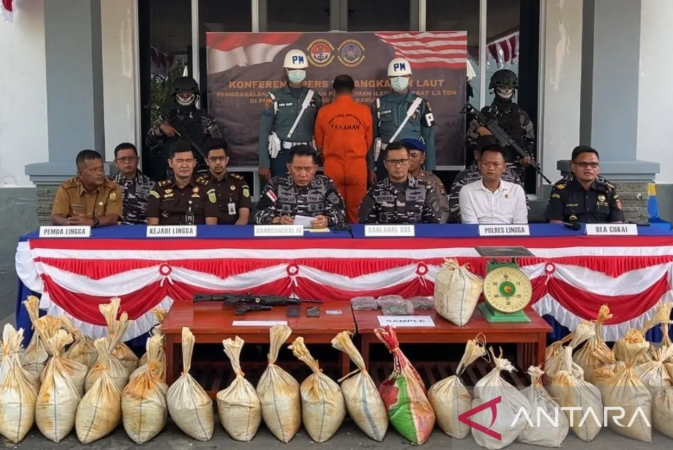
The Indonesian Navy has successfully prevented a substantial smuggling operation involving approximately 75.7 tonnes of illegally extracted tin sand that was apparently destined for Malaysian buyers. The intercepted shipment, originating from the tin-rich Bangka Belitung Islands located off Sumatra's eastern coast, carries an estimated market value of Rp76.04 billion, equivalent to roughly US$79,300. The discovery has triggered a multi-stage investigation that has expanded across five separate locations, with Indonesian authorities pledging to pursue the entire criminal network responsible for the operation.
The breakthrough came through maritime vigilance rather than advance intelligence. On August 2, personnel deployed by the Indonesian Navy detected a truck laden with approximately eight tonnes of tin sand at a jetty in East Belitung. This initial interception proved to be the opening thread that unraveled a far more extensive smuggling enterprise. Rather than treating the seizure as an isolated incident, naval commanders authorised a series of coordinated follow-up operations designed to expose the full scope of illegal mining and trafficking activities.
These subsequent raids yielded progressively larger discoveries. On August 3, investigators found roughly 50 tonnes of tin sand concealed in Lenggang village, a substantial find that suggested sophisticated storage and distribution infrastructure. Further operations on August 4 uncovered another ten tonnes carefully packed into 200 sacks, indicating methodical preparation for transport. A fifth seizure on August 8 recovered an additional five tonnes, bringing the cumulative total close to the final figure disclosed. Vice Admiral Denih Hendrata, who leads the Indonesian Fleet Command, publicly acknowledged during a livestreamed briefing in Tanjungpandan, Belitung, that investigators deliberately expanded the operation beyond initial seizures to dismantle the underlying network architecture.
The Bangka Belitung Islands have long represented a crucial global source of tin production, but the region has simultaneously become notorious for unregulated mining that depletes natural resources while generating minimal government revenue and substantial environmental damage. Illegal tin extraction typically occurs through informal artisanal operations that lack environmental safeguards, operate without taxation, and create ecological degradation through uncontrolled land disturbance. The smuggling of locally extracted tin to neighbouring countries, particularly Malaysia which maintains significant tin processing capacity, represents a natural outlet for goods that cannot be legally exported or taxed. This illicit commerce undermines Indonesia's formal tin industry, deprives the state treasury of legitimate export duties and resource taxes, and facilitates international trafficking networks.
At present, investigators have not publicly identified any individual suspects or named specific entities suspected of orchestrating the smuggling network. The expansion of investigations to five locations suggests that authorities are pursuing multiple dimensions of the operation simultaneously, potentially examining extraction sites, storage facilities, distribution centres, and transportation hubs. This methodical approach reflects an understanding that smuggling operations typically involve numerous participants spanning production, financing, logistics, and cross-border facilitation phases. The focus remains on mapping relationships and uncovering the complete chain of custody rather than securing rapid arrests.
Technical analysis is underway to determine precise mineral content within the confiscated stockpiles. Laboratory testing serves multiple purposes: establishing the quality and market value of seized materials, identifying geographical and geological markers that might pinpoint extraction locations, and gathering evidence suitable for potential prosecutions. Indonesian authorities recognise that sophisticated smuggling operations often involve multiple intermediaries and cross-border coordination, necessitating more comprehensive investigative frameworks than domestic law enforcement alone can provide.
The international dimension of this case has already been acknowledged by senior officials. Vice Admiral Hendrata has indicated that resolving the full investigation will require cooperative engagement with Malaysian authorities. Determining the intended recipients, distribution networks within Malaysia, and the broader trafficking infrastructure demands bilateral coordination and information exchange between Jakarta and Kuala Lumpur. Such cross-border investigations typically proceed through formal diplomatic channels and require mutual legal assistance agreements that specify evidentiary standards and witness cooperation protocols.
For Malaysian observers, this case illuminates several policy concerns. The presence of substantial illegal tin destined for Malaysian markets suggests that end-users within Malaysia—whether processors, traders, or exporters—may have insufficient due diligence mechanisms to verify supply chain legality. Malaysia's prominent role as a global tin smelter and processor means that tightened scrutiny of raw material sourcing and verification procedures could substantially disrupt illegal supply flows. Conversely, robust demand from Malaysian buyers creates the underlying incentive structure that motivates Indonesian smugglers to risk naval interception.
The seizure also underscores the persistent difficulty Indonesian authorities face in controlling resource extraction across its archipelago. Despite the strategic and financial significance of tin reserves, implementing comprehensive oversight across thousands of dispersed mining sites remains operationally challenging. The Bangka Belitung Islands' remoteness and the comparative ease of maritime transport to neighbouring countries create inherent vulnerabilities that smuggling networks systematically exploit. Effective solutions require sustained naval patrols, intelligence networks embedded in mining communities, and coordinated action with receiving countries to eliminate the demand that sustains illegal extraction.
Moving forward, the investigation's success in uncovering this particular operation may influence smuggling patterns rather than eliminate them entirely. Criminal networks typically respond to enforcement actions by modifying routes, disguising shipments, or adjusting timing rather than ceasing operations. The publicity surrounding this case may prompt temporary caution among established smuggling participants, but likely will not extinguish the fundamental economic incentives driving illegal tin extraction and cross-border trafficking. Sustained pressure requires ongoing maritime patrols, intelligence development, and strengthened capacity at ports and jetties where illicit materials pass through.
The broader implications extend beyond tin commerce to regional stability concerns. Natural resource smuggling generates revenues for informal networks operating beyond government regulation and oversight. These proceeds can fund other illicit activities or provide capital for criminal enterprises. Indonesia's commitment to disrupting smuggling operations reflects both legitimate resource management objectives and security interests in maintaining state authority over economic activities within its exclusive maritime zones. The case demonstrates that determined naval enforcement can achieve tactical success, but strategic success in constraining smuggling networks demands integrated approaches combining detection, prosecution, and demand-reduction in destination countries like Malaysia.

