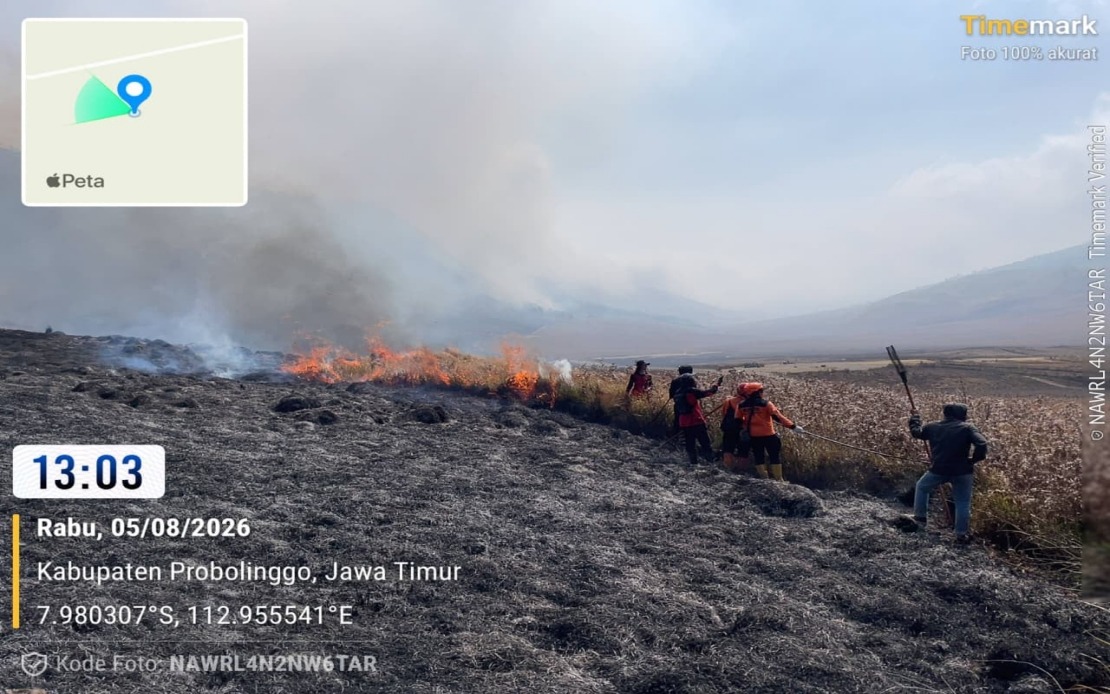
Indonesia has escalated its response to a spreading wildfire at Mount Bromo by deploying water-bombing helicopters, as ground teams struggle to reach hotspots scattered across steep, inaccessible terrain. The blaze, which ignited on Monday, has ravaged roughly 60 hectares divided between Probolinggo Regency, where approximately 10 hectares have burnt, and the Bromo Tengger Semeru National Park in neighbouring Malang Regency, where the remaining 50 hectares lie within protected territory. The scale of destruction underscores the challenges posed by fighting fires in mountainous regions where conventional firefighting methods prove insufficient.
Abdul Muhari, head of the National Disaster Management Agency (BNPB)'s Disaster Data, Information and Communication Centre, disclosed on Thursday that aerial resources had become essential to the suppression effort. The two water-bombing helicopters were specifically tasked with targeting fires on precipitous slopes that remain beyond the operational reach of ground-based personnel. This tactical decision reflects a broader recognition within Indonesian disaster management that topography frequently dictates which firefighting approaches succeed and which fail, particularly in volcanic regions where terrain can be treacherous and unpredictable.
Progress in containment became evident by Wednesday afternoon, when authorities reported that the majority of the active fire had been brought under control through coordinated ground operations. However, this apparent progress masks a persistent challenge: several hotspots remain stubbornly active in zones deemed too dangerous or difficult for personnel to safely access on foot. The continued monitoring and engagement with these residual fires represents an ongoing commitment by emergency responders, though they acknowledge the inherent limitations when dealing with fire in mountainous geography. The deployment of aerial assets directly addresses this operational constraint.
Beyond helicopter support, Indonesian authorities are preparing additional countermeasures that reflect sophisticated disaster management practices now common in the region. The BNPB is organising a Weather Modification Operation, contingent on atmospheric conditions proving suitable for implementation. This technique, which uses technology to encourage precipitation, would complement the existing firefighting strategy and represents an innovative approach to large-scale wildfire suppression that has gained traction across Southeast Asia in recent years.
The temporary closure of portions of the Mount Bromo tourist area continues as authorities prioritise both suppression operations and visitor safety. This decision carries economic implications for local tourism operators while signalling official determination to prevent further spread and avoid placing tourists in danger. Mount Bromo attracts significant domestic and international visitor traffic, making the closure decision a consequential one that affects livelihoods across the adjacent communities in Probolinggo and Malang.
While investigations into the fire's origin remain ongoing, preliminary assessments suggest that an unattended campfire abandoned by hikers may have triggered the blaze. This theory, if confirmed, would align with a troubling pattern across Southeast Asia where recreational activities in protected areas generate uncontrolled fire risks. The region's national parks frequently balance conservation mandates against public access demands, yet incidents like Mount Bromo demonstrate how casual visitors can inadvertently trigger environmental crises with far-reaching consequences for ecosystems and local communities.
The Mount Bromo incident carries implications beyond East Java's borders, particularly for Malaysia and other regional nations managing similar volcanic landscapes and high-altitude forests. Malaysian authorities operating Gunung Kinabalu and other protected mountain areas face comparable fire risks, especially during dry seasons when vegetation becomes highly flammable. The Indonesian response—combining aerial firefighting, advanced weather monitoring, and rapid deployment protocols—offers a practical model for regional disaster management cooperation and knowledge-sharing regarding mountain fire suppression.
The involvement of the Bromo Tengger Semeru National Park Authority in the response highlights how Indonesia's protected area management systems mobilise during crises. These bodies maintain on-ground expertise and infrastructure that becomes invaluable when emergencies strike, though the fire's rapid spread to 60 hectares also suggests that prevention mechanisms and visitor education programmes may require strengthening. The park's authority faces the dual challenge of protecting biodiversity while preventing incidents that could damage both natural ecosystems and tourism revenue streams.
From a broader Southeast Asian perspective, wildfire incidents at major tourist destinations reveal vulnerabilities in disaster preparedness infrastructure. Most regional nations depend on seasonal weather patterns and ground-based firefighting capabilities that often prove inadequate for large-scale mountain fires. The Indonesian decision to invest in helicopter resources and weather modification technology reflects growing recognition that preventative spending on aerial assets and advanced firefighting techniques yields better outcomes than reactive responses. Malaysia and regional neighbours may benefit from examining these approaches as they develop their own wildfire response strategies.
The Mount Bromo fire also underscores a persistent problem affecting protected areas throughout Southeast Asia: the tension between conservation objectives and recreational access. Many national parks across the region operate under pressure to generate tourism revenue and accommodate visitor demand, sometimes at the expense of strict environmental controls. Incidents triggered by visitor negligence—such as unattended campfires—highlight the necessity for enhanced education campaigns and stricter enforcement of camping regulations within protected zones.
Looking forward, the successful containment of this Mount Bromo wildfire will likely inform regional protocols for similar emergencies. The coordination between local authorities, national disaster management agencies, and park management demonstrates capacity that can be refined and expanded. For Malaysian policymakers observing this incident, the key lessons involve the strategic deployment of aerial resources, the integration of weather modification technology into firefighting strategies, and the critical importance of visitor behaviour management in preventing fires at the source.

