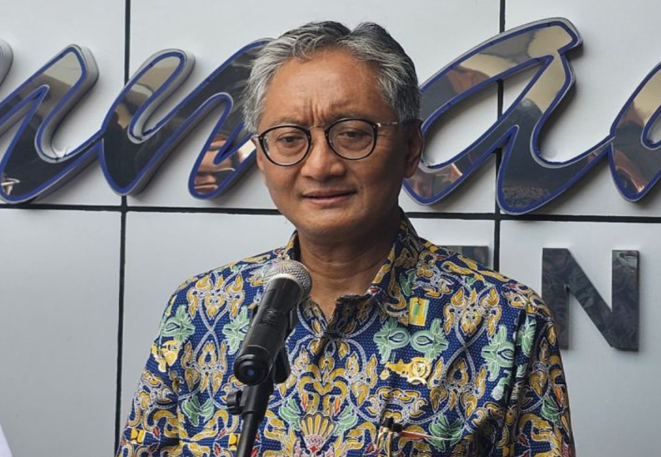
Indonesia's Public Works Ministry has descended into internal chaos following the circulation of a confidential travel document that listed Minister Dody Hanggodo's wife and daughter among delegates scheduled for a United Nations-related visit to New York in July. The disclosure has ignited a firestorm of public criticism over the use of state resources for family members and triggered a series of staff reassignments that employees view as punitive, exemplifying broader governance challenges within the ministry that mirror concerns facing Southeast Asian bureaucracies grappling with accountability and institutional stability.
The controversy originated when an official memo, signed by ministry secretary-general Apri Artoto on June 29, circulated on social media early in the month. The document outlined travel plans for eight delegates heading to New York from July 13 to 19 to participate in a United Nations-sponsored meeting scheduled for July 16 and 17. Notably, the delegation roster included Dody's wife Irma Hermawati and their daughter Aurellia Tsabitha Meidirama, an inclusion that immediately drew public ire and accusations of misusing public funds and infrastructure. The planned journey was ultimately abandoned after the backlash intensified.
Within days of the document's viral spread, social media platforms erupted with claims that Dody had orchestrated the reassignment of multiple officials to positions in regional offices, predominantly situated outside Java, as retaliation for exposing the travel plans. The allegations fuelled perceptions of a vindictive leadership style and raised questions about institutional integrity. When questioned by reporters on Wednesday, Dody acknowledged the transfers but categorically rejected suggestions that they represented payback. "I have 38,600 employees, why shouldn't I be allowed to reassign them?" he stated to media outlets, including Kompas.com, effectively sidestepping deeper concerns about workplace morale and the circumstances surrounding the personnel moves.
Apri attempted to justify the family members' inclusion during a July 7 press briefing, arguing that their names appeared on the delegation list to streamline visa application procedures through the Foreign Ministry. He insisted that no state funding would have covered their participation costs. However, Apri simultaneously committed to identifying the person responsible for leaking the document, which he contended was never meant for public circulation. The secretary-general went further by threatening to pursue legal sanctions against any staff member found culpable for the disclosure, a stance that underscored the ministry's hardline approach to managing the crisis internally rather than addressing underlying governance failings.
Since assuming office in October 2024, the 60-year-old Dody, whose professional background spans engineering and business ventures connected to South Kalimantan entrepreneur Andi "Haji Isam" Syamsuddin Arsyad, has executed multiple rounds of personnel restructuring. Social media compilations documented the reassignment of more than 100 employees during his tenure, spanning positions from senior director generals down to junior civil servants. The scale of these movements, coupled with their frequency, has created palpable unease throughout the organization. Most recently, in May, Dody elevated seven high-ranking officials, including Apri as secretary-general, replacing his predecessor Wida Nurfaida who held the position for fewer than 12 months following another reorganization in July 2025.
These recurring shake-ups have alarmed members of parliament responsible for infrastructure oversight. During a June meeting, Yasto Soepredjo Mokoagow, a representative from the House of Representatives Commission V representing the Indonesian Democratic Party of Struggle (PDI-P), articulated serious reservations about the management approach. He highlighted how disciplinary actions, including demotion of directors to non-structural positions, had fostered widespread apprehension among the workforce. "Civil servants at the ministry are now afraid to carry out programs," Mokoagow stated on June 11, warning that such a climate of fear would undermine the execution of critical infrastructure initiatives essential to the nation's development agenda.
Dody has repeatedly justified the institutional turbulence by invoking the existence of a "deep state" within the ministry, employing a metaphor comparing its corrosive effects to termites eroding a wooden structure. This characterization frames the reorganizations as necessary remedial measures to purge entrenched resistance and dysfunction. However, critics contend that the explanation masks a more autocratic management philosophy incompatible with professional civil service norms. The minister's insistence on constant restructuring, combined with his public rebukes of subordinates and reassignments perceived as retaliatory, has created an organizational culture marked by insecurity rather than institutional reform.
Simultaneously, the ministry confronts deeper credibility challenges stemming from ongoing corruption investigations. Several senior officials are implicated in a water resources project graft inquiry. The Jakarta High Prosecutor's Office formally identified suspects in June, including Dwi Purwantoro, the ministry's former water resources director general, and Yosiandi Radi Wicaksono, who previously served as acting irrigation and swamp director. Confronted with these allegations, Dody pledged full cooperation with law enforcement and promised not to shield subordinates implicated in misconduct, statements intended to demonstrate commitment to accountability even as other aspects of his leadership suggest otherwise.
The contradictions evident in Dody's governance style have been amplified by viral video footage capturing his interactions with staff members. One particularly damaging clip showed him reproaching an employee at a school construction site visit in East Java in April, visibly pointing at the worker while disparaging his explanation as "dumb excuses." Such displays of public humiliation, widely disseminated through digital platforms, reinforce employee perceptions of capricious leadership and contribute to the organizational anxiety documented by parliamentary observers. The juxtaposition of pledged transparency on corruption matters with visible intolerance for perceived dissent or error reflects fundamental tensions in how the ministry's leadership balances accountability with institutional morale.
For Malaysian observers, the Indonesian Public Works Ministry's predicament offers instructive lessons regarding governance vulnerabilities affecting regional administrations. The episode demonstrates how decisions involving family members and state resources, when mishandled, can rapidly erode public trust and institutional cohesion. The subsequent attempts to control narratives through personnel transfers and threats against whistleblowers exemplify counterproductive approaches that exacerbate rather than resolve underlying governance deficits. Southeast Asian governments navigating similar pressures would benefit from recognizing that sustainable institutional reform requires transparent processes, clear accountability mechanisms, and workplace cultures that encourage rather than punish integrity. The Indonesian situation underscores how leadership styles emphasizing control and retaliation, regardless of stated intentions regarding anti-corruption efforts, ultimately weaken rather than strengthen public institutions essential to development objectives across the region.

