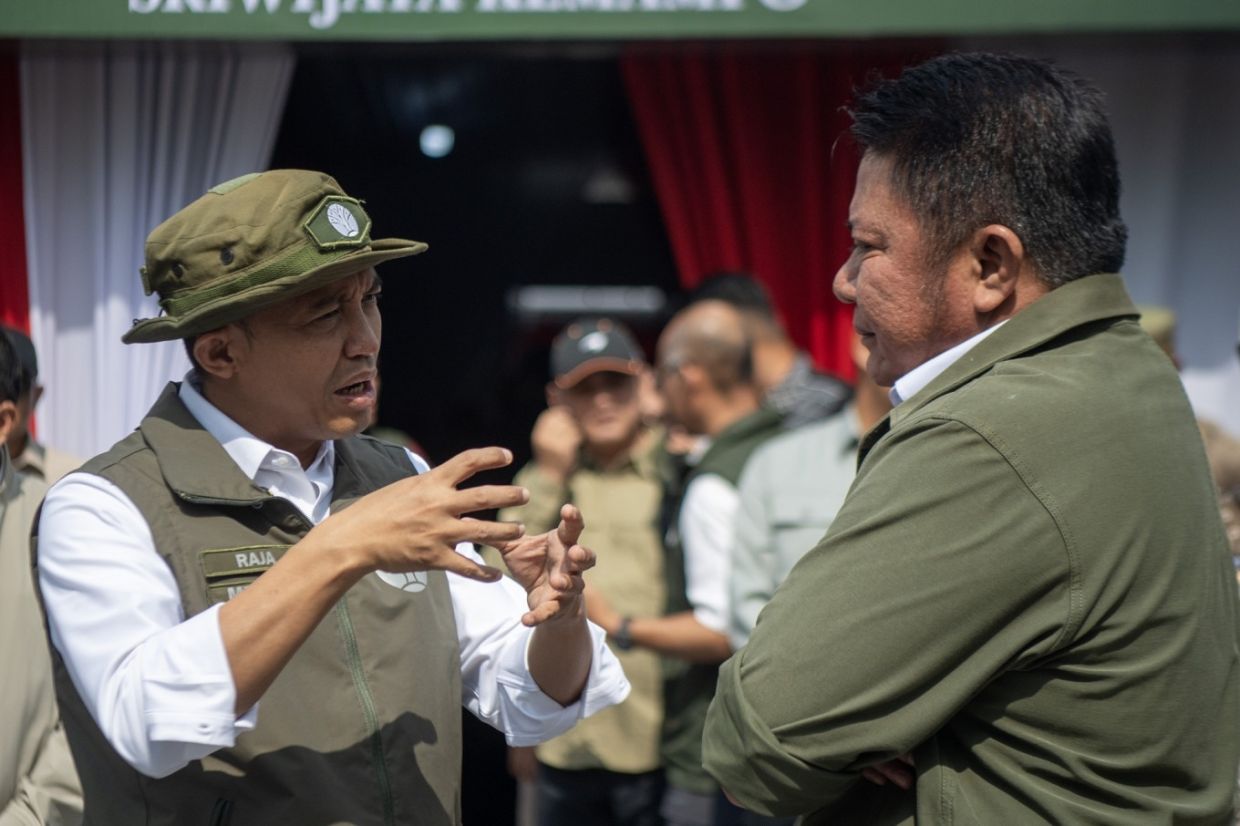
Indonesia's Corruption Eradication Commission (KPK) has reopened scrutiny of Forestry Minister Raja Juli Antoni over suspicions that he failed to fully return bribes allegedly offered by a local administrator, marking a significant escalation in a graft case that threatens to undermine confidence in the country's forestry governance.
The investigation centres on a discrepancy between the amount of illicit funds the minister initially claimed he received and the total sum allegedly given by Suhardiman Amby, regent of Kuantan Singingi in Riau province. During a June 2 meeting between ministry representatives and the Kuantan Singingi administration, Suhardiman purportedly handed Raja Juli an envelope containing S$14,000 (approximately US$10,919). KPK spokesperson Budi Prasetyo revealed on Thursday, August 6, that investigators are meticulously comparing the documented amount against what the minister has declared and subsequently returned, seeking to establish whether a gap exists between these figures.
The circumstances surrounding the bribe attempt underscore how personal connections in Indonesia's bureaucratic landscape can facilitate corruption schemes. Raja Juli subsequently reported the incident to the KPK on July 3, claiming he had rejected the envelope and returned it on June 12 at Kuantan Singingi Police headquarters, just ten days after receiving it. However, the anti-graft body's current probe suggests investigators harbour doubts about the completeness of this account. The regulatory framework governing such situations is explicit: officials who receive improper gifts related to their positions must report them to the KPK within thirty days of acceptance, not to police authorities, to avoid potential criminal liability.
Concern over the minister's conduct intensifies when considering the apparent quid pro quo arrangement underlying these interactions. The KPK is examining whether the kickbacks bore any connection to the Kuantan Singingi administration's repeated requests to reclassify more than 1,800 hectares of limited production forest (HPT) into categories permitting different land usage. Such conversions represent commercially significant transactions, as they effectively unlock previously restricted land for development or industrial purposes. The Forestry Ministry wields substantial authority over these reclassification decisions, placing Raja Juli in a position where corrupt officials could reasonably expect his receptiveness to financial inducements.
Additionally troubling for the minister's credibility is the pattern of engagement between him and Suhardiman extending well beyond the single June meeting. Budi disclosed that the two officials met on at least three separate occasions across April, May, and June, though investigators have not yet clarified whether these earlier meetings shared common objectives. This frequency of contact suggests either persistent lobbying efforts or a deliberate cultivation of personal relationships intended to facilitate future cooperation on forest conversion matters. Such systematic interaction lends weight to suspicions that the S$14,000 gift represented merely one manifestation of a broader corruption arrangement rather than an isolated indiscretion.
The broader regional context renders this investigation particularly consequential for Southeast Asian environmental governance. Forest management decisions in Indonesian provinces frequently attract international scrutiny, given the nation's role as guardian of critical rainforest ecosystems supporting global biodiversity and carbon sequestration. When high-ranking officials allegedly accept bribes connected to forest reclassification, it undermines international confidence in Indonesia's environmental stewardship and raises questions about whether conservation priorities remain subordinate to corruption networks. For Malaysian stakeholders monitoring transboundary environmental issues and deforestation trends across the region, this investigation signals whether Indonesia's institutions possess sufficient independence to police environmental misconduct at senior levels.
The political dimensions of this affair compound its severity, particularly given the actors involved. Suhardiman, arrested and named a suspect by the KPK in late June, represents President Prabowo Subianto's Gerindra Party, meaning the investigation touches directly upon the governing coalition's credibility. Similarly, Raja Juli holds the position of secretary-general at the Indonesian Solidarity Party (PSI), a smaller coalition partner. The KPK's expansion of charges against Suhardiman to encompass alleged kickbacks to the Forestry Ministry indicates investigators perceive a coherent corruption scheme rather than isolated incidents, suggesting institutional vulnerability extends beyond individual actors to encompass administrative procedures and oversight mechanisms.
Parliamentary oversight bodies have commenced responding to these revelations with appropriate vigilance. Members of the House of Representatives Commission IV, which supervises forestry planning and policy, formally summoned the minister for explanation. However, Raja Juli's subsequent absence from a scheduled July 14 meeting, attributed by Commission IV deputy chair Alex Indra Lukman to an umrah trip, drew criticism for appearing to evade accountability during a moment when transparency would strengthen public confidence. Whether the minister's absence reflected genuine scheduling conflict or strategic avoidance remains unclear, but the optics damage the ministry's credibility claims regarding anti-corruption commitment.
Government responses to date have offered reassurance without substantive commitments. The Forestry Ministry issued a statement reaffirming its dedication to respecting the KPK's investigation and pledging cooperation if investigators request additional documentation or information. The ministry additionally emphasized that no forest reclassifications have received approval in Kuantan Singingi, with the most recent three proposals either rejected or still undergoing verification. These clarifications, while potentially factually accurate, ring somewhat hollow given the ongoing bribery investigation and fail to address the fundamental question of whether decision-making processes were compromised by improper personal relationships regardless of final outcomes.
The legal consequences potentially facing Raja Juli should investigators establish that he failed to return all bribe money represent serious deterrents against similar conduct. Indonesian law prescribes maximum penalties of twenty years' imprisonment and a Rp 1 billion (approximately US$55,867) fine for state officials convicted of accepting illicit gifts linked to their official positions. Such sentences, if imposed, would effectively terminate high-level political careers and presumably serve warning to other officials contemplating similar arrangements. However, enforcement of these provisions depends entirely upon investigative quality and prosecutorial determination, making the KPK's ongoing work pivotal to whether Indonesia's anti-corruption framework translates legal provisions into genuine accountability.
For Malaysian observers and regional governance experts, this case illuminates the persistent challenges confronting Southeast Asian institutions seeking to combat elite-level corruption. The investigation demonstrates that sophisticated officials can employ seemingly plausible explanations—that they rejected bribes or returned them promptly—while discrepancies between claimed and actual amounts suggest incomplete candour. The KPK's willingness to reopen investigation when initial accounts appear questionable indicates at least some institutional independence, yet questions persist regarding whether such efforts extend sufficiently to protect officials within governing coalitions. As Indonesia proceeds with this inquiry, its handling will substantially influence regional confidence in whether anti-corruption mechanisms function as genuine checks on executive power or merely perform symbolic roles.

