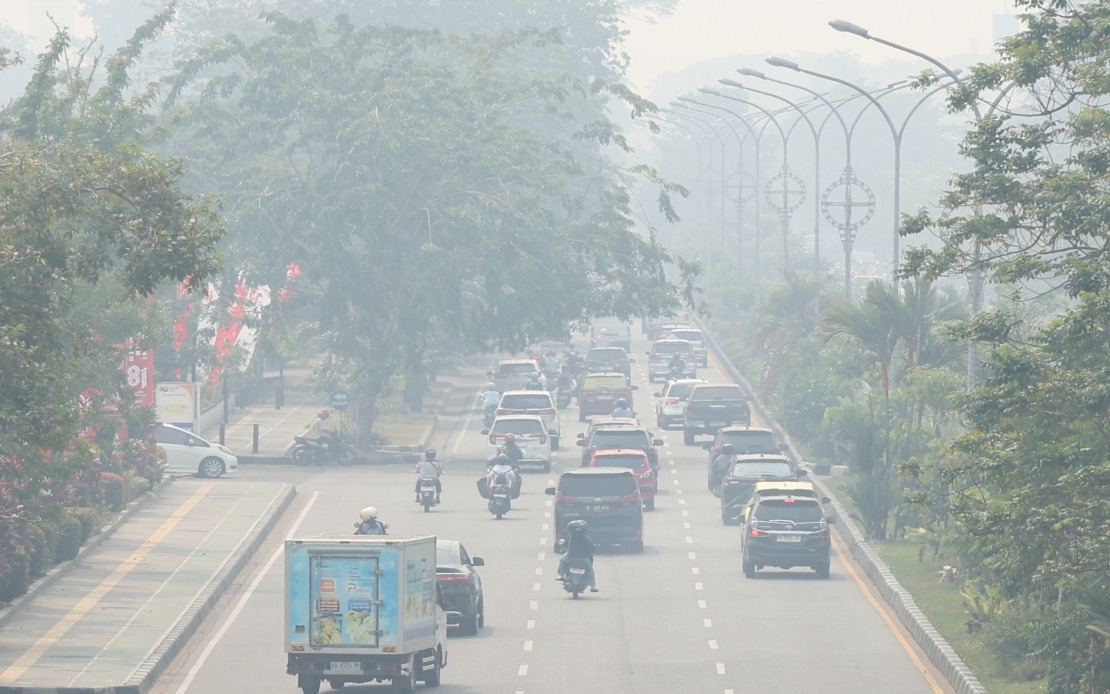
Indonesia faces a severe air quality emergency as uncontrolled forest and land fires continue to ravage vast tracts across the archipelago, sending pollution readings to hazardous levels that pose immediate threats to millions of residents. The Air Pollutant Index in Jekan Raya, a subdistrict within Palangka Raya in Central Kalimantan, surged to an alarming 573 as of early Wednesday morning, according to readings compiled from 17 monitoring stations. This measurement, documented by Then Suyanti, the Environmental Health Director at Indonesia's Health Ministry, places the affected area firmly in the hazardous category where outdoor exposure becomes genuinely dangerous for the general population.
The geographical spread of hazardous and very unhealthy air quality demonstrates the scale of the environmental crisis unfolding across Indonesia's most biodiverse and economically vital regions. Beyond Central Kalimantan's extreme readings, Muaro Jambi Regency in Jambi province has recorded an API of 302, which also falls within the hazardous category requiring immediate public health interventions. Meanwhile, a cluster of locations spanning multiple provinces—including Pelalawan in Riau, Penukal Abab Lematang Ilir and Ogan Ilir in South Sumatra, Southeast Pontianak in West Kalimantan, and both Gunung Mas and Katingan in Central Kalimantan—are experiencing very unhealthy air quality with API readings between 201 and 300. This widespread contamination affects some of Southeast Asia's most densely populated and economically active zones, threatening both industrial productivity and public welfare across the region.
The health implications extend far beyond temporary discomfort. Then Suyanti's public health guidance at Wednesday's media briefing emphasized that residents in hazardous zones should cease outdoor activities entirely, reflecting the genuine medical risks posed by such extreme pollution levels. For populations enduring very unhealthy air quality, authorities have advised against prolonged outdoor exposure, particularly for vulnerable populations including children, the elderly, and those with pre-existing respiratory or cardiovascular conditions. The Indonesian Health Ministry has mobilized a comprehensive response, deploying 321 health personnel across the seven affected provinces to monitor and respond to pollution-related illnesses. Currently, the crisis has resulted in 42 minor injuries, two serious burn injuries requiring hospitalization in South Kalimantan, and thankfully no reported deaths or mass evacuations at this stage.
The human toll extends across a staggering geographic expanse, with approximately 3.4 million people across seven provinces now experiencing degraded air quality and its attendant health consequences. The affected territories span both the Sumatran and Kalimantan regions, encompassing Riau, Jambi, and South Sumatra on Sumatra island, alongside West Kalimantan, Central Kalimantan, East Kalimantan, and South Kalimantan on Borneo. Provincial authorities have formally declared emergency alert status across these regions, though they have not yet escalated to full emergency response status—a distinction suggesting officials believe the situation remains controllable through intensified firefighting operations. The hope articulated by Agus Jamaludin, heading the Health Ministry's Health Crisis Centre, rests upon rapidly suppressing the underlying fires to allow atmospheric conditions to gradually recover.
Indonesia's Forestry Ministry satellite monitoring reveals the daunting challenge facing containment efforts, with nationwide detection of 805 high-confidence hotspots and a far more concerning 11,313 medium-confidence hotspots as of Tuesday evening. Within the six priority provinces, South Sumatra emerged as the most critical flashpoint with 239 high-confidence hotspots, significantly exceeding Central Kalimantan's 113 detections. South Kalimantan and West Kalimantan followed with 89 and 86 respectively, while Jambi and Riau recorded substantially fewer high-confidence readings at seven and one. The distribution of medium-confidence hotspots paints an even more alarming picture, with West Kalimantan alone accounting for 2,447 such detections, suggesting enormous areas where fire risk remains elevated even if active burning has not yet been definitively confirmed by satellite imagery.
The Indonesian government's policy response is rapidly escalating to address both immediate health crises and longer-term institutional preparedness. The Health Ministry is preparing a comprehensive circular expected to issue within two days from the secretary-general's office, institutionalizing protocols for managing air quality emergencies. Among proposed measures is the authorization for schools to transition to distance learning when air quality deteriorates beyond safe thresholds, protecting student health while maintaining educational continuity. This reflects Indonesia's recognition that extreme pollution episodes can persist for extended periods, necessitating flexible institutional responses rather than temporary ad hoc measures.
For Malaysian readers and the broader Southeast Asian community, this Indonesian crisis carries immediate and serious implications. Historical patterns demonstrate that transboundary haze from Indonesian fires regularly affects Malaysia, Singapore, and Brunei within days or weeks of initial outbreak, particularly during dry seasons. The sheer scale and severity of current fire activity—with over 12,000 hotspots detected nationwide—suggests significant haze export risk to neighboring nations in coming weeks. Malaysian authorities should heighten monitoring of atmospheric conditions and prepare contingency measures for potential air quality degradation, particularly in Peninsular Malaysia's eastern and northern zones closest to Sumatra and Kalimantan.
The underlying causes of Indonesia's recurring fire crises remain rooted in land-use conflicts, agricultural expansion pressures, and inadequate enforcement of environmental regulations across vast territories. Despite international commitments and domestic policies restricting land clearing through fire, deliberate and accidental fires continue to plague the region seasonally. The convergence of peatland vulnerability, extreme weather patterns, and economic incentives for land conversion creates a perfect storm for environmental catastrophe. Until Indonesia implements comprehensive landscape-level fire prevention systems, strengthens community engagement in fire management, and enforces stronger penalties for deliberate burning, such crises will likely recur with troubling regularity.
The current emergency underscores the urgent need for enhanced regional cooperation on environmental management and disaster response. Malaysia, Singapore, Brunei, and other affected nations possess legitimate interests in Indonesia's fire management practices and should engage more robustly in bilateral and multilateral discussions about transboundary haze mitigation. Sharing technological expertise, supporting Indonesian firefighting capabilities, and establishing early warning mechanisms could substantially reduce future crisis severity. The Association of Southeast Asian Nations framework offers institutional mechanisms for such cooperation, though political will to move beyond dialogue toward concrete coordinated action remains inconsistent across member states.

