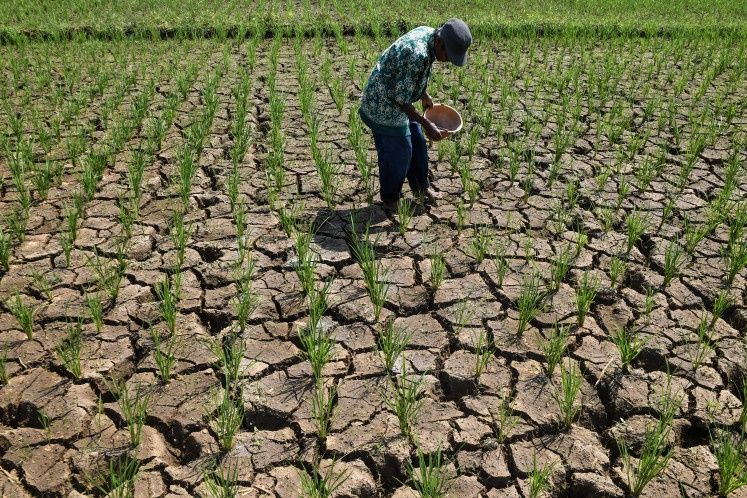
Indonesia's water crisis is cascading across the archipelago as meteorologists confirm that this year's El Niño-driven dry season will be exceptionally severe, forcing national authorities to declare emergency measures in multiple provinces and regions. The National Disaster Mitigation Agency has begun distributing water by tanker truck to affected communities whilst simultaneously urging all levels of government to elevate their drought preparedness protocols. The situation has deteriorated rapidly enough that several regions have triggered 90-day drought alert statuses, a procedural mechanism designed to expedite emergency resource allocation and administrative responses across local government hierarchies.
The geographical scope of the crisis has expanded dramatically within recent weeks. Three additional regencies—Gunungkidul in Yogyakarta, Semarang in Central Java, and Jember in East Java—were officially added to the shortage list on Friday, bringing approximately 700 additional households into the affected population. These new additions join an already substantial contingent exceeding 7,100 households already struggling to secure adequate clean water supplies in regions including Cilacap, Klaten, and Jepara across Central Java; Bantul in Yogyakarta; Karawang, Tasikmalaya, and Sukabumi in West Java; as well as Seram in the eastern province of Maluku. The cumulative effect suggests a systemic water distribution challenge rather than isolated local complications.
Climate monitoring agencies have provided sobering projections for the months ahead. The Meteorology, Climatology and Geophysics Agency forecasts that the dry season will reach peak intensity between July and September, with precipitation falling below normal across more than eighty percent of Indonesia's diverse climate zones. The agency's characterisation of the forthcoming conditions as potentially "extreme" reflects genuine concern that prolonged water scarcity could trigger cascading agricultural failures. By mid-June, roughly one-third of Indonesia's climate zones had already transitioned into the dry season, whilst nearly half the country was already experiencing below-normal rainfall patterns. These measurements underscore that current conditions represent not merely seasonal variations but significant climatic anomalies driven by warming Pacific Ocean surface temperatures associated with El Niño dynamics.
The agricultural sector faces particular vulnerability given Indonesia's dependence on rain-fed irrigation and its role as a substantial rice producer serving both domestic consumption and regional export commitments. Agricultural officials acknowledge that water availability directly constrains planting schedules and crop yields, creating potential vulnerabilities across the national food supply chain. Government projections suggest that comprehensive mitigation strategies must encompass adjusting planting calendars, prioritising drought-resistant crop varieties and early-maturing cultivars, and diversifying staple crop portfolios beyond traditional rice monocultures. The Agriculture Ministry has emphasised that it has anticipated worsening drought conditions and has accelerated deployment of irrigation pumps to maintain water availability throughout critical growing periods. Officials have repeatedly asserted that national rice reserves remain at historically elevated levels, ostensibly sufficient to satisfy domestic requirements through the following year, though this reassurance does little to address underlying production vulnerability.
West Nusa Tenggara and Banten provinces have experienced particular acute pressures. West Lombok authorities formally declared a drought emergency on June 15 after approximately 3,600 households experienced access restrictions, whilst Banten remained in assessment mode as of Friday, evaluating whether to implement a province-wide alert that would facilitate expedited water distribution protocols. These declarations reflect administrative recognition that climate impacts now exceed local government capacity to manage through conventional supply mechanisms. Gunungkidul had remained under alert status since June, while West Java's formal drought declaration occurred during July, indicating a rolling crisis pattern rather than a single concentrated event.
Parliamentary oversight mechanisms have begun mobilising in response to the unfolding emergency. The House of Representatives' Commission IV, responsible for monitoring agriculture and food production policy, has directed government agencies to accelerate assistance delivery to vulnerable regions, encompassing seed distribution, fertiliser allocation, farming equipment provision, and livestock feed supplies. This legislative pressure reflects recognition that emergency water delivery, whilst necessary as an immediate intervention, addresses only symptomatic manifestations rather than fundamental structural inadequacies in water infrastructure and food production resilience.
Water policy researchers have articulated a critical distinction between emergency response measures and long-term systemic solutions. Bagas Yusuf Kausan, a researcher affiliated with Yayasan Amerta Air Indonesia, a water policy research organisation, contends that Indonesia requires substantial infrastructure investment in piped water distribution systems administered through regional water utilities. He advocates that such services should receive government subsidisation in drought-vulnerable regions as a demonstration of political commitment to affected communities. This analysis reflects broader recognition that recurring drought vulnerabilities cannot be attributed exclusively to climate variables but rather stem from cumulative human-driven environmental degradation, including land use conversion that reduces water infiltration and depletion of groundwater reserves through unsustainable extraction practices.
The environmental dimension of Indonesia's drought vulnerability extends beyond immediate climate patterns. Human activities including conversion of water catchment areas for agricultural, industrial, or urban development have systematically reduced the landscape's hydrological resilience and groundwater recharge capacity. Researchers argue that El Niño events should be reframed as opportunities for implementing stronger environmental protections, particularly restrictions on land conversion in water catchment zones. Such measures would address underlying environmental degradation rather than merely allocating scarce water supplies to competing demands.
For Malaysian observers, Indonesia's escalating drought crisis carries several implications. First, any disruption to Indonesian rice production could influence regional grain pricing and availability, potentially affecting Malaysian food import costs and domestic price pressures. Second, the Indonesian experience demonstrates vulnerability patterns relevant to other Southeast Asian nations experiencing similar climatic patterns and environmental pressures. Third, the inadequacy of emergency response measures unaccompanied by infrastructure development represents a cautionary scenario regarding the consequences of deferred long-term investment in water security systems. Malaysia's own water security challenges, particularly in drought-prone regions, might benefit from observing Indonesia's experience and the policy recommendations emerging from Indonesian researchers and parliamentary bodies.
The interconnected nature of the crisis—spanning meteorological phenomena, agricultural production, food security, water infrastructure, and environmental management—suggests that purely sectoral responses will prove insufficient. Indonesia's national government faces mounting pressure to demonstrate that emergency measures will transition into comprehensive long-term strategies addressing both climate adaptation and environmental restoration. The coming months will determine whether the El Niño-driven extreme dry season catalyses genuine institutional transformation or merely prompts temporary resource mobilisation followed by a return to structural inadequacies.

