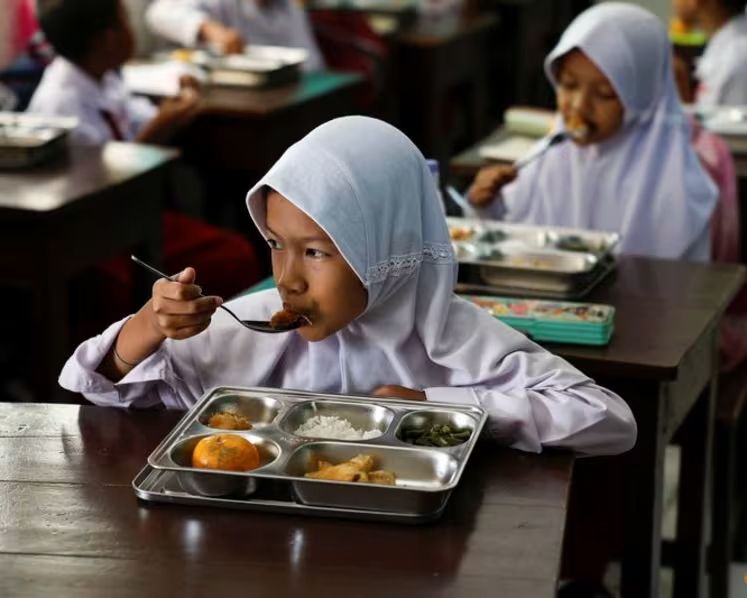
Indonesia's beleaguered free meals initiative has entered fresh institutional turmoil with the resignation of National Nutrition Agency chief Nanik Sudaryati Deyang, who cited serious health complications as her reason for stepping down. Her departure represents the second major leadership upheaval at the agency in little more than a month, signalling deepening dysfunction at the heart of President Prabowo Subianto's most ambitious and costly electoral pledge. The programme, which began delivering meals in January 2025, was designed as a flagship intervention to address childhood malnutrition and remains central to the president's domestic policy agenda. Yet since its inception, it has encountered mounting logistical problems, food safety controversies, and organisational instability that have raised questions about whether the initiative can achieve its stated ambitions.
Nanik's medical crisis illustrates the immense pressure bearing down on those managing the massive undertaking. She revealed that her physician had warned of severely constricted arteries stemming from stress-related factors, prompting her decision to seek overseas medical treatment. In announcing her resignation via Facebook, she described the toll the role has extracted, saying she required immediate intervention to preserve her health. The president, she indicated, had consented to her departure with sympathy for her circumstances. Yet her departure comes amid circumstances far more complex than personal medical necessity. Her nine-month tenure coincided with escalating budget constraints and intensifying scrutiny from anti-corruption authorities examining the programme's administration and expenditure patterns.
The timing of Nanik's exit is particularly significant given that her predecessor was dismissed by Prabowo and subsequently arrested on corruption allegations only weeks earlier. That prior chief was implicated in irregularities connected to the programme's multibillion-dollar funding flows, prompting a raid on the agency's offices by investigators. The rapid succession of departures at the top of the organisation raises concerns about whether structural problems run deeper than individual misconduct. For Malaysian observers, the instability mirrors challenges seen in other Southeast Asian countries attempting to execute large-scale social programmes involving complex supply chains and multiple oversight layers.
Budgetary pressures have intensified the operational and institutional strain. The agency announced a second major reduction in 2026 funding, trimming the allocation from 268 trillion rupiah to 229 trillion rupiah, equivalent to approximately USD 12.79 billion. This latest cut represents a dramatic compression from the original 335 trillion rupiah allocation, leaving the programme more than 100 trillion rupiah short of its initially planned budget. The financial tightening directly undermines programme scope and ambition, forcing painful choices about coverage and service quality. Officials acknowledged that further reductions remain possible pending additional budgetary reviews, suggesting continuing uncertainty about the initiative's financial trajectory.
These constraints have immediate consequences for the programme's reach and effectiveness. Originally designed to supply free meals to 83 million individuals, encompassing schoolchildren and pregnant women, the initiative had reached approximately 62.5 million beneficiaries prior to the latest budget review. The disparity between intended and actual coverage reveals how financial limitations translate into unmet social need. Each round of budget reductions forces programme managers to make trade-offs between expanding geographical coverage, improving meal quality, and strengthening logistical infrastructure. For a region where malnutrition remains a significant public health concern, such constraints carry real consequences for vulnerable populations.
The operational challenges confronting the programme extend beyond budgetary limitations. Multiple incidents involving contaminated food supplies have damaged public confidence and generated intense media scrutiny across Indonesia and regionally. Logistical difficulties in coordinating meal preparation and distribution across vast geographic areas have resulted in inconsistent service quality and occasional service failures. These implementation problems suggest that ambition alone cannot overcome the practical complexities of executing a nationwide feeding programme involving millions of daily transactions. The quality concerns have fed into broader public scepticism, with critics questioning whether the initiative represents genuine social investment or merely political symbolism preceding the 2025 election campaign.
Nanik sought to reframe the programme as fundamentally a nutritional intervention rather than a political undertaking, rejecting characterisations that portrayed it as campaign posturing. She emphasised the genuine public health rationale for ensuring adequate nutrition among vulnerable groups, a legitimate concern across Southeast Asia where childhood malnutrition remains endemic. Her framing attempts to redirect conversation away from implementation problems and institutional scandals toward the underlying policy objectives. Yet such rhetorical repositioning carries limited weight when operational reality continues generating negative headlines about food poisoning incidents, budget turmoil, and leadership departures. Public perception of policy effectiveness rests ultimately upon demonstrated implementation capability, not stated intentions.
President Prabowo's apparent response includes contemplating organisational restructuring through the establishment of a supervisory oversight board that Nanik would lead. This proposed governance arrangement suggests the president recognises that institutional deficiencies require more than replacing individual leaders. A supervisory framework introducing external oversight could potentially strengthen accountability and coordination across the agency's functions. However, creating additional bureaucratic layers risks compounding rather than resolving implementation challenges. The effectiveness of such an arrangement would depend entirely upon the experience, authority, and political support afforded to board members.
The succession question remains formally unresolved, with Nanik indicating only that her replacement would be drawn from junior agency personnel. Promoting from within offers continuity and institutional knowledge but does not necessarily address the systematic issues that have plagued the programme. Whether internal appointment signals that the presidency remains committed to the initiative or reflects difficulty attracting experienced candidates to a troubled and high-pressure position remains ambiguous. The ambiguity underscores how quickly flagship programmes can deteriorate when troubled by institutional instability, financial pressures, and quality concerns simultaneously.
For regional observers and policymakers, the Indonesian experience offers instructive lessons about scaling ambitious social programmes. Free meal initiatives have proliferated across Southeast Asia, reflecting genuine recognition of childhood malnutrition's prevalence and impact on human development. Yet implementation at scale requires not merely political commitment but robust institutional capacity, adequate and stable financing, professional supply chain management, and credible oversight mechanisms. The Indonesian programme demonstrates how rapidly technical problems can compound with institutional dysfunction when these prerequisites prove inadequate. As other nations expand similar initiatives, Indonesia's experience provides a cautionary reminder that good policy intentions must be matched by equivalent attention to operational fundamentals and governance architecture.

