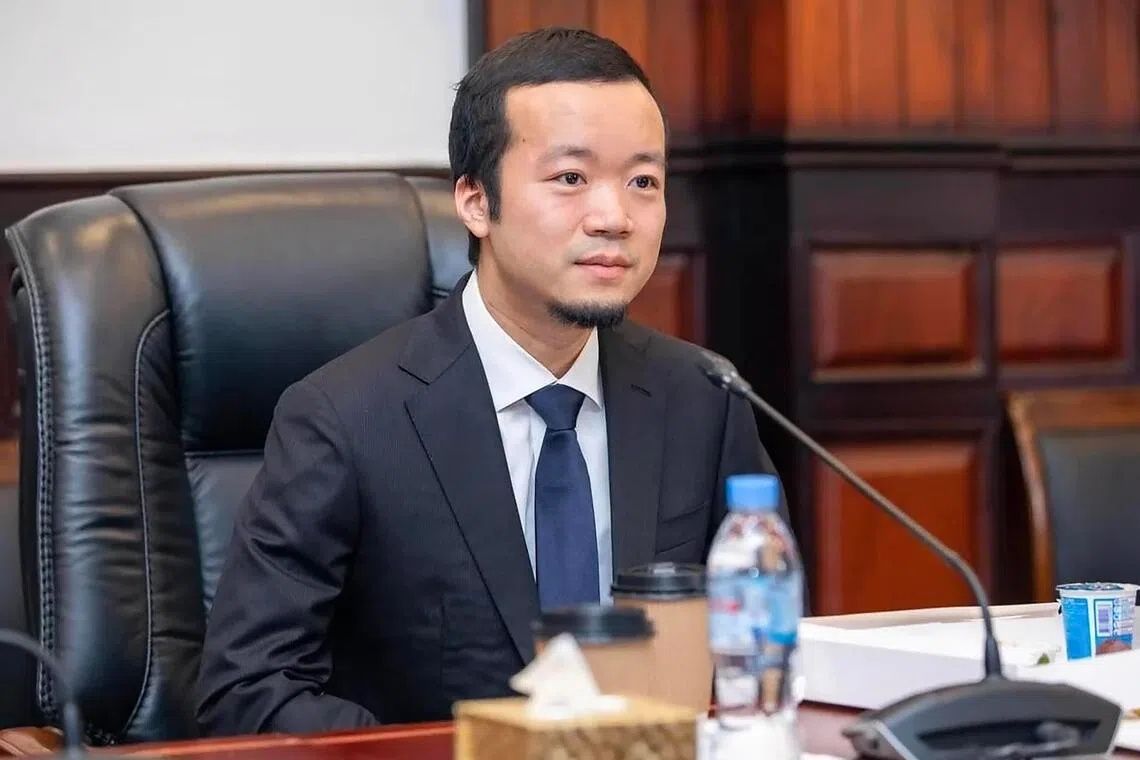
A six-month collaborative investigation by The Straits Times and the Organised Crime and Corruption Reporting Project has exposed Chen Sokly, identified in a US federal indictment as the second-in-command of one of the world's largest criminal syndicates. Born in Shanghai in 1986 and operating under multiple identities across jurisdictions including Singapore, Cambodia, and the United States, Sokly emerged as a central figure in the money-laundering operations of Prince Holding Group, the vehicle through which scam kingpin Chen Zhi orchestrated a multi-billion dollar fraud network. The investigation, which involved cross-referencing hundreds of pages of official records and corporate filings, provides rare transparency into how sophisticated criminal enterprises embed themselves within legitimate business ecosystems in Southeast Asia.
Sokly's transformation from Chen Xing to Chen Sokly occurred around the end of 2017 when he obtained Cambodian citizenship through undisclosed means—a pattern familiar to transnational organised crime networks seeking to obscure their origins and movements. In Singapore's business circles, he cultivated a separate identity as the wealthy entrepreneur Martin Chen, a carefully constructed persona designed to facilitate access to Singapore's financial and corporate infrastructure. This compartmentalisation of identities was not incidental to the operation but rather integral to its design, allowing the network to maintain plausible deniability across multiple jurisdictions while centralising control through trusted intermediaries like Sokly who could navigate between these separate spheres.
According to prosecutors, Chen Zhi specifically tasked Sokly with managing the syndicate's risk control function—essentially serving as the operation's internal security chief. In this capacity, Sokly was responsible for monitoring law enforcement investigations into Prince Group's activities worldwide and for cultivating relationships with foreign government officials to shield the organisation from legal accountability. The indictment alleges that in May 2023, Sokly engaged in corrupt negotiations with a Chinese government official who promised to protect Prince Group associates from legal consequences in exchange for personal favours, including assistance with the official's son. More brazenly, Sokly allegedly directed this Chinese official to instruct local police officers to conduct extortion operations on behalf of the syndicate—a stunning example of how criminal enterprises can subvert state apparatus when they achieve sufficient penetration of official structures.
The documents present Sokly as supremely confident in his network of compromised officials, dismissing the Cambodian government's crackdown on illegal scam compounds with assurances that nothing would befall Prince Group. Communications between Chen Zhi and Sokly reveal extensive discussions about the number of officials they had effectively purchased, with a ledger of alleged bribes recovered by US authorities showing that Sokly spent over US$3 million to purchase a yacht for a foreign government official in 2019. This willingness to deploy vast sums for the purpose of official corruption suggests that the syndicate's revenues were not only substantial but sufficiently liquid to allow for such expenditures without triggering internal audit concerns—a luxury only available to the most successful criminal enterprises.
Beyond corruption and money-laundering, the indictment portrays Sokly as willing to employ violence to maintain the network's dominance over competitor scam operators. In July 2024, Chen Zhi directly instructed Sokly to deal with a group member who had embezzled funds, indicating that Sokly functioned as the organisation's enforcer in addition to his administrative responsibilities. Sokly himself boasted to associates that the global syndicate was generating approximately US$30 million daily through its illicit activities—a figure that, if accurate, would place Prince Group's annual revenues in the range of US$10 billion to US$11 billion, rivalling the legitimate GDP of several small nations.
Sokly's financial footprint in the United States reveals a pattern of strategic property acquisition and divestment aligned with regulatory enforcement actions. In 2019, property records show he purchased a California residence from Fang Zhizhen, a member of the Knight Attack Group, an earlier Chinese cybercriminal organisation that prefigured Prince Group's operational model. He subsequently sold the property in 2024 for approximately US$4.5 million. More significantly, on November 4, 2025—just weeks after the US imposed sweeping sanctions on Prince Group and its associates—Sokly transferred ownership of a separate US$4 million property to his wife, which was subsequently placed into a trust structure in December 2025. This timing raises questions about whether the transfers were anticipatory measures to shield assets from potential forfeiture proceedings, a common protective manoeuvre when criminal enterprises anticipate regulatory action.
Sokly's Singapore presence, documented through property and corporate records, demonstrates how the city-state functioned as a crucial operational base for the syndicate's regional ambitions. In 2017, he announced his arrival with the purchase of a S$11 million apartment at 10 Leedon Heights, a 5,694 square-foot luxury residence in one of Singapore's most exclusive enclaves. Shortly thereafter, he incorporated M Capital Global Holdings and invested just over S$5 million in equal partnership with his wife—a deliberate strategy to establish corporate legitimacy while maintaining spousal co-ownership for asset protection purposes. Over the following two years, Sokly registered himself as a director of at least 16 Singapore companies, though he systematically removed himself from most of these between 2020 and 2023, likely as regulatory scrutiny of the network increased.
The Singapore companies under Sokly's direction shared a Shenton Way address, Singapore's established financial district—a choice that conferred legitimacy through proximity to established banking and professional services firms. When The Straits Times visited the location, the electronic directory revealed only two companies occupying the relevant office, with no apparent connection to Sokly's operations. This suggests the Shenton Way address served primarily as a mail drop or administrative placeholder rather than a genuine operational headquarters, consistent with patterns observed in other transnational criminal enterprises that require legitimate-appearing registered offices without maintaining substantive physical presence. The building's apparent compartmentalisation allowed Sokly to maintain numerous corporate identities while minimising his actual exposure within any single office environment.
Former employees familiar with Sokly's Singapore activities, speaking on condition of anonymity, characterised him as spending between two and three months annually in the city-state, typically engaging in social entertaining with syndicate associates including Chen Zhi himself. He maintained a significant personal vehicle fleet, including a Bentley and a luxury seven-seater sports utility vehicle, both housed at his Leedon Heights residence—ostentatious displays of wealth that nonetheless fell short of the kind of behaviour that might trigger financial crime reporting. This measured approach to personal consumption, combined with his legitimate business registrations and property ownership through proper channels, demonstrates the sophisticated compartmentalisation strategies that enabled Sokly and others in the Prince Group network to operate within Singapore's regulated environment for an extended period.
Sokly's case illuminates a critical vulnerability in how Southeast Asian financial systems intersect with global money-laundering networks. Despite Singapore's reputation for regulatory rigour, the network's ability to establish legitimate corporate entities, acquire residential property, and maintain banking relationships suggests either insufficient information-sharing between regional regulators and international law enforcement, or the effectiveness of the network's operational security in masking the true beneficial ownership and purpose of its corporate vehicles. The US government's subsequent forfeiture of 127,271 bitcoins valued at approximately US$15 billion represents the consequence of this extended operational period, during which billions in proceeds from forced labour in Cambodian scam compounds were successfully channelled through Singapore's financial infrastructure. For Malaysian policymakers and regulators, the Sokly case serves as a cautionary lesson: transnational criminal enterprises will systematically exploit regulatory inconsistencies between jurisdictions, requiring not merely domestic enforcement excellence but sustained intelligence-sharing and coordinated investigation with international partners to effectively disrupt such networks before they achieve the scale and sophistication demonstrated by Prince Group.

