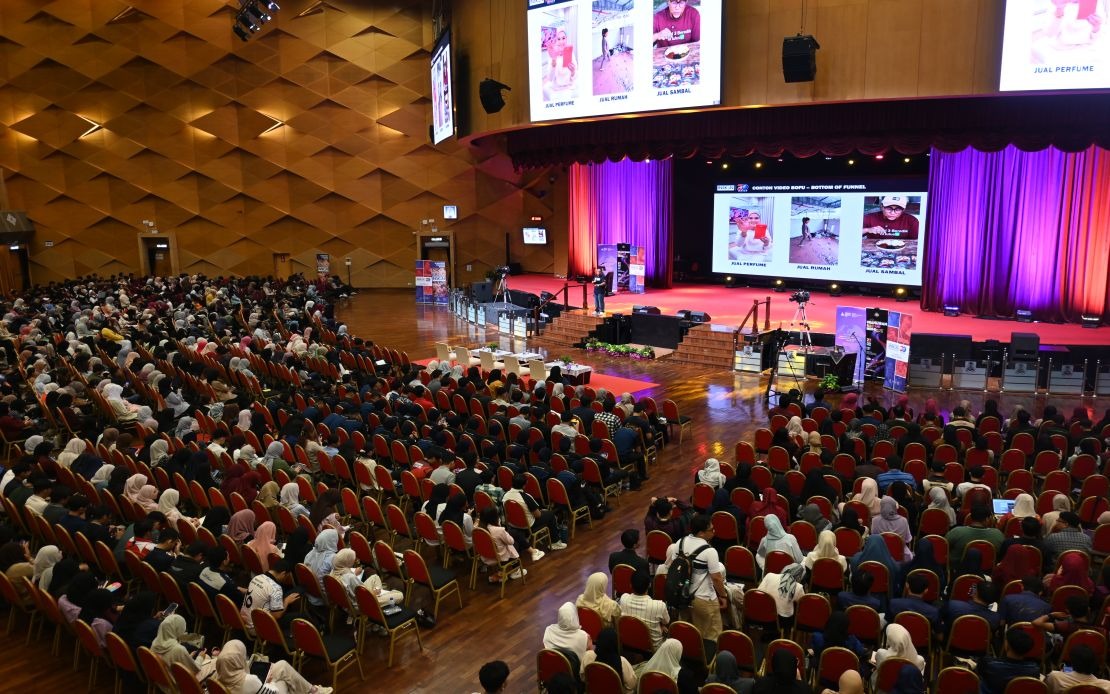
Malaysia's entrepreneurial landscape received a significant boost on June 23 when the Usahawan MADANI Mega (SUM MEGA) 2026 seminar convened 6,877 participants across physical and online platforms in Shah Alam, establishing a new national benchmark for student engagement in entrepreneurship education. The landmark gathering, held at Dewan Agung Tuanku Canselor at Universiti Teknologi MARA, earned recognition from the Malaysia Book of Records as the largest student participation in an entrepreneurship seminar, reflecting the sustained appetite among younger Malaysians to explore business ownership and self-employment as viable career trajectories.
The seminar's unprecedented scale reflects a fundamental shift in how university students and recent graduates perceive entrepreneurship within Malaysia's evolving economy. Orchestrated by the National Entrepreneurship Institute (INSKEN) alongside the Malaysian Academy of SME and Entrepreneurship Development (MASMED) and UiTM, the event assembled emerging entrepreneurs from across the nation for comprehensive knowledge-sharing, hands-on capacity-building workshops, and strategic networking opportunities designed to equip them with practical business acumen. This collaborative approach demonstrates how government institutions, academic bodies, and development agencies are aligning efforts to cultivate a generation of job creators rather than merely job seekers.
Deputy Minister of Entrepreneur and Cooperatives Development Datuk Mohamad Alamin characterised the turnout as evidence of a structural reorientation in youth career aspirations, particularly as entrepreneurship transitions from a peripheral option to a mainstream pathway. He emphasised that entrepreneurship transcends individual economic advancement, functioning instead as a critical engine driving national prosperity in an increasingly dynamic and competitive global marketplace. The minister's remarks underscore the Malaysian government's recognition that a robust entrepreneurial ecosystem directly correlates with employment generation, innovation velocity, and long-term economic resilience—concerns that become increasingly pressing as automation and globalisation reshape labour market dynamics across Southeast Asia.
Through the Ministry of Entrepreneur and Cooperatives Development (KUSKOP), the MADANI government has articulated a comprehensive vision for nurturing inclusive, sustainable, and high-impact entrepreneurship. Mohamad Alamin outlined a multifaceted support framework encompassing capacity development programmes, accessible financing mechanisms, market linkage initiatives, digital transformation support, and targeted business advisory services. These interventions address structural barriers that traditionally constrain Malaysian entrepreneurs, particularly those from disadvantaged backgrounds or operating in emerging sectors. By tackling obstacles across the entire entrepreneurial value chain—from idea validation through scaling—the government seeks to increase the survival rate and growth trajectory of startups beyond the critical three-year threshold when most ventures typically falter.
INSKEN's Board of Trustees chairman and UiTM board member Datuk Mustaffa Kamil Ayub observed that the overwhelming response to SUM MEGA 2026 signals a maturation of entrepreneurial culture among Malaysians, particularly the younger demographic navigating uncertain employment futures. His assertion that entrepreneurship must be cultivated as a mindset and cultural movement—rather than merely a tactical career alternative—points to a deeper transformation in how society values risk-taking, innovation, and self-determination. This ideological shift carries significant implications for Malaysia's trajectory, suggesting that future competitiveness will increasingly depend on fostering a population comfortable with uncertainty and equipped to identify and capitalise on market opportunities.
During the seminar proceedings, participants engaged with practical frameworks through the MOFA approach, an educational methodology emphasising four foundational pillars of business success: marketing strategy, operational efficiency, financial management, and administrative infrastructure. This pedagogical structure translates abstract entrepreneurship theory into actionable competencies, enabling participants to immediately apply principles to their venture concepts. The MOFA framework's emphasis on balanced development across functional domains addresses a common failure pattern wherein founders excel in one area while neglecting others—such as possessing innovative products but lacking financial discipline or marketing sophistication. By reinforcing holistic business acumen, the programme increases participant readiness for entrepreneurial challenges beyond the initial product development phase.
The SUM MEGA initiative positions itself as a cornerstone strategy for cultivating entrepreneurial culture specifically among university students and recent graduates, a demographic with relative advantages in terms of education, network access, and adaptive capacity compared to other potential entrepreneur populations. By targeting this cohort, INSKEN and collaborating institutions aim to channel human capital and intellectual resources toward enterprise creation during a formative career period when individuals possess maximum flexibility to pursue unconventional paths. The seminar thus functions as a strategic intervention designed to shift a meaningful portion of tertiary graduates toward entrepreneurship, thereby diversifying Malaysia's employment structure and enhancing economic dynamism.
Beyond the seminar itself, INSKEN maintains an expanding portfolio of entrepreneurial development initiatives designed to provide sustained support across different venture lifecycle stages. Programmes including the INSKEN Masterclass, BANGKIT, and PROTÉGÉ offer specialised training, mentorship, and incubation services tailored to entrepreneurs at varying maturity levels. This tiered approach recognises that entrepreneurial needs evolve significantly from initial conception through growth phases, and that different cohorts require differentiated support modalities. Collectively, these initiatives construct a comprehensive infrastructure acknowledging that event-based seminars, while valuable for awareness and motivation, must be complemented by ongoing guidance to translate enthusiasm into successful business outcomes.
SUM MEGA 2026 furthermore serves as a convening mechanism strengthening collaboration between government bodies, educational institutions, industry actors, financial providers, development agencies, and the broader business community. This ecosystem approach acknowledges that sustainable entrepreneurship requires coordination across multiple sectors and stakeholders, each contributing distinct resources, expertise, and legitimacy. Financial institutions provide capital and risk assessment capabilities; educational bodies contribute talent development and intellectual credibility; government agencies establish regulatory frameworks and direct support; while industry actors offer mentorship, procurement opportunities, and market validation. By facilitating dialogue and partnership across these constituencies, SUM MEGA creates conditions where entrepreneurs can access comprehensive, multidimensional support rather than navigating fragmented resources independently.
The seminar's alignment with the National Entrepreneurship Policy 2030 demonstrates governmental coherence in long-term entrepreneurial development strategy. Rather than ad hoc initiatives, this policy framework establishes consistent direction and measurable objectives across the decade, enabling sustained institutional commitment and resource allocation. For Malaysian entrepreneurs and aspiring business founders, this policy continuity provides confidence that government support mechanisms will persist beyond electoral cycles, reducing perceived risk associated with entrepreneurship as a career path. The explicit policy integration also signals to financial institutions and corporate partners that entrepreneurship development constitutes enduring national priority, encouraging private sector investment in supporting infrastructure and programmes.
For Southeast Asian observers, Malaysia's emphasis on large-scale entrepreneurship education among youth carries regional implications beyond national borders. As other ASEAN economies grapple with similar challenges of employment creation, innovation acceleration, and economic diversification, Malaysia's institutional approaches and policy frameworks provide tested models worthy of adaptation and refinement. The intersection of government policy, academic infrastructure, and dedicated development institutions evident in Malaysia's entrepreneurship ecosystem offers insights for neighbouring nations seeking to build comparable capacity. Furthermore, as regional economies increasingly integrate through trade and investment, Malaysian entrepreneurs cultivated through such initiatives become competitive actors within the broader Southeast Asian marketplace, potentially driving cross-border opportunities and collaborative ventures that strengthen regional economic interdependence.