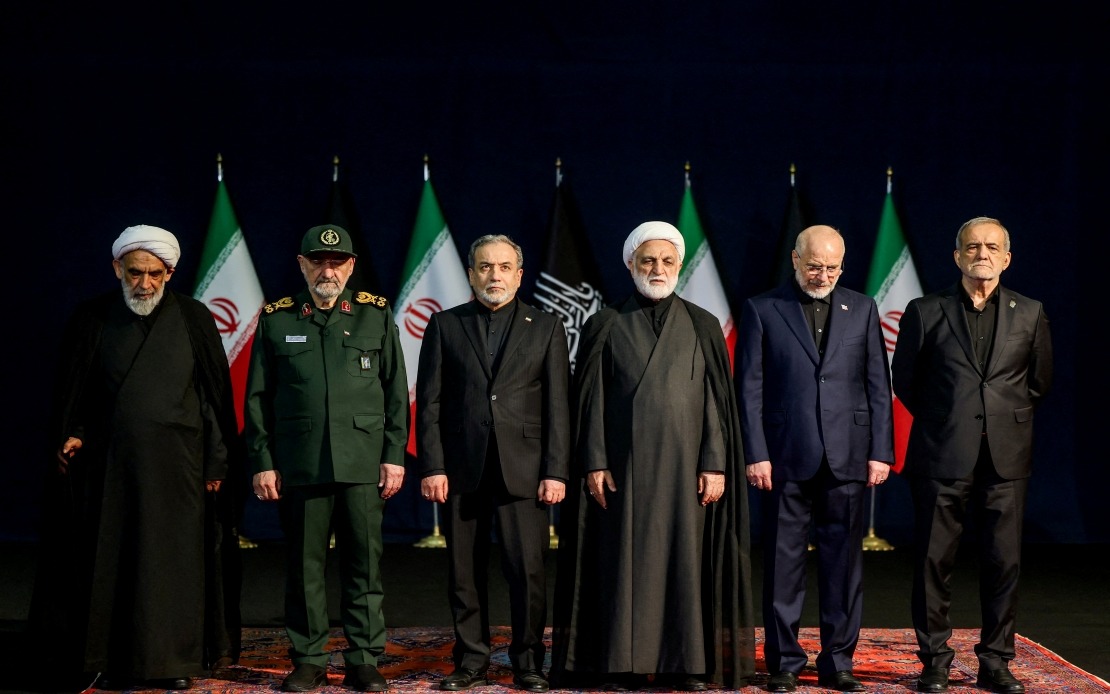
A massive state funeral ceremony drew senior government figures and foreign dignitaries to Tehran on Friday as Iran formally honoured its late Supreme Leader Ayatollah Ali Khamenei. The tribute, held at Imam Khomeini's Mosalla prayer hall in central Tehran, underscored the prominent international dimension of Iran's internal power succession and the broader regional implications of the country's leadership transition. Proceedings began in the morning and extended throughout the day, reflecting the scale and solemnity of an event marking the passing of a figure who wielded supreme authority for over three decades across Iran's political, military, and religious institutions.
The Iranian state leadership turned out in full, with President Masoud Pezeshkian, Parliament Speaker Mohammad Baqer Qalibaf, Judiciary Chief Gholamhossein Mohseni-Ejei, and Chairman of the Expediency Discernment Council Sadeq Amoli Larijani all present. Their attendance symbolised the continuity of state functions during the transition and reaffirmed the legitimacy of institutional processes governing Iran's top-down political system. Beyond formal officials, religious scholars, tribal leaders, and other figures wielding cultural and religious authority participated, reflecting the ceremony's importance to Iran's diverse constituencies and the interlocking of temporal and spiritual authority that characterises Iran's governance model.
The international representation proved particularly telling about Iran's standing within its regional networks and its diplomatic outreach beyond traditional allies. Pakistan's government sent Prime Minister Shehbaz Sharif alongside Chief of Army Staff Field Marshal Syed Asim Munir, signalling Islamabad's recognition of Tehran's continued strategic weight despite international isolation and recent security turbulence. Armenia's Prime Minister Nikol Pashinyan and Georgia's President Mikheil Kavelashvili attended, indicating Iran's significance to Caucasian states navigating complex relationships with Russia, Turkey, and Western powers. Iraqi leadership presence was substantial, with President Nizar Amedi and Kurdistan Region President Nechirvan Barzani both attending—a gesture acknowledging Iraq's dependence on Iranian support and Iraq's own internal balance between Baghdad's fragile federal government and regional Kurdish autonomy.
Tajikistan's President Emomali Rahmon participated, reflecting Iran's ongoing engagement with Central Asia despite geographical distance. Representatives from China and Russia, Iran's principal strategic partners against Western pressure, also attended at senior levels. This constellation of mourners demonstrated Iran's persistent regional influence and its ability to convene state actors across cultural, religious, and geopolitical boundaries despite decades of Western sanctions and isolation. The funeral thereby functioned as both a commemoration and an implicit reassertion of Iran's place within regional and global systems.
Khamenei's death resulted from a devastating drone strike in Tehran on February 28 that targeted his convoy in a coordinated operation attributed to the United States and Israel. The strike marked an extraordinary escalation in the long-running shadow conflict between Iran and these two powers, demonstrating vulnerabilities in Iran's air defence systems and raising profound questions about regime security that persist even after his death. The scale of the ceremony and security precautions surrounding it reflected Iranian authorities' determination to project stability and continuity despite the trauma of his assassination and the vulnerability it exposed.
The succession process moved with remarkable speed, indicating that contingency planning had been thorough. Mojtaba Khamenei, the late Supreme Leader's son, was selected as his successor in March, accelerating a transition that observers had anticipated might be contested or protracted. The selection of a family successor rather than an institutional or collegial alternative represented a significant centralisation of authority and raised questions about whether the new leader possessed the networks, revolutionary credentials, and diplomatic experience necessary to manage Iran's complex internal factions and external challenges. His assumption of power nevertheless proceeded without visible institutional resistance or public turmoil.
Funeral rites will continue through July 9, with major processions scheduled for Tehran, Qom, and Mashhad—cities carrying immense religious significance within Shia Islam. Additional ceremonies are planned in Iraq, reflecting the profound interconnection between Iranian and Iraqi Shia communities and Khamenei's standing as a religious authority across national boundaries. These extended observances serve practical functions in allowing mass public participation and demonstrating continuity of state authority across Iran's geography.
Tehran and Mashhad have been placed under airspace restrictions and public closures on designated dates, while Thursday was declared a national day of mourning. Such measures reflect concerns about security and crowd management during a period of heightened emotional and political intensity. They also enable the state to control narratives about grief and commemoration, ensuring that public expressions of mourning align with official messaging about stability and institutional resilience.
For Malaysia and other Southeast Asian states, the ceremony and succession carry significance beyond its immediate Iranian context. Iran remains a consequential actor in global energy markets, regional security architecture in the Middle East and beyond, and ongoing great-power competition. The succession to Mojtaba Khamenei will shape whether Iran moderates its regional interventionism or intensifies it, how vigorously it pursues nuclear and missile capabilities, and whether it seeks diplomatic openings with adversaries or hardens its confrontational posture. These trajectories have implications for international stability, oil markets, and the broader geopolitical environment within which Southeast Asian nations pursue their strategic interests and economic partnerships. The breadth of international participation in the funeral ceremony signals that multiple powers remain engaged with Iran's evolution, suggesting that the succession will be watched closely by regional and global observers attempting to forecast Iran's future direction.

