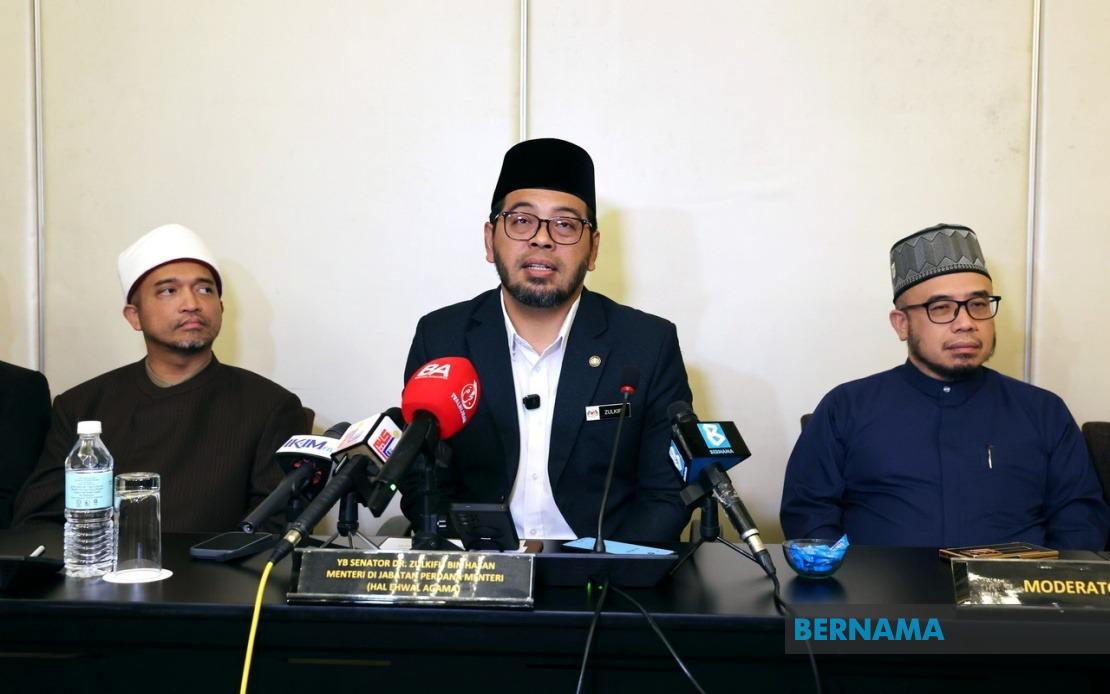
Religious Affairs Minister Dr Zulkifli Hasan has rejected the applicability of the term "kafir harbi" within Malaysia's social and legal framework, arguing that all citizens operate under the obligations and protections of the Federal Constitution. Speaking in Putrajaya on August 10, the Minister in the Prime Minister's Department (Religious Affairs) drew on conclusions from a specialised roundtable forum convened to examine the controversial terminology and its relevance to contemporary Malaysian society.
The roundtable discussion, titled "'Kafir Harbi' in Malaysia: A Discussion," brought together stakeholders to analyse whether this classical Islamic jurisprudential term—which denotes hostile non-believers—holds validity within a multicultural, constitutional democracy. The deliberations produced a consensus that the label carries no legitimate application in the Malaysian context, where citizenship itself establishes a binding relationship between individuals and the state that supersedes religious classifications.
Zulkifli elaborated on the fundamental principle underpinning this position: Malaysia's constitutional framework creates a unified civic order in which all residents, regardless of faith, assume equal responsibilities as fellow citizens and inhabitants of a shared homeland. This constitutional anchoring creates mutual obligations and rights that render external religious categorisations of hostility both legally irrelevant and normatively inappropriate. The minister emphasised that invoking such terminology against Malaysian citizens contradicts the basic premise of constitutional citizenship and national solidarity.
The Department of Islamic Development Malaysia (JAKIM) will assume a coordinating role in amplifying this message across government and civil society, partnering with allied agencies and ministries to mount a comprehensive public education campaign. Rather than confining the initiative to religious authorities alone, the government intends to embed the counter-narrative across multiple institutional channels, reflecting an understanding that strengthening national integration demands whole-of-government engagement rather than sectoral responses.
This initiative reflects broader anxieties within the Malaysian establishment regarding communal discourse and the deployment of religious language in ways that could fracture national cohesion. The invocation of "kafir harbi" by certain actors—whether in religious sermons, online forums, or political rhetoric—has periodically surfaced as a flashpoint in Malaysian public conversation, particularly when directed at citizens of different faiths or perceived religious heterodoxy. Such usage threatens the implicit social compact that underpins Malaysia's plural architecture: that citizens voluntarily accept constitutional constraints on sectarian expression in exchange for religious freedom and communal accommodation.
The minister's pronouncement gains significance against the backdrop of Malaysia's delicate religious demographics and historical constitutional design. The Federal Constitution recognises Islam's special position while simultaneously guaranteeing freedom of religion for adherents of other faiths. This equilibrium depends partly on restraint in how religious actors and authorities frame relationships between communities. When terminology rooted in historical Islamic jurisprudence—designed for contexts of actual armed conflict between Muslim and non-Muslim polities—becomes weaponised in domestic political or social contexts, it threatens to recast citizens of different faiths as external threats rather than co-members of a constitutional community.
The roundtable's conclusions implicitly reject interpretive frameworks that treat Malaysia's religious and ethnic composition as a zero-sum conflict requiring defensive theological posturing. Instead, they affirm a constitutional patriotism in which shared allegiance to national institutions and shared investment in national development override religious difference. This framing aligns with official Malaysian policy articulations emphasising unity in diversity and the primacy of constitutional order over sectional identities.
Zulkifli's call for intensified collaborative outreach indicates that government officials perceive a genuine need to reshape public understanding of both citizenship and appropriate religious discourse. The systematic public awareness campaign JAKIM will undertake suggests that ad-hoc rebuttals have proven insufficient; instead, proactive norm-setting across educational, media, and religious channels will endeavour to establish "kafir harbi" as a term foreign to Malaysian civic vocabulary. This reflects recognition that terminology itself shapes how citizens think about one another and about the boundaries of legitimate political and social expression.
The minister's broader exhortation to Malaysians—urging unity, fraternity, mutual respect, and cultural-religious understanding—situates the "kafir harbi" intervention within a larger project of ideological renewal centred on constitutional patriotism and civic nationalism. By repositioning religious diversity from a source of threat requiring theological boundary-maintenance into an asset requiring mutual appreciation, the government hopes to reorient both elite and popular discourse toward integrative rather than divisive framings.
For Malaysia and comparable Southeast Asian polities grappling with religious pluralism and communal stability, this intervention carries methodological significance. It demonstrates an institutional attempt to manage how classical religious concepts migrate into contemporary political contexts, and to establish legal and constitutional order as the primary frame for citizenship rather than allowing sectarian theological categories to govern interpersonal and civic relations. The success of this recalibration will depend substantially on whether the message permeates beyond government circles into grassroots religious leadership, educational institutions, and digital spaces where such terminology circulates.

