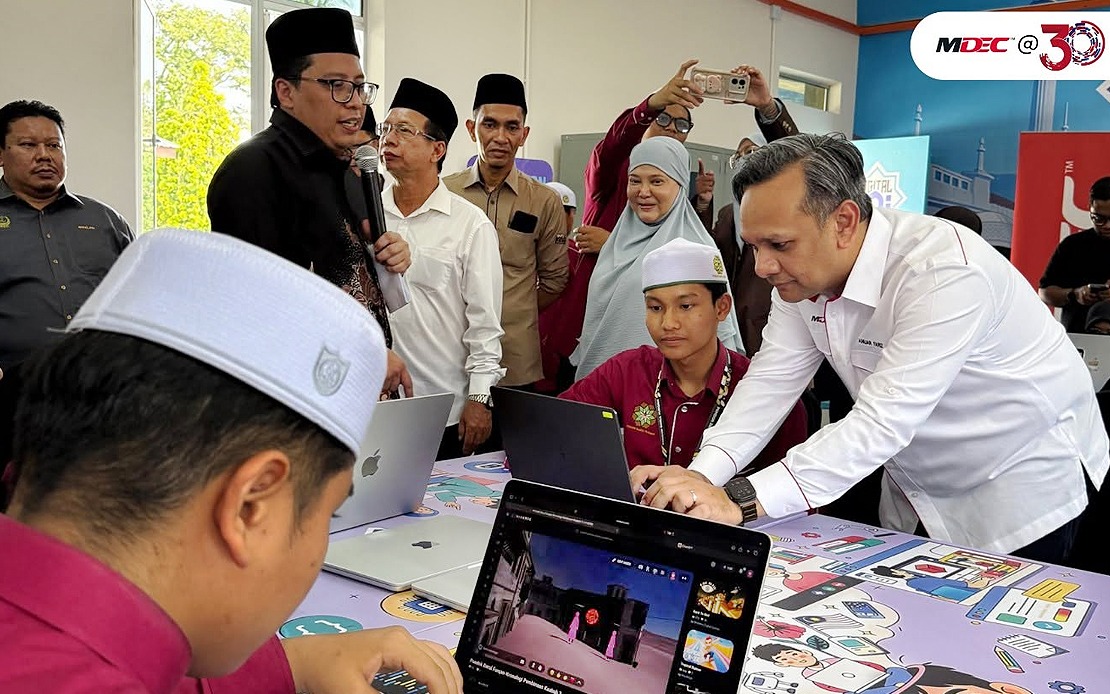
Pondok Darul Furqan, an Islamic boarding school in Tambun near Ipoh, has become the latest recipient of a Digital Maker Hub established by the Malaysia Digital Economy Corporation (MDEC), marking an expansion of technology access into Malaysia's Islamic education sector. The handover represents a significant step in bridging the digital divide within institutions that serve thousands of students across the country, many of whom have historically had limited exposure to cutting-edge technological tools and platforms. The facility aims to democratise access to digital learning opportunities in a sector that traditionally emphasises religious scholarship alongside academic subjects.
The Digital Maker Hub functions as a dedicated interactive learning environment stocked with contemporary equipment designed to introduce students and educators to practical applications of modern technology. Facilities within the space include personal computers with reliable internet connectivity, interactive smartboards suitable for collaborative learning, robotics construction kits that teach engineering principles through hands-on assembly, and microcontroller platforms that demystify the basics of automation and computational thinking. This comprehensive approach ensures that learners encounter technology not as abstract theory but as tangible tools they can manipulate, test, and refine—a pedagogical shift that resonates with current global best practices in STEM education.
Anuar Fariz Fadzil, chief executive of MDEC, articulated the strategic rationale underpinning the initiative during the facility's launch. He emphasised that Malaysia's trajectory toward becoming an AI-enabled economy by 2030 requires talent development mechanisms that span across all educational pathways and demographic groups, including institutions focused on Islamic scholarship. Concentrating digital training exclusively in mainstream schools would leave significant portions of Malaysia's youth population unprepared for a technology-driven economic landscape. By extending opportunities into the pondok system—which educates a meaningful share of Malaysian children—the government signals recognition that economic transformation depends on inclusive capability-building across diverse educational traditions.
The Digital Maker Hub rollout occurs under the umbrella of the Islamic Education Institution Digital Transformation Programme, known locally as Digital IPI, a collaborative initiative between MDEC and the Department of Islamic Development Malaysia (JAKIM). This partnership framework is essential because it ensures cultural and religious sensitivity in how technology is presented and integrated, avoiding potential tensions between pedagogical innovation and traditional religious instruction. Rather than imposing external models, the programme seeks to demonstrate how digital tools can enhance and support Islamic learning objectives, creating synergies rather than friction between these domains.
The metaverse emerged as a particular focus during the launch event, with 30 students and five teachers from Pondok Darul Furqan participating in a two-day MetaSkool Metaverse Programme. This immersive initiative introduced participants to virtual reality concepts and three-dimensional digital environments through experiential activities designed to spark creative problem-solving and innovation. Exposure to metaverse technology at this stage in students' academic journeys positions them to think imaginatively about emerging digital frontiers, potentially inspiring future entrepreneurs and technologists. The programme's emphasis on hands-on exploration rather than passive instruction aligns with contemporary learning science research demonstrating superior retention and engagement through interactive experience.
Under the current pilot phase, four additional Islamic education institutions across different Malaysian states are receiving identical Digital Maker Hubs. The geographical spread—encompassing Kedah, Kelantan, Negeri Sembilan, Pahang, and Penang—reflects a deliberate strategy to test and refine the model across diverse regional contexts before potential nationwide expansion. This measured rollout allows MDEC to gather data on implementation challenges specific to different regions, institutional capacities, and student populations, ensuring that scaling maintains quality and cultural appropriateness. The inclusion of institutions in East Coast states historically less integrated into Malaysia's urban digital economy suggests particular attention to reducing geographic disparities in technology access.
The broader Digital IPI programme, which Prime Minister Datuk Seri Anwar Ibrahim launched in March, targets considerably greater reach than the initial facility handovers. The initiative projects benefiting over 3,000 students and 50 teachers through structured training modules encompassing digital literacy fundamentals, artificial intelligence principles, creative digital content production, immersive technology platforms, and metaverse applications. This curriculum breadth indicates a sophisticated understanding that modern digital fluency encompasses not merely technical operation of tools but creative production, critical evaluation of AI systems, and ethical engagement with emerging technologies.
Integrating values-based instruction with technology education represents a distinctive feature of the Digital IPI approach. Rather than treating religious education and digital skill development as separate spheres, the programme consciously explores how universal values including trustworthiness, integrity, and social responsibility can be modelled and reinforced through technology-mediated learning. This integration is pedagogically sound and practically important; it positions technology not as morally neutral infrastructure but as a domain where values matter profoundly—a message increasingly urgent in societies grappling with misinformation, algorithmic bias, and digital ethics challenges.
For Malaysia, this initiative carries implications beyond immediate skills development. The regional context matters significantly; Southeast Asian nations compete intensively for digital talent and investment, with Thailand, Vietnam, and Indonesia all advancing their own technology transformation agendas. By ensuring that talent development reaches traditionally underserved educational populations, Malaysia strengthens its human capital base relative to regional competitors. Additionally, inclusive digital upskilling may contribute to social cohesion by demonstrating that technology opportunities benefit all communities, including those centred on religious institutions and values.
The practical challenges of implementation should not be understated. Ensuring that pondok teachers, often trained primarily in religious scholarship, develop sufficient confidence and competence with advanced technology requires sustained professional development beyond the initial facility handover. Internet reliability in some regional locations may constrain the utility of cloud-based applications. Student digital literacy varies considerably, potentially requiring differentiated instructional approaches. MDEC's partnership with JAKIM suggests awareness of these complexities, yet success will depend on adequate ongoing support and realistic expectations about adoption timelines.
Looking forward, the Digital IPI model could inform how other educational sectors integrate emerging technologies. Agricultural schools, vocational institutions, and community learning centres might benefit from similar infrastructure investments paired with values-aligned curriculum frameworks. The notion that digital transformation need not override cultural or religious identity but can instead complement and strengthen it offers a template for inclusive innovation—particularly relevant in a multicultural society navigating rapid technological change. If the pilot phase demonstrates robust outcomes across participating institutions, expansion would represent a strategic commitment to ensuring that Malaysia's AI Nation ambitions are genuinely inclusive rather than concentrated among already-privileged populations with early technology access.

