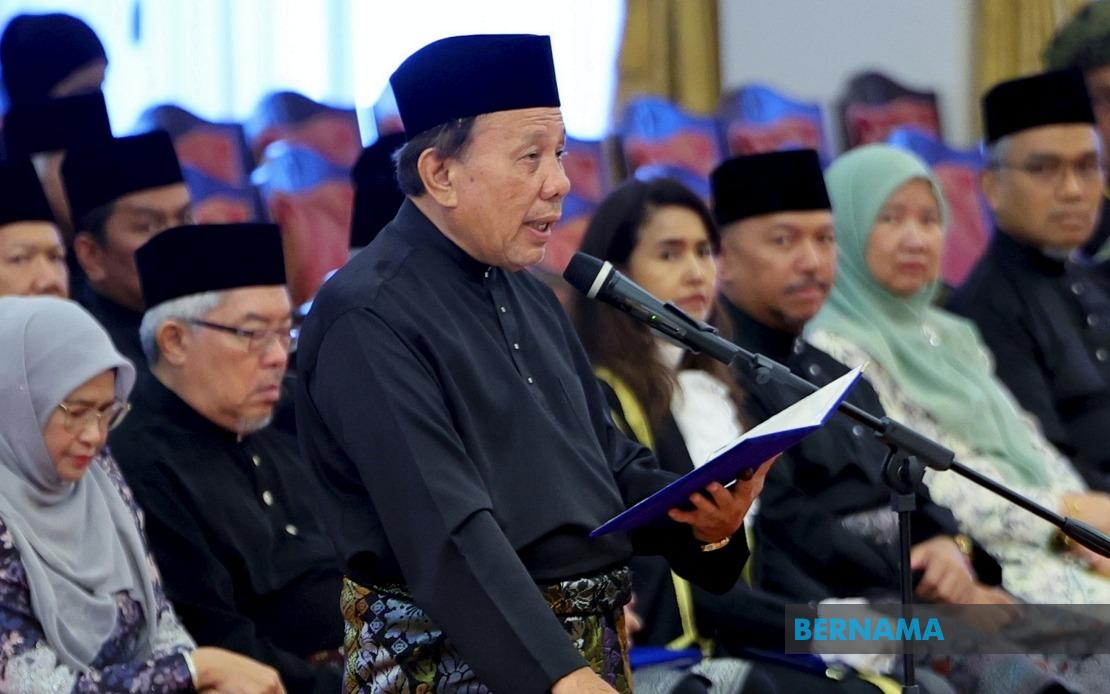
Datuk Ismail Lasim formally assumed office as Negeri Sembilan Menteri Besar on August 2, taking his oath before Tuanku Muhriz Tuanku Munawir at Istana Besar Seri Menanti in Kuala Pilah. The swearing-in ceremony marked the beginning of his administration following the state's 16th election, with Ismail emphasising that the electoral outcome represented both an honour and a weighty obligation to serve the people with integrity and competence.
In his inaugural address, Ismail characterised the public mandate as extending far beyond symbolic recognition. He articulated that the confidence invested in him by voters constituted a binding commitment to demonstrate that government functions effectively when grounded in principles of diligence, genuine responsiveness to citizen concerns, and operational fairness. This framing positioned his administration's legitimacy not merely on winning an election, but on the continuous demonstration of accountable governance throughout his term.
Central to Ismail's stated vision is a commitment to preserving Negeri Sembilan's distinct constitutional and customary heritage. He specifically referenced Adat Perpatih, the state's indigenous governance framework built upon consensus-based decision-making, equitable distribution of authority, social cohesion, and collective wisdom. By anchoring his administrative programme to these principles, Ismail signalled continuity with the state's historical institutional fabric while positioning modernisation within a traditionally-rooted context.
The new Menteri Besar outlined an economic and social development agenda spanning multiple sectors. His priorities encompass economic diversification through attracting quality foreign and domestic investment, expanding employment pathways, raising living standards, and enhancing service delivery in education, healthcare, housing, agriculture, and social support systems. Notably, Ismail emphasised that rural communities must participate equally in development dividends, implicitly addressing potential urban-rural imbalances that have characterised some Malaysian states' growth trajectories.
Ismail's conception of progress diverges meaningfully from narrow infrastructure and gross domestic product metrics. He articulated that genuine advancement requires simultaneous attention to human wellbeing, interethnic and interfaith harmony, institutional robustness, and public confidence in governmental and administrative systems. This broader framework acknowledges growing Malaysian discourse questioning whether conventional economic growth translates into meaningful quality of life improvements, particularly for lower and middle-income citizens.
Operationally, the incoming administration committed to institutionalising trust, integrity, efficiency, and transparency across state governance structures. Ismail pledged to strengthen the civil service as an institution characterised by professional standards, dedication to duty, and genuine accountability to public interest rather than factional interests. This emphasis on bureaucratic excellence carries significance in the Malaysian context, where civil service politicisation and inconsistent service quality remain contentious issues across states.
Ismail further committed to fostering consensus-based decision-making and demonstrated receptiveness to constructive opposition input. By explicitly valuing dissenting voices and critical feedback, he positioned his administration as confident enough to engage substantively with alternative perspectives rather than retreating into defensive partisanship. This approach potentially differentiates his governance model and addresses widespread citizen frustration with administrations perceived as dismissive of legitimate criticism.
The new Menteri Besar emphasised strengthening collaborative relationships across institutional boundaries: between state and federal governments, between political and royal institutions, between the public sector and private business community, and between government and civil society. This multi-stakeholder approach acknowledges that state-level challenges require coordinated responses transcending single-institution capabilities, particularly given overlapping federal and state jurisdictional responsibilities in Malaysia's constitutional structure.
Ismail's recognition of his predecessor Datuk Seri Aminuddin Harun's contributions reflects diplomatic awareness that administrative transitions succeed when prior administrations' development foundations receive acknowledgment rather than dismissal. By framing Negeri Sembilan's accumulated infrastructure and policy progress as a platform for continuity and advancement rather than as requiring wholesale rejection, Ismail signalled potential for bipartisan cooperation on state development regardless of electoral competition.
For Negeri Sembilan specifically, Ismail's administration confronts the twin imperatives of sustaining recent economic growth while addressing persistent disparities in service access and opportunity distribution between the state's developed areas and peripheral districts. The new leadership's success will depend substantially on translating rhetorical commitments to transparency and people-centredness into concrete policy outcomes and visible resource allocation benefiting communities that may previously have felt marginalised from state development initiatives.
The broader Malaysian context renders this transition significant beyond Negeri Sembilan's borders. As states experiment with governance models and administrative philosophies, other administrations observe approaches demonstrating success or failure in delivering transparent, responsive governance. Ismail's emphasis on customary institutional frameworks grounded in consensus potentially offers a model balancing modernisation with cultural preservation, relevant to other Malaysian states navigating identity and development tensions.
Ismail's inaugural commitments ultimately represent early indicators rather than guarantees of performance. The critical test will emerge through subsequent months as stated principles encounter practical governance challenges: budgetary constraints, competing stakeholder interests, bureaucratic inertia, and inevitable controversies requiring difficult political choices. How his administration navigates such inevitable tensions between idealistic governance rhetoric and pragmatic administrative reality will ultimately define his tenure's substantive legacy.

