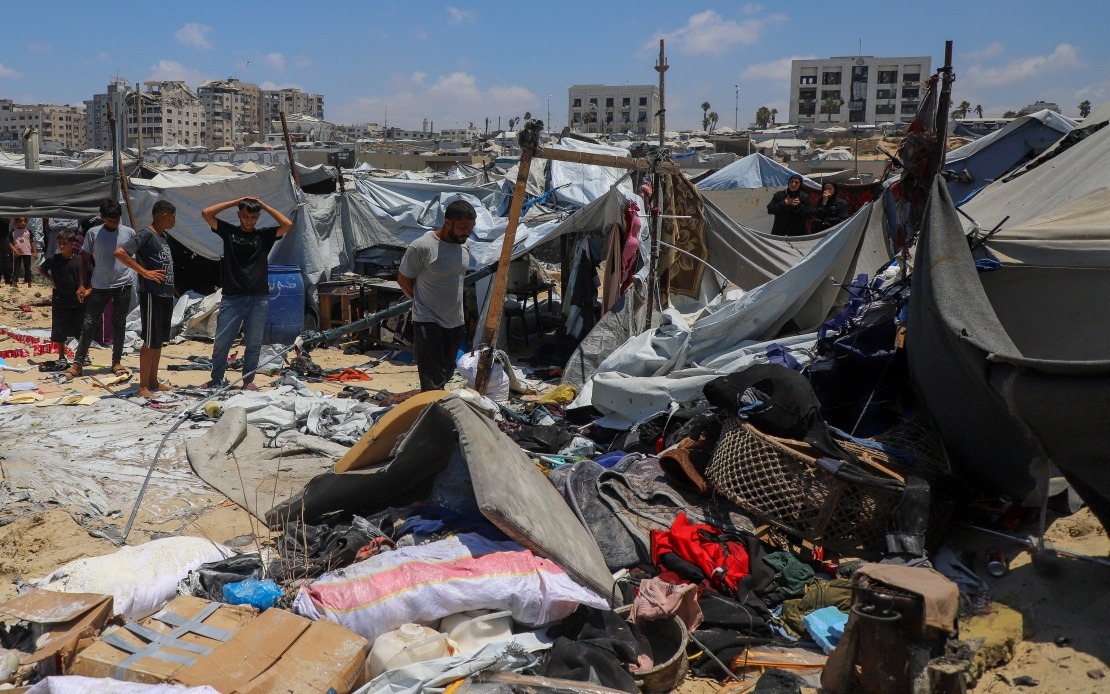
According to a weekly situation report issued by the Palestinian Government Communication Centre, Israeli military operations have devastated the Gaza Strip at an unprecedented scale, with destruction estimates exceeding 90 per cent of the enclave. The assessment, released on Monday and covering the period from June 29 to July 6, indicates that occupation forces now maintain control over roughly 80 per cent of the conflict-affected territory, fundamentally altering the operational landscape across the region.
The intensification of Israeli military activities during the documented week focused particularly on Khan Younis, Rafah, and Gaza City, where coordinated operations resulted in documented civilian fatalities. Medical sources within Gaza reported eight Palestinians killed during this seven-day period alone, a figure that reflects the ongoing toll of military engagements across population centres. Beyond direct combat operations, the report documented systematic destruction of civilian infrastructure, with residential neighbourhoods subjected to artillery bombardment and residential structures demolished, forcing additional Palestinian families to abandon their homes and seek refuge in already overcrowded displacement camps.
The West Bank has simultaneously experienced escalating military pressure, with occupation forces conducting widespread raids across multiple Palestinian population centres. These operations involved forced entry into homes, detention of residents, and the imposition of movement restrictions across key Palestinian urban areas including Ramallah, Nablus, Hebron, Bethlehem, Jenin, Qalqilya, Tulkarem, and occupied Jerusalem. Road closures have further constrained Palestinian mobility and economic activity, creating a complex security environment that extends beyond direct conflict zones.
Beyond formal military operations, the report highlighted systematic attacks perpetrated by Israeli colonial settler militias operating across the occupied territories. These incidents reflect a pattern of coordinated or tolerated violence targeting Palestinian communities and property. Documented incidents included arson attacks on Palestinian civilian infrastructure, such as a cafeteria facility in al-Lubban ash-Sharqiya, physical assaults on Palestinian shepherds near Bethlehem, and attempted livestock theft. Village entrances have been blocked, restricting Palestinian access to essential services and markets.
The agricultural sector has emerged as a particular focal point of documented damage. The Palestinian Ministry of Agriculture released data indicating systematic targeting of agricultural livelihoods across the occupied West Bank. During the reporting period alone, approximately 2,559 olive trees were either uprooted, burned, or damaged beyond productive use. The Salfit, Jenin, and Nablus governorates bore the heaviest impact, with regional agricultural economies severely disrupted. At least 125 farming families experienced direct economic losses, with documented damages totalling approximately US$11.78 million. This destruction extends beyond immediate financial loss, threatening long-term food security and rural livelihoods in Palestinian communities where agriculture represents a critical economic foundation.
For Malaysian and Southeast Asian observers, these developments underscore the humanitarian dimensions of the Israeli-Palestinian conflict at a scale that has attracted increasing international attention. The comprehensive destruction documented in Gaza contrasts sharply with previous conflict phases and reflects a significant escalation in military intensity. The systematic nature of the destruction patterns, affecting civilian infrastructure, agricultural capacity, and residential areas, raises questions about proportionality and civilian protection standards that international humanitarian law frameworks are designed to address.
The parallel targeting of agricultural resources merits particular consideration within the Malaysian context, where agrarian communities maintain significant political and social weight. The destruction of olive groves and farming infrastructure represents not merely economic loss but an assault on Palestinian rural cultural heritage and food-producing capacity. For agricultural societies across Southeast Asia, such targeting demonstrates the vulnerability of farming populations during conflict and the long-term development implications of systematic agricultural destruction.
The maintenance of control over 80 per cent of Gaza territory by occupation forces indicates a fundamental shift in the operational environment, with implications for humanitarian access, civilian movement, and the provision of essential services. The territorial control factor compounds the effects of infrastructure destruction, potentially creating a situation where the combination of physical devastation and military occupation severely constrains Palestinian recovery and reconstruction capacity. This pattern of control combined with destruction creates distinct challenges for post-conflict rehabilitation and development.
The documented toll on civilian populations, extending from Gaza through the West Bank and encompassing both formal military operations and settler militia activity, reflects the geographically dispersed nature of current tensions. The coordination of operations across multiple Palestinian territories suggests a comprehensive military and security posture that extends beyond tactical responses to specific incidents. For regional observers, these patterns demonstrate how the Israeli-Palestinian conflict continues to create humanitarian challenges affecting multiple Palestinian communities simultaneously.
The Palestinian Government Communication Centre's systematic documentation of these incidents represents an attempt to create an official record of destruction and military activity. The specificity of the agricultural data—precise tree counts, farmer numbers, and documented financial losses—reflects a methodical approach to quantifying conflict impacts. Such documentation carries significance for potential future accountability mechanisms and international advocacy, while also establishing baseline data regarding the scale and nature of current destruction patterns across Palestinian territories.

