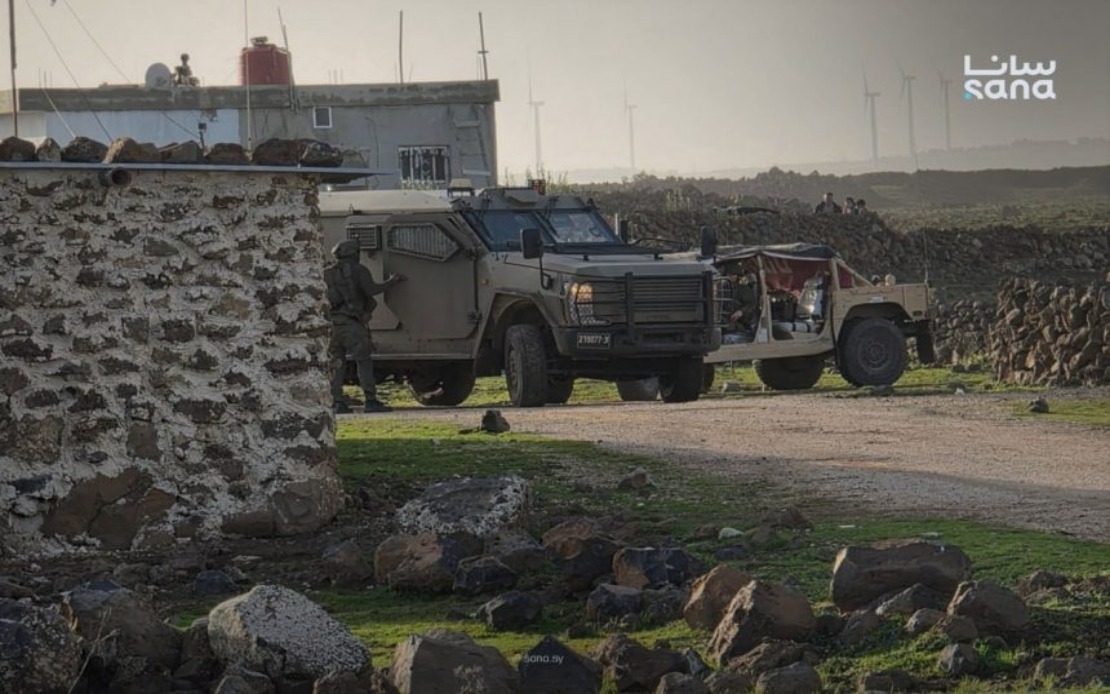
An incursion by Israeli military forces into Syrian territory on Saturday underscores escalating security concerns in the Middle East's southwestern borderlands. According to reports from Syria's state news agency SANA, a contingent of six Israeli military vehicles penetrated Syrian airspace in the southwestern Quneitra province, advancing toward the Kudna Dam region in central Quneitra while unmanned aerial systems conducted concurrent operations overhead. The operation represents the latest in a series of deliberate crossings that have intensified significantly since the collapse of Bashar al-Assad's government in December 2024.
The strategic significance of the Quneitra province lies in its historical position as a demilitarized buffer between Israeli-controlled territories and Syrian lands. For decades, the 1974 disengagement agreement established by the United Nations maintained a fragile separation, with Israeli forces observing strict boundaries. The Assad regime's unexpected fall fundamentally altered this geopolitical equilibrium, prompting Israel to formally withdraw from the 1974 agreement and assert control over the buffer zone—actions that have since provided the legal and military justification for expanded operations within Syrian territory.
Since the December 2024 regime change, southern Syria has become a focal point of repeated Israeli military activities. These incursions extend well beyond occasional border crossings and now encompass a comprehensive pattern of enforcement operations. Israeli forces have conducted systematic raids targeting specific locations, executed searches of civilian areas, carried out mass arrests of suspected combatants or opposition figures, and established a network of military checkpoints throughout the region. This multifaceted approach suggests a strategy aimed at establishing effective ground control and preventing any potential threat to Israeli security from emerging within Syrian territory.
The use of unmanned drones during Saturday's operation reflects modern military doctrine, where aerial surveillance complements ground force movements. The deployment of both vehicles and airborne assets simultaneously indicates a coordinated, comprehensive approach to monitoring and potentially controlling the Kudna Dam area and its surroundings. For Malaysian policymakers and analysts observing Middle Eastern developments, this demonstrates how technological advancement enables even smaller military forces to project significant capabilities across disputed territories.
The broader context of these violations reveals a calculated erosion of Syrian sovereignty at a particularly vulnerable moment in the nation's history. With the Assad regime no longer in place and the country's governmental structure in flux, traditional mechanisms for international complaint and diplomatic redress have proven ineffective. The international community, while noting these incidents through various news agencies, has largely proceeded without substantive intervention, effectively allowing Israeli military activities to proceed with minimal external constraints.
For Southeast Asian nations, particularly Malaysia, these developments carry important implications beyond the immediate Israeli-Syrian context. The incident exemplifies how state collapse can create power vacuums that stronger regional actors exploit to advance their strategic interests. It also demonstrates the vulnerability of international agreements—the 1974 disengagement accords, established through United Nations mediation, dissolved almost immediately upon regime change, suggesting that formal treaties offer limited protection when one party determines that underlying political conditions have fundamentally shifted.
The intensification of Israeli operations in southern Syria also reflects broader regional realignments. With the Assad government's departure, the regional balance of power has shifted dramatically. Sunni-majority opposition forces and various armed groups now control significant portions of Syrian territory, creating uncertainty about which entities might emerge as dominant power brokers. In this transitional environment, Israel has determined that proactive military operations serve its security interests better than maintaining a passive posture along its borders.
The Kudna Dam represents a strategically important water resource within the region. Control or monitoring of such infrastructure can provide significant leverage over local populations and potentially over downstream communities depending on water flows. Israeli interest in this particular location suggests calculations extending beyond immediate security concerns to longer-term influence over critical resources in post-Assad Syria.
International responses to these incursions have been subdued, with SANA reporting the incidents but without apparent diplomatic escalation or coordinated international pressure on Israel to cease operations. This pattern reflects the limited capacity of Syria's interim authorities to command international attention or invoke protective mechanisms. The absence of significant international intervention creates space for Israeli operations to continue essentially unchallenged.
Malaysian observers should note that these developments occur against a backdrop of broader Middle Eastern instability. Syria's internal reconstruction phase will likely last years, during which external powers may exploit internal divisions to advance their interests. The pattern established in Quneitra province may serve as a template for other regional actors contemplating interventions within Syrian territory.
Looking forward, the trajectory of Israeli-Syrian interactions will depend partly on the pace at which Syria's internal political situation stabilizes and partly on whether any new Syrian government commands sufficient international standing to demand adherence to sovereignty principles. The current situation demonstrates that military power, rather than international law or established agreements, increasingly determines outcomes in contested border regions. For Southeast Asia, closely monitoring such dynamics provides instructive lessons about the enduring importance of maintaining strong state institutions and international alliances capable of defending sovereignty against more powerful neighbors.

