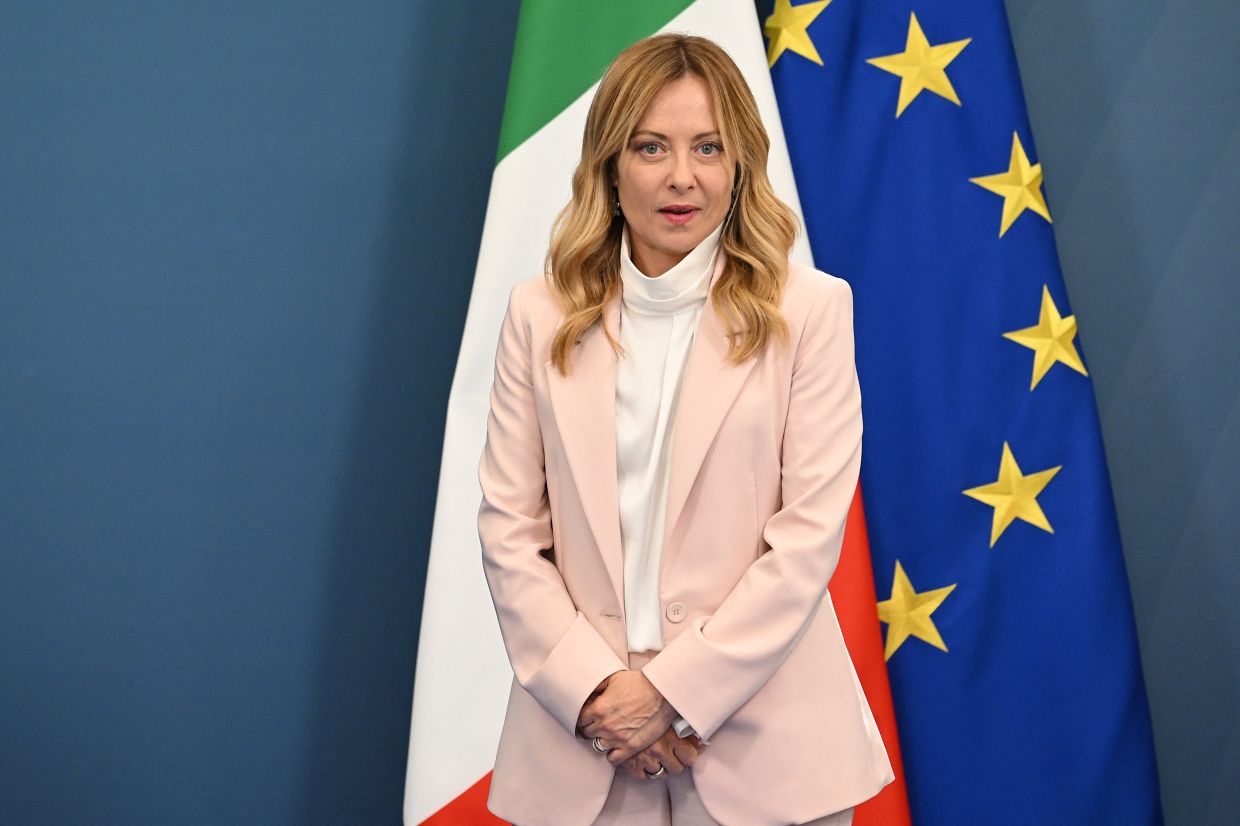
Italy's Prime Minister Giorgia Meloni has engineered a striking transformation in her public appearance that mirrors her political trajectory from combative outsider to seasoned, internationally engaged leader. The sartorial shift—from the uncompromising dark suits and sturdy black boots she wore upon taking office in October 2022 to today's softer palette of pastel-coloured ensembles with wide-legged trousers—represents far more than mere fashion preference. According to experts in the intersection of clothing and political communication, her wardrobe choices function as a carefully calibrated nonverbal vocabulary, allowing her to convey strength and competence whilst simultaneously projecting approachability and moderation to both domestic and international audiences.
When Meloni assumed the premiership nearly two years ago, her sartorial presentation explicitly invoked the aesthetics of her party's combative positioning on Italy's political right. The dark, severely cut clothing and industrial-style footwear served as visual shorthand for her background as a party leader for a smaller, more ideologically defined faction. Antonio Mancinelli, who teaches at Rome's Costume And Fashion Academy, explains that Meloni demonstrates sophisticated understanding of how clothing functions in political communication beyond words and rhetoric. Her evolving style choices reveal an acute awareness that how leaders present themselves physically carries meaning that voters and international partners unconsciously absorb and interpret.
The contrast between Meloni's current wardrobe and her earlier public persona could hardly be more pronounced. During a 1996 French television interview when she was nineteen years old, the young activist appeared dressed almost entirely in black, speaking as she organised right-wing youth movement members. Those appearances included controversial statements defending Benito Mussolini—comments that would resurface periodically to complicate her political narrative. The all-black aesthetic of her youth thus carried unmistakable historical baggage within the Italian context, where such imagery carries associations with the country's fascist past that remain deeply fraught culturally and politically.
Meloni's political positioning has shifted substantially since those early years. By the time Silvio Berlusconi appointed her youth minister in 2008, she had begun adopting more conventionally serious professional attire, typically dark suits paired with white shirts that signalled governmental responsibility without the harder edge of her earlier styling. This gradual evolution accelerated during her 2022 election campaign, when she began consciously broadening her appeal beyond her core ideological base. Her famous declaration of identity—"a woman, a mother, a Christian"—became a viral moment that helped her gain traction among conservative centrists uncomfortable with more extreme right-wing positioning.
As premier, Meloni has governed considerably less radically than many observers initially anticipated when her party's post-fascist roots became prominent in international coverage. Whilst maintaining conservative, anti-migrant domestic policies consistent with her party's platform, she adopted pragmatic engagement with the European Union rather than the antagonistic stance many had feared. She became one of Europe's strongest advocates for Ukraine following Russia's 2022 invasion, and she has demonstrated willingness to challenge American President Donald Trump publicly—positioning that has earned respect from European counterparts concerned about continental unity and transatlantic relationships.
This political moderation finds direct expression in her fashion choices. Lighter colours, according to Michela Bonafoni who teaches fashion at Unicollege in Florence, psychologically suggest loyalty, tenderness and gentleness to observers. By adopting pastel tones and more welcoming colour palettes, Meloni communicates something more than aesthetic preference; she projects an openness and accessibility that contrasts sharply with the harder visual language of her earlier career. The wide-legged trousers that now characterise her public appearances deliberately obscure her high heels—shoes that might otherwise be read as aggressive or attention-seeking. The overall effect, according to fashion analysts, conveys authority grounded in substance rather than confrontation.
The significance of Meloni's wardrobe choices gains additional weight from Italy's particular relationship with fashion and global perception. Italy's fashion industry remains a cornerstone of the national economy and a primary vehicle through which the country projects soft power internationally. For a female leader representing a nation famous for sartorial excellence, wardrobe decisions carry heightened stakes compared to male counterparts or leaders from nations with different fashion heritage. Stella Jean, an Italian-Haitian fashion designer, notes that when a woman leading a fashion-conscious country makes clothing choices, the issue transcends personal style into questions of national image and economic importance.
Political analyst Riccardo Alcaro of Italy's Institute For International Affairs contextualises the evolution within Meloni's changed circumstances. When she led a small right-wing party, she needed to project conviction and distinctiveness to a focused electorate seeking clear ideological signals. Now, as leader of a major European Union country, she must present herself as a credible government chief whose ideas merit serious engagement with international partners and diverse domestic constituencies. The wardrobe shift enables this repositioning by allowing her to maintain political substance and conservative credentials whilst visually signalling reliability, moderation and European institutional engagement.
Meloni's fashion evolution reflects broader patterns among world leaders who leverage clothing as political communication. Ukrainian President Volodymyr Zelenskyy has consistently worn military-style garments since Russia's invasion, visually reinforcing his role as wartime commander. British Prime Minister Andy Burnham has adopted casual jeans and t-shirts to communicate commitment to working-class concerns and governmental accessibility. Mexican President Claudia Sheinbaum wears dresses and blouses created by Indigenous artisans, using fashion to honour textile traditions and Indigenous communities. Yet Meloni's transformation carries particular resonance because it represents movement across the ideological spectrum—a softening of visual rhetoric that accompanies substantive policy moderation.
The deliberate nature of this sartorial shift remains somewhat opaque, as Meloni's office has declined to discuss her wardrobe choices or identify any fashion advisers. Nevertheless, fashion critics observing her appearance progression since October 2022 describe a coherent strategy rather than random variation. The shift toward tailored suits in muted tones began shortly after she assumed office, coinciding with her increasing visibility on the global stage. The evolution appears precisely calibrated to communicate the message that she represents serious, establishment governance rather than disruptive populism or ideological extremism.
Heading into the final year of her current mandate, Meloni faces mounting political pressure from rival right-wing figures seeking to position themselves as more authentically ideological than she has demonstrated herself to be. Whatever her sartorial choices, this rivalry will inevitably highlight how significantly she has moderated her positioning on various issues, disappointing some supporters who anticipated more radical governance. The contrast between her current pastel-suited presentation and the all-black aesthetic of her youth thus encapsulates a broader transformation that has made her simultaneously more acceptable to mainstream European partners whilst potentially more vulnerable to challenges from her political right.
Meloni's wardrobe evolution ultimately demonstrates how political leaders, particularly women, navigate the complex terrain where personal presentation intersects with substantive governance. Her shift from combative outsider styling to establishment moderateness reflected in softer, more welcoming fabrics and colour choices allows her to communicate transformation without explicitly renouncing earlier positions. The clothes she wears function as a visual argument about her fitness to lead a major European democracy—an argument that resonates particularly in Italy, where fashion remains both cultural priority and economic necessity.

