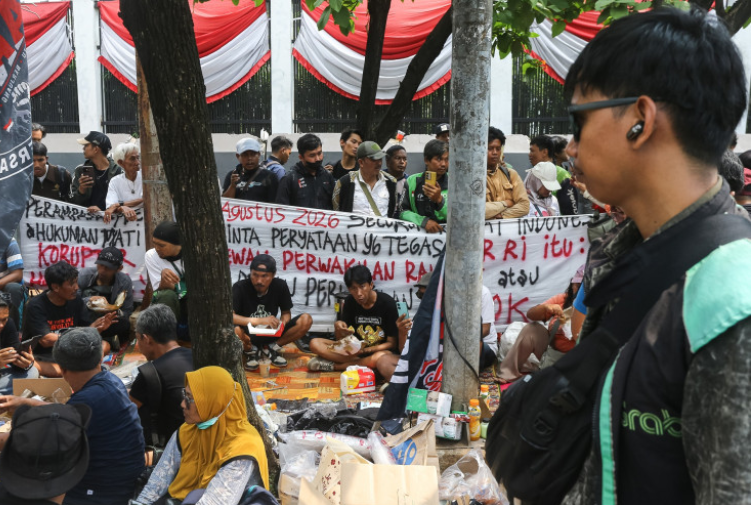
Hundreds of demonstrators gathered at the Senayan Legislative Complex in Central Jakarta on Thursday morning to pressure lawmakers into accelerating anti-corruption measures that have languished for over a decade. The protests, which drew groups from multiple regions including a substantial contingent from Pati in Central Java, represented an unusual show of public pressure on Parliament to finalise legislation designed to strip convicted and even suspected criminals of their illicitly gained wealth. Organisers united behind demands that ranged from capital punishment for corrupt officials to immediate passage of a controversial asset forfeiture bill, whilst also voicing grievances over rising prices for everyday goods that have squeezed household budgets across the archipelago.
The United Pati People's Alliance, which coordinated the demonstrations, had meticulously organised the mobilisation since the previous week, arranging multiple coach convoys to transport supporters to the capital. The group's determination became evident when several buses were intercepted by police during transit to Jakarta—a tactic designed to discourage participation. More significantly, the state-owned Bank Mandiri temporarily froze a bank account belonging to AMPB coordinator Supriyono, drawing fierce public backlash and calls for boycotts of the financial institution. Such measures typically signal government unease about grassroots organising, yet they paradoxically energised the movement. Supriyono defiantly announced that five additional buses would reach Jakarta through public donations, demonstrating how attempts to suppress the protests inadvertently strengthened their narrative.
Indonesian authorities mounted a substantial security operation to manage the demonstrations, implementing extensive traffic diversions throughout central Jakarta and deploying police contingents around Parliament. Officers blocked both directions of Jl. Gatot Subroto from Senayan Park to the legislative complex entrance, effectively cordoning off the area from regular traffic flow. Jakarta Police spokesperson Sr. Comr. Budi Hermanto estimated at least 500 protesters would participate, acknowledging that numbers might swell considerably as groups beyond Pati's organisers joined the action. The police messaging struck a familiar tone, pledging to maintain order while permitting peaceful protest, yet also cautioning demonstrators against damaging public infrastructure or disrupting commerce and education—a framework that balanced tolerance with the implied threat of intervention should matters escalate.
The asset forfeiture legislation at the centre of these demands represents an extraordinarily contentious piece of proposed law. First introduced in 2008 but perpetually stalled in legislative gridlock, the bill would grant authorities power to seize assets deemed proceeds of crime even before formal criminal conviction—a significant departure from traditional legal frameworks requiring guilt determination before asset confiscation. Advocates argue such measures accelerate recovery of stolen public wealth and deter corrupt officials who might otherwise shelter assets beyond state reach. Yet legal scholars and civil liberties groups have consistently warned that the mechanism carries serious risks of abuse, potentially weaponising state power against political adversaries or facilitating extortion by unscrupulous officials who might threaten asset seizure to extract bribes or silence critics.
Despite these concerns, parliamentary momentum appeared to be building in late August. The House of Representatives began formal deliberations in January and received delegations from Pati to discuss accelerating passage. Gerindra Party lawmaker Habiburokhman, chairing House Commission III responsible for legal affairs, declared that remaining deliberations required approximately eight weeks, targeting December completion. This optimistic timeline reflected genuine commitment from major parliamentary blocs to finalise the legislation, particularly given backing from the Prabowo Subianto administration. Government Communications Agency head Muhammad Qodari framed the matter as now residing squarely within Parliament's purview, suggesting the executive had fulfilled its advocacy role.
The convergence of grassroots protest and elite political backing created unusual alignment around an otherwise contentious proposal. For Malaysian observers, the Indonesian case illuminates broader Southeast Asian struggles with corruption management. Indonesia's constitutional framework and legal structures ostensibly provide tools for addressing official graft, yet implementation lags persistently behind statutory authority. The asset forfeiture bill, whatever its dangers, reflects genuine frustration that existing mechanisms prove insufficient for recapturing wealth already siphoned from public coffers. The ability of groups like AMPB to mobilise supporters effectively and translate street pressure into parliamentary attention suggests Indonesian civil society possesses organisational capacity that transcends rural-urban divides.
The targeting of AMPB's banking arrangements revealed government discomfort with the demonstrations' scale and coordination. Bank Mandiri's account freeze, whether initiated independently or through official suggestion, represented a high-handed response that backfired spectacularly. Public outcry over the move demonstrated that Indonesians increasingly recognise financial system manipulation as a form of political suppression. For Malaysian viewers, the incident underscores how state institutions can be weaponised against legitimate advocacy, and how such overreach often proves counterproductive by generating sympathy for protesters and highlighting their core claims about government overreach.
The economic grievances interwoven with corruption demands reflected broader Indonesian frustrations. Protesters' emphasis on basic commodity pricing acknowledged that abstract anti-corruption messaging resonates far more powerfully when linked to concrete impacts on purchasing power and living standards. This tactical framing recognised that ordinary citizens care most about how corruption filters downward through supply chains, into pricing mechanisms, and ultimately diminishes their buying capacity. The simultaneous demands for both asset forfeiture legislation and price controls reflected intuitive understanding that corruption and inflation intertwine within systems where officials gain from cartels and monopolies that restrict competition and inflate costs.
The timeline for legislative passage carried significance beyond Indonesia's borders. As the world's third-most-populous nation and Southeast Asia's largest economy, Indonesian policy developments influence regional approaches to governance and anti-corruption strategy. A successfully enacted asset forfeiture bill, assuming adequate safeguards against abuse, could establish precedent that regional neighbours evaluate for their own contexts. Conversely, passage without proper protections against weaponisation might discourage adoption elsewhere. The December target date set by Parliament placed the issue squarely within Prabowo's first administrative year, potentially establishing anti-corruption positioning as central to his governance narrative.
The Pati demonstrators' success in reaching the capital and commanding parliamentary attention, despite police obstruction and banking sanctions, suggested grassroots mobilisation capacity within Indonesia remains formidable. This capacity, when directed toward accountability demands and anti-corruption messaging, creates genuine pressure on lawmaking processes. For Southeast Asia more broadly, the Jakarta protest demonstrated that citizens increasingly expect their governments to move beyond rhetorical commitments to anti-corruption and enact substantive legislative measures, regardless of implementation risks. Whether the asset forfeiture bill ultimately strengthens governance or becomes corrupted itself will depend significantly on how thoroughly legislators address safeguards during the remaining deliberation weeks.

