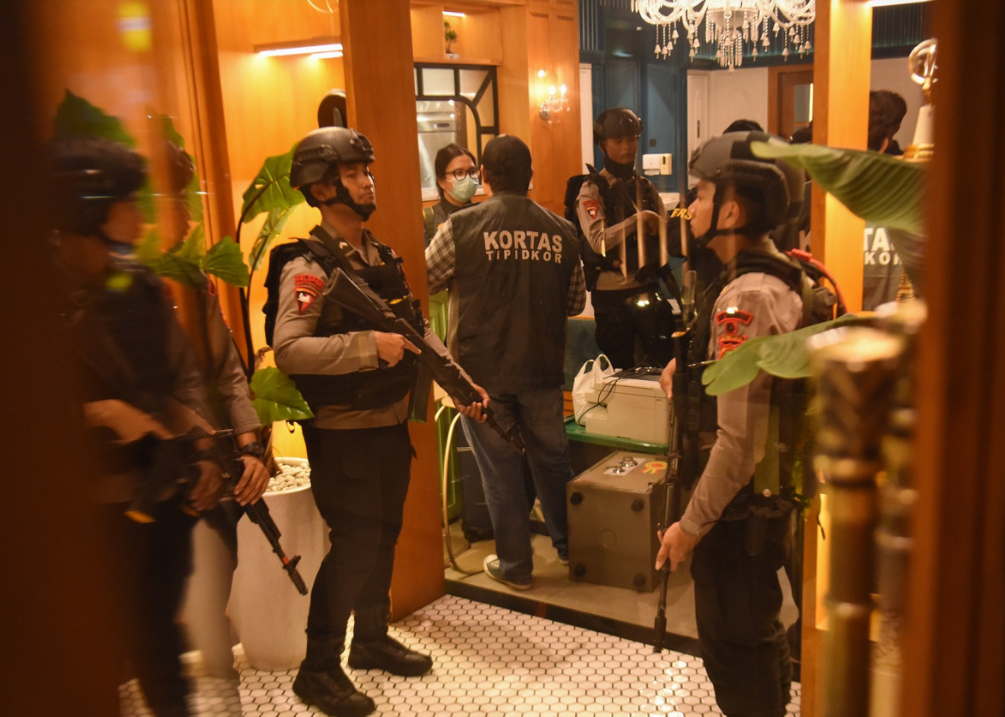
A dramatic sweep of high-value properties across Jakarta has exposed what may be one of Indonesia's most significant corruption scandals in recent years, with police discovering US$26.3 million in seized assets linked to a senior law enforcement official. The multi-location operation, which unfolded over a single night and into Thursday morning, targeted an array of commercial establishments and residential properties, revealing a network of concealed wealth that has raised urgent questions about governance and oversight within Indonesia's legal institutions.
The operation began when armed personnel from Jakarta's police force and the National Police's corruption crime corps, supported by heavily equipped Mobile Brigade units, descended upon de'Clan Signature, a restaurant in the Cipete district of South Jakarta. Working methodically through the upscale venue, officers located a safe hidden behind a cabinet containing documents and millions of dollars in mixed-currency cash. The scene, observed by startled patrons, set the tone for what would become an expansive investigation. Officers immediately moved to adjacent premises, accessing another vault at Koin Money Changer next door, which held substantial quantities of rupiah-denominated notes worth hundreds of thousands of dollars additional to what had already been discovered.
The most significant discovery emerged from a residence in Sentul, a verdant hillside suburb roughly an hour's drive south of Jakarta's central business district. Within the upscale property, authorities uncovered seven suitcases packed with 74 kilograms of gold bullion alongside additional cash reserves denominated in multiple foreign currencies. This haul alone accounted for the bulk of the total valuation announced by authorities. The residence belongs to Febrie Adriansyah, who until his recent resignation held the position of deputy attorney general specialising in special crimes, a role he had occupied for more than four years. Though now identified as a suspect in both corruption and money-laundering investigations, Febrie has not been detained and has maintained that while the Sentul property is indeed his, the discovered assets do not belong to him, suggesting their origins would only become clear through legal proceedings.
The visual documentation of the seizure—particularly photographs showing rows of gleaming gold bars and neatly stacked wads of currency displayed by authorities—has become the dominant narrative surrounding what observers are characterising as a watershed moment for Indonesia's law enforcement sector. These images circulated rapidly across local and national media platforms, cementing public perception of a scandal that touches the highest levels of the country's justice apparatus. The raids extended considerably beyond the initial locations, with police teams searching at least ten additional sites throughout Jakarta, ranging from the Pacific Place apartment complex near the stock exchange to various corporate offices and residential properties across the metropolitan area.
The investigation's geographical scope widened to include a residence in the Gandaria neighbourhood of South Jakarta, which authorities linked to Don Ritto, a legal practitioner who has also been identified as a suspect. Ritto, unlike Febrie, has reportedly been detained pending further proceedings. Corporate records examined by local journalists indicate that Ritto maintains business interests in entities connected to both the raided restaurant and the money changer, suggesting a possible network of financial relationships underpinning the operation.
The unfolding scandal has triggered intensive debate within Jakarta's legal and political circles regarding both the adequacy of existing anti-corruption mechanisms and the broader institutional health of Indonesia's law enforcement establishment. Some observers have suggested the seizures demonstrate that investigative apparatus and oversight systems are functioning as designed, successfully identifying and neutralising wrongdoing. Others, however, interpret the incident as symptomatic of persistent and perhaps deepening corruption problems that continue to plague the nation's key institutions despite repeated attempts at institutional reform.
Mahfud MD, a prominent constitutional law scholar and former chief justice of Indonesia's Constitutional Court who previously served as coordinating minister for political, legal and security affairs, has publicly expressed significant concern about the investigative process surrounding the case. Appearing on his YouTube channel, Mahfud specifically questioned the decision to transfer the investigation from the police to the Attorney General's Office, arguing that such a transfer lacks legal foundation under Indonesia's criminal procedure code. He warned that this procedural irregularity could provide grounds for a successful pretrial challenge that might jeopardise the entire case. Mahfud instead advocated for the Corruption Eradication Commission, an independent state body specifically established to tackle such matters, to assume control of the investigation.
The Corruption Eradication Commission, formally known as the Komisi Pemberantasan Korupsi, operates as an autonomous institution deliberately insulated from direct government influence, designed to investigate high-level corruption cases involving public officials and state bodies. Its involvement would theoretically provide greater assurance of procedural integrity and institutional independence compared with prosecution through either the police or the Attorney General's Office, both entities that maintain hierarchical reporting relationships within the government structure. Mahfud's intervention suggests that procedural propriety and institutional credibility may prove as significant as the substantive evidence in determining the ultimate success or failure of prosecutions arising from this investigation.
The discovery of such substantial undisclosed wealth held by a senior justice official raises fundamental questions about asset declaration requirements, verification mechanisms, and oversight systems governing public officials in Indonesia. The case highlights potential vulnerabilities in the existing framework designed to detect unexplained wealth accumulation among those in positions of authority. For Malaysia and other Southeast Asian nations wrestling with similar governance challenges, the Jakarta incident offers a cautionary case study regarding the persistence of corruption within law enforcement and judicial institutions, even as regional governments incrementally strengthen anti-corruption frameworks.
The timing of Febrie's resignation, occurring immediately after the raids rather than preceding them, underscores the reactive rather than proactive nature of Indonesia's response to high-level wrongdoing. The fact that an individual serving as deputy attorney general for special crimes—a position theoretically positioned to investigate such misconduct—could accumulate such substantial undisclosed assets suggests either extraordinary weaknesses in oversight or deliberate circumvention of existing controls. The case will likely influence regional discussions about institutional design, with other Southeast Asian jurisdictions potentially reconsidering their own verification processes and investigative protocols.
As the investigation progresses, Jakarta observers are intensely focused on whether the legal proceedings will be conducted transparently and whether outcomes will strengthen public confidence in Indonesia's justice system or deepen existing cynicism about endemic corruption. The procedural questions raised by Mahfud regarding investigative jurisdiction will significantly influence both the technical viability of prosecutions and, perhaps more importantly, public perception of whether the case represents genuine accountability or merely high-profile performance. The coming weeks will determine whether this scandal catalyses meaningful institutional reform or becomes another example of spectacular revelations yielding minimal systemic change.

