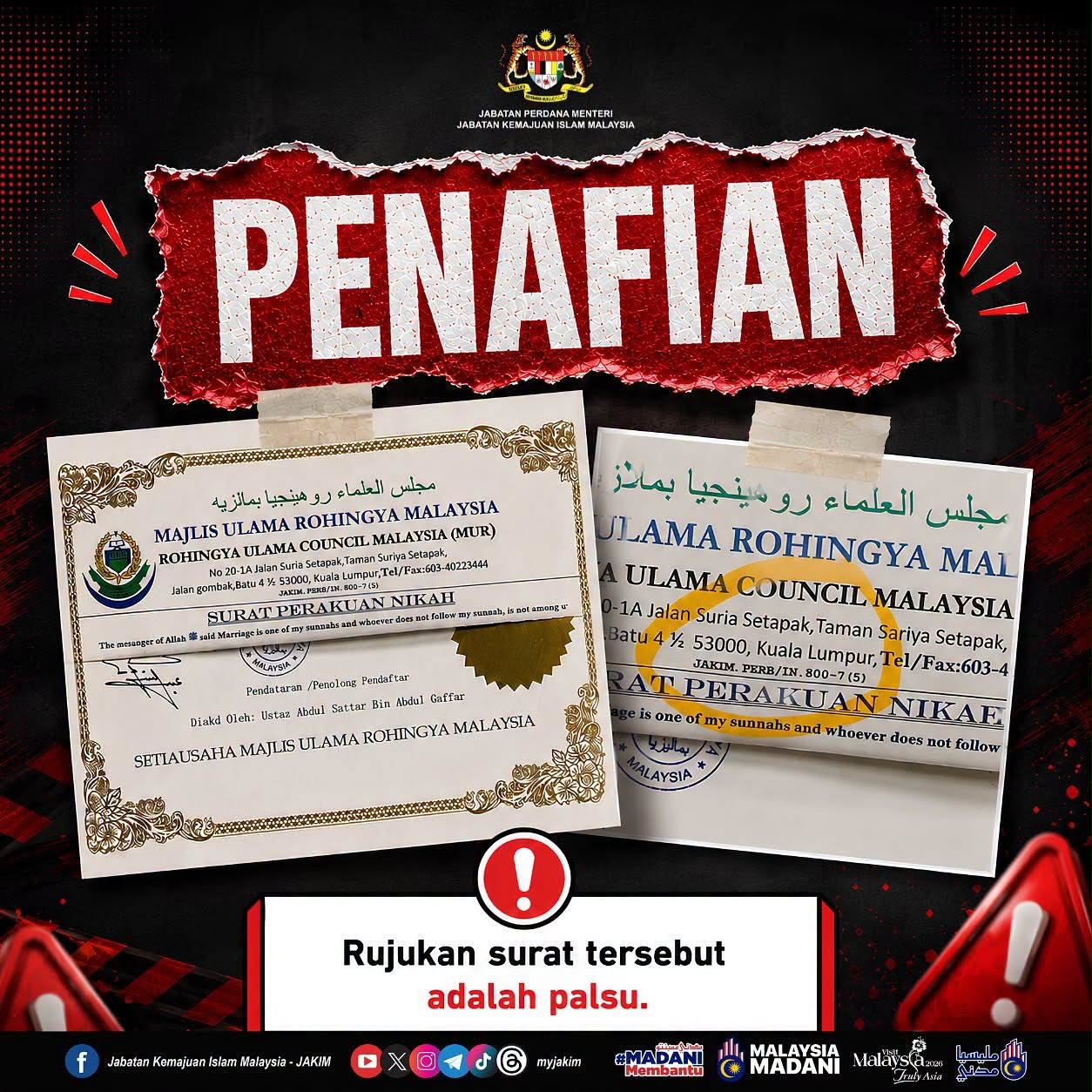
The Department of Islamic Development Malaysia has moved swiftly to stamp out misinformation after a forged document claiming institutional recognition began spreading across social media platforms. On July 15, JAKIM issued a definitive statement confirming that a marriage-related letter circulating online bears no legitimacy and was never authorised by any official Islamic body operating within Malaysian jurisdiction.
At the centre of the controversy sits a document allegedly issued by the Malaysia Rohingya Ulama Council, which included the reference number "JAKIM.PERH/LN.800-7(5)". The reference code itself became the red flag that prompted scrutiny from social media users and religious authorities alike. JAKIM's subsequent investigation revealed that this identification number is entirely fabricated, serving no official function within the department's administrative systems. The discovery underscores growing concerns about the ease with which forged religious documents can gain traction in the digital age, potentially misleading vulnerable populations seeking guidance on matters of personal importance.
In its official statement disseminated through social media channels, JAKIM made explicit that neither the department nor any state Islamic religious councils have appointed the organisation mentioned in the viral letter to oversee, manage, or certify marriage-related matters. This clarification carries particular weight given the sensitive nature of marriage documentation in Malaysia, where such certificates hold legal significance in Islamic law and can affect the validity of matrimonial unions. The distinction between legitimate and fraudulent marriage documentation therefore extends beyond mere administrative accuracy into matters that directly impact family law outcomes.
The department's response reflects a broader institutional concern about document fraud targeting religious and governmental authority. By publicly denouncing the reference number as fake, JAKIM aimed to prevent further circulation of the false document and to educate the public about verification procedures. The statement represents a defensive measure by Malaysia's primary Islamic authority, signalling that sophisticated forgers are now attempting to exploit religious administration systems to lend credibility to illegitimate claims.
Minister in the Prime Minister's Department (Religious Affairs) Dr Zulkifli Hasan acknowledged the seriousness of the matter, announcing that a formal investigation would proceed once complete information had been compiled. This escalation to ministerial level demonstrates that the government treats document forgery affecting religious institutions as a matter warranting high-level attention. The investigation's trajectory will likely establish whether this constitutes a single isolated incident or part of a coordinated scheme to generate fraudulent religious documentation.
For Malaysian citizens and residents, the incident highlights the critical importance of direct verification procedures before accepting any document claiming official sanction. JAKIM explicitly advised the public to consult directly with the department or relevant state-level Islamic religious authorities whenever uncertainty surrounds a document's authenticity. This guidance reflects the reality that social media circulation and professional-looking formatting can mask fabrication, making independent verification an essential consumer protection measure in the religious services sector.
The Malaysia Rohingya Ulama Council, named in the fraudulent letter, finds itself inadvertently drawn into a controversy through no fault of its own. The selection of this organisation's name suggests that forgers deliberately chose an entity that might possess some plausibility to observers, yet remain difficult for most members of the public to directly verify. This strategic misuse of institutional names underscores the vulnerability created when legitimate organisations operate with limited public awareness of their actual functions and authority.
The broader implications extend beyond this single incident to encompass systemic vulnerabilities in how religious authority is communicated and verified within Malaysia's multi-layered Islamic administrative structure. Encompassing federal JAKIM operations alongside state Islamic councils creates multiple points where documentation could theoretically be verified, yet also introduces complexity that forgers can exploit by generating documents that appear credible through technical formatting and strategic reference number fabrication.
For individuals seeking legitimate marriage-related services and documentation, the takeaway is unambiguous: consult official channels directly rather than relying on documents circulated through social media or informal networks. JAKIM and state Islamic religious authorities maintain dedicated inquiry systems specifically designed to authenticate documents and confirm institutional relationships. The department's public warning essentially establishes a new baseline expectation that conscientious individuals will proactively verify rather than passively accept digital communications claiming official sanction.
This incident also reflects the evolving nature of document fraud in Southeast Asia, where technological sophistication increasingly enables forgers to create convincingly formatted materials that exploit genuine institutional hierarchies and administrative terminology. Malaysian authorities' prompt and public response serves as both damage control and educational intervention, attempting to limit the letter's continued circulation while establishing clear authoritative guidance for citizens evaluating similar documents in future.

