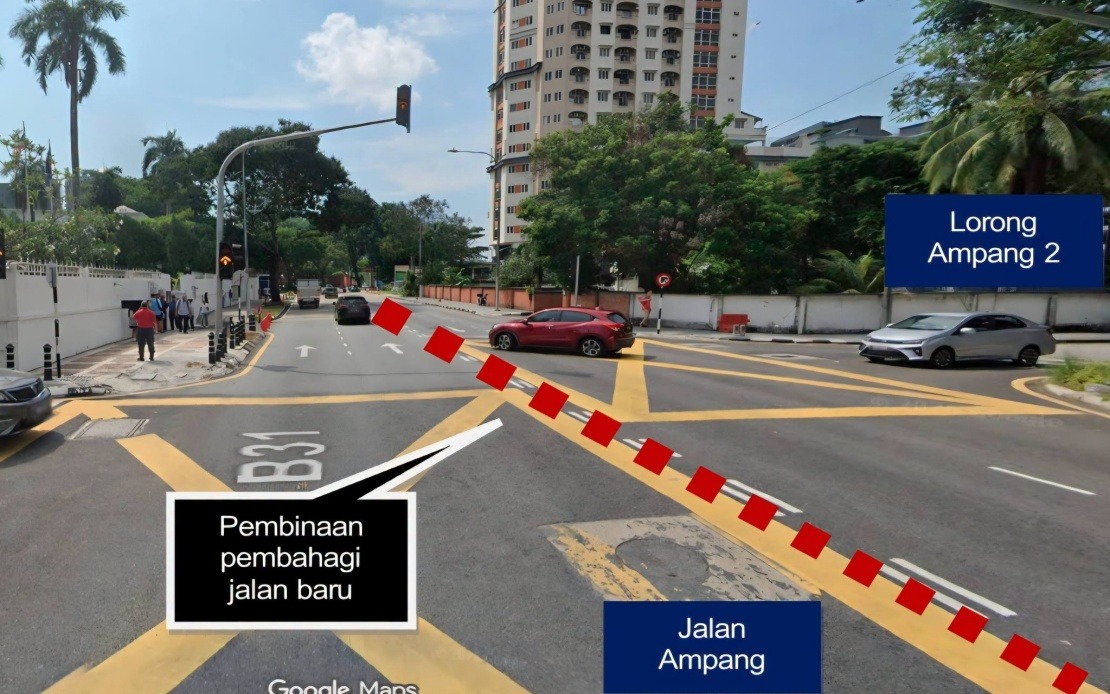
Kuala Lumpur motorists will need to adjust their commute patterns as the city authority permanently closes two traffic light intersections along Jalan Ampang beginning today. The closure affects the intersection in front of the Royal Thai Embassy and the one at Lorong Ampang 2, both of which have served as key traffic control points for the busy corridor. Kuala Lumpur City Hall announced the move as part of its broader infrastructure modernisation programme targeting the 3.2-kilometre stretch of Jalan Ampang running from the Jalan Tun Razak junction through to Middle Ring Road 2.
The permanent shutdown represents a significant shift in traffic management strategy for one of Kuala Lumpur's principal arterial roads. Rather than maintaining traditional signal-controlled intersections, the city authority has opted to eliminate these crossing points entirely in favour of a redesigned road network. This approach reflects evolving urban traffic engineering practices that prioritise continuous flow over conventional intersection management, particularly in congested metropolitan areas where bottlenecks at traffic signals can create cascading delays across the entire network.
The upgrade initiative addresses multiple infrastructure deficiencies simultaneously. Beyond the closure of the two intersections, DBKL plans to implement comprehensive improvements spanning road geometry, pedestrian facilities, and environmental enhancements. The project includes construction of permanent road dividers that will physically separate traffic streams, expansion of the main carriageway to accommodate four lanes in each direction, and substantial upgrades to pedestrian infrastructure. Street lighting modernisation forms another component, with officials recognising that improved visibility contributes meaningfully to road safety outcomes, particularly during evening commutes and night-time journeys.
Traffic engineers anticipate measurable benefits from eliminating these signalised crossing points. The permanent removal of intersections theoretically reduces opportunities for vehicle weaving—the unsafe lane-changing behaviour that occurs as drivers jockey for position before traffic signals turn red. By eliminating these conflict points entirely, the design aims to foster more orderly traffic movement and reduce the sudden deceleration events that typically characterise intersection approaches. Officials further expect reduced intersection delays and more consistent travel times, advantages that extend beyond individual journeys to encompass the broader logistics operations that depend on predictable travel windows.
For daily commuters, the closure necessitates familiarity with revised routing options. Drivers heading towards Ampang from the city centre may now execute a U-turn at Jalan Tun Razak before proceeding along the reconfigured Jalan Ampang, adding distance to some journeys. Conversely, those travelling from the Ampang area towards the city core can perform a U-turn at Jalan Ampang Hilir to redirect their vehicles appropriately. These alternative routes, while functional, represent a departure from previously direct trajectories, and the transition period will inevitably generate some congestion as motorists adapt to the new network geometry.
The Jalan Ampang corridor holds particular importance within Kuala Lumpur's transport architecture. As a primary route connecting residential areas and commercial districts, it experiences substantial daily traffic volumes and serves as a critical link in the broader road network. Congestion along this corridor ripples throughout the city's traffic system, making improvements here relevant to commuters well beyond those directly using Jalan Ampang. Residents of areas such as Ampang Jaya, Wangsa Maju, and neighbouring suburbs depend heavily on this route, as do commercial vehicles servicing the eastern suburbs and beyond.
The project reflects DBKL's broader capital investment strategy in road infrastructure modernisation. Rather than incremental maintenance-level interventions, the city authority pursues comprehensive rebuilds that fundamentally reimagine corridor functionality. This approach demands sustained coordination across multiple city departments and careful sequencing to minimise disruption. The timing of today's closure suggests construction teams are now prepared to commence physical works on the first phase of improvements, with the intersection closures presumably facilitating the roadworks required to construct dividers and expand the carriageway.
Contextually, this upgrade forms part of greater efforts to enhance Kuala Lumpur's road network efficiency as the city grapples with persistent congestion challenges. The Federal Territory has witnessed decades of rapid development that has outpaced initial infrastructure planning in many areas, creating structural bottlenecks that new road design principles attempt to remedy. Investments in corridors like Jalan Ampang signal recognition that systematic congestion demands systematic solutions rather than localised fixes.
Motor associations and transport advocacy groups have generally supported signals-to-dividers conversions in principle, noting that well-designed road dividers can improve safety by preventing unsafe crossing behaviour and reducing head-on collision risks. However, successful implementation requires comprehensive public information campaigns and careful traffic management during the transition phase. DBKL's advisory urging motorists to observe traffic signage appears calibrated towards managing this transition period, though commuters should anticipate several weeks of adjustment as the network stabilises into its new configuration.
The permanent nature of these closures distinguishes this project from temporary construction impacts. Once the intersections cease functioning, reverting to signal-controlled crossing points would demand substantial redesign and reconstruction. This permanence reflects the authority's confidence in the new traffic management approach, though it also means that any unexpected consequences will require additional mitigation measures rather than simple restoration of previous arrangements. As the project advances, monitoring of travel times, incident rates, and air quality along the corridor will provide empirical data on whether the theoretical benefits of intersection elimination translate into measurable real-world improvements.

