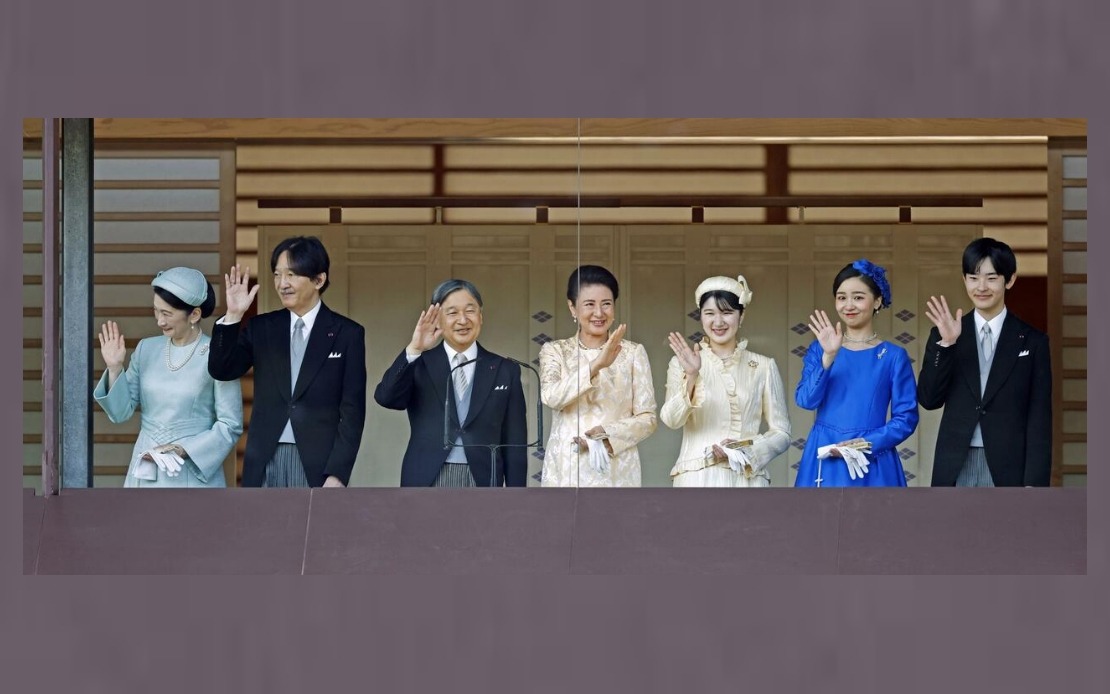
Japan's parliament has taken a cautious step toward modernizing its imperial succession framework, approving revisions to the 1947 Imperial House Law on Friday while deliberately preserving the tradition of male-line inheritance that has defined the world's oldest continuous monarchy. Prime Minister Sanae Takaichi's government, marking her tenure as Japan's first female premier with a notable irony, steered the legislation through lawmakers despite mounting public frustration over the restricted approach to addressing the dynasty's demographic crisis.
The revised law introduces two significant structural changes intended to shore up the imperial family's shrinking membership without fundamentally altering its patrilineal character. For the first time in modern Japanese history, unmarried males from the 11 former branch families—whose members were severed from the imperial register following World War II—may now be formally adopted into the imperial lineage if they have reached age 15. Additionally, female members of the imperial family gain the right to retain their royal status and titles even after marrying individuals outside the imperial household, a departure from longstanding practice that had automatically stripped women of imperial standing upon marriage to commoners.
This measured reform addresses a genuine institutional vulnerability. Japan currently has only three male heirs to Emperor Naruhito, creating an acute succession challenge that policymakers have struggled to resolve for years. The 1947 law, enacted during the American occupation that followed Japan's defeat in World War II, had dramatically contracted the imperial family when 51 members from 11 collateral branches were removed from the succession framework. That statute explicitly stipulated that "the throne shall be succeeded to by a male offspring in the male line belonging to the Imperial Lineage"—language that remains unchanged in the new version, crystallizing the conservative coalition's commitment to patrilineal continuity.
The legislative process itself has drawn criticism from opposition parties, who argue that parliament's deliberations were insufficiently thorough and transparent. The ruling coalition, comprising the long-dominant Liberal Democratic Party and its junior partner, the Japan Innovation Party, has faced accusations of rushing the legislation through without adequate cross-party scrutiny. Though months of dialogue involving 13 parliamentary parties and groups produced a formal legislative "consensus," this consensus notably sidestepped the most contentious question: whether the throne itself should ever pass to a female or to someone descended from the imperial line through a female ancestor.
The government has framed the adoption mechanism as a durable solution to succession scarcity, contending that male descendants of the newly re-integrated branch families will provide eligible heirs for generations to come. Under the revised framework, any male adopted from these former branches becomes eligible for throne succession, opening a pathway that was previously considered constitutionally and legally untenable. For Malaysian observers monitoring developments in regional governance, this Japanese approach offers insight into how entrenched constitutional traditions can be selectively reformed while core patriarchal structures remain protected from democratic scrutiny.
Yet a striking disconnect separates official policy from the sentiments of ordinary Japanese. A Kyodo News poll conducted in May revealed that 83.0 percent of respondents favor permitting female emperors, while only 13.1 percent oppose such a change. This substantial majority support—spanning generational, geographic, and ideological divides—reflects broader transformations in Japanese society regarding gender roles and institutional legitimacy. The government's decision to disregard this democratic preference reveals tensions between elite constitutional conservatism and populist sentiment that characterize contemporary Japan.
Takaichi's government has maintained that the revised law's provisions on male adoption provide sufficient flexibility to sustain imperial succession without explicitly extending eligibility to female sovereigns or maternal-line descendants. This position essentially forecloses any scenario in which an empress regnant might ascend the Chrysanthemum Throne, even if future demographic circumstances made such succession necessary. The law's silence on female and maternal-line succession represents a deliberate choice rather than an oversight, signaling the ruling coalition's determination to preserve patrimonial principles regardless of practical necessity.
The historical context amplifies the significance of this legislative moment. The 1947 Imperial House Law itself was a revolutionary document in Japanese terms, imposed by occupying American authorities who sought to reduce imperial authority and introduce democratic principles. That the current government would resist further democratic reform of the same statute—particularly concerning gender equality—underscores how constitutional frameworks, once established, can entrench particular distributions of power across generations. For Southeast Asian nations grappling with their own constitutional arrangements and succession questions, Japan's experience demonstrates both the durability and the limitations of formal legal change in the absence of underlying political will.
The adoption provision, while breaking new legal ground, ultimately offers a conservative solution to an acute problem. Rather than reconceptualizing imperial authority in gender-neutral terms, it simply expands the pool of eligible male successors by bringing former branch families back into the imperial system. This approach preserves the fundamental structure while addressing immediate scarcity, resembling comparable compromises found in European monarchies that have gradually expanded female succession only when male heirs genuinely disappeared. Japan's strategy reflects a preference for minimal institutional disruption, even at the cost of ignoring robust public opinion.
The timing of this legislation under Japan's first female premier carries considerable symbolic weight, albeit ambiguously. Takaichi's leadership demonstrates that women can exercise executive authority in contemporary Japan, yet her government simultaneously restricts imperial authority along strictly patrilineal lines. This contradiction suggests that gender equality in political systems remains segmented rather than comprehensive, with certain institutions—particularly those carrying historical or ceremonial significance—remaining shielded from broader democratic movements.
Looking forward, the revised Imperial House Law establishes a framework that may function adequately for several decades, provided that the pool of eligible male descendants from restored branch families produces sufficient heirs. However, should demographic trends continue to narrow the field of viable male successors—a plausible scenario given Japan's broader aging and declining population—the legislature will eventually confront the question it has deferred: whether the throne's integrity ultimately depends on patrilineal exclusivity or on institutional continuity itself. When that moment arrives, the 83 percent public consensus favoring female emperors may prove more durable than the conservative legal consensus enacted this week.

