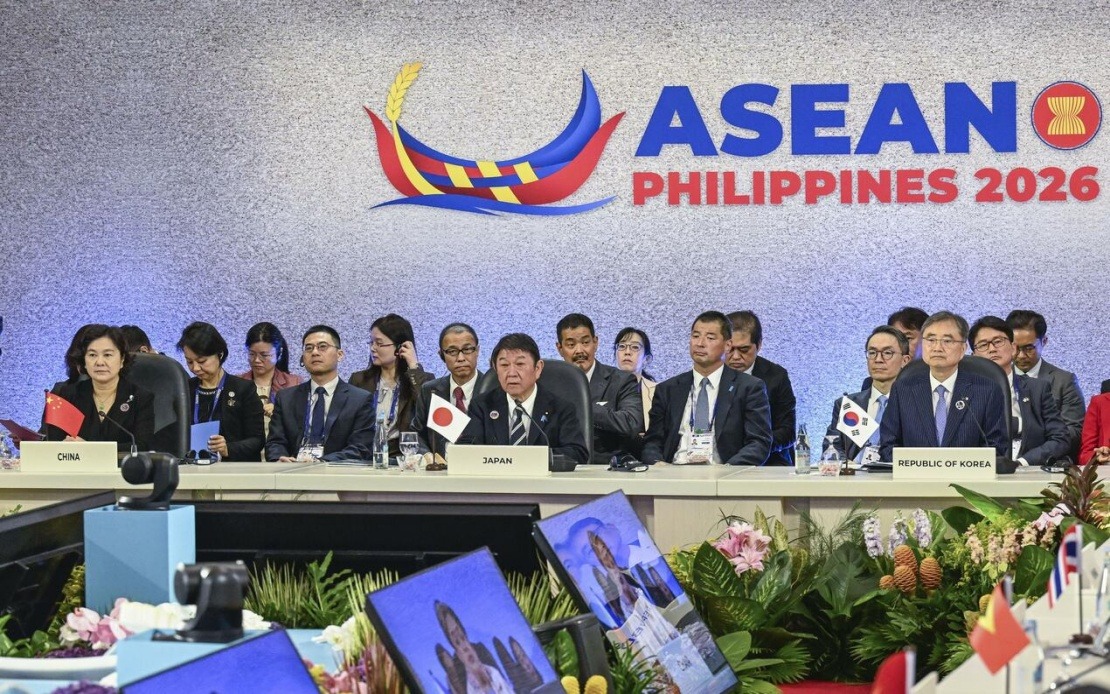
Japan has signalled its commitment to deepening regional ties on critical security and economic issues, with Foreign Minister Toshimitsu Motegi outlining Tokyo's priorities for energy resilience and cybercrime prevention at a multilateral gathering in Manila. The meeting brought together foreign ministers from the ten-member Association of Southeast Asian Nations alongside representatives from China and South Korea—a diplomatic forum established to foster practical cooperation and stability across East Asia and the broader Indo-Pacific region.
Motegi's emphasis on energy cooperation reflects mounting concerns about supply chain vulnerabilities in Southeast Asia, particularly in light of geopolitical tensions in West Asia that threaten global energy flows. The grouping's collective focus on fortifying energy networks signals recognition that regional prosperity hinges on uninterrupted access to affordable power and fuel. For Malaysia and other ASEAN members, this commitment carries significant implications as nations across the bloc seek to balance rapid economic growth with energy security during a period of global supply chain uncertainty.
The inclusion of online scams on the agenda highlights a persistent challenge confronting the region, where digital fraud schemes have proliferated in recent years, targeting citizens across multiple countries and creating cross-border enforcement complexities. Collaborative efforts among ASEAN nations, Japan, China, and South Korea could facilitate information-sharing and coordinated law enforcement responses to transnational cybercriminal networks. Malaysia in particular has grappled with sophisticated scam operations, making this area of cooperation especially relevant for protecting consumers and strengthening digital governance frameworks.
Motegi underscored the economic weight of the ASEAN-plus-three grouping, noting that combined GDP exceeds one quarter of the global economy. This observation reflects the region's trajectory toward greater geopolitical and economic influence at a time when Asia-Pacific dynamics are reshaping global trade patterns and investment flows. The scale of this economic bloc positions it as an increasingly consequential player in shaping international norms and standards across multiple sectors, from energy to financial services.
Japan's stated support for ASEAN centrality and the ASEAN Outlook on the Indo-Pacific represents continuity in Tokyo's regional strategy, which has long prioritised Southeast Asia as central to maintaining a stable, rules-based order in Asia. By reaffirming backing for AOIP—an initiative designed to preserve freedom of navigation, transparency, and inclusive dialogue—Japan signals alignment with ASEAN's vision of balanced great-power relations. This positioning allows Tokyo to maintain strategic partnerships with Washington and other Western allies while engaging constructively with Beijing through multilateral ASEAN-led frameworks.
The convergence between Japan's Free and Open Indo-Pacific vision and ASEAN's Outlook underscores shared interest in preventing any single power from dominating regional affairs. For Malaysia and other ASEAN members navigating great-power competition, this alignment offers reassurance that Japan remains committed to supporting regional autonomy and decision-making authority. Japanese coordination with China and South Korea to advance these principles through ASEAN-plus-three mechanisms suggests Tokyo views multilateralism as an effective channel for moderating tensions and maintaining constructive dialogue.
China's participation through Vice Foreign Minister Hua Chunying, rather than Foreign Minister Wang Yi, may reflect scheduling considerations or internal diplomatic messaging. Nonetheless, Beijing's engagement in ASEAN-plus-three discussions on energy and security matters indicates Chinese interest in maintaining this institutional framework, even as bilateral Sino-Japanese and Sino-American tensions persist elsewhere. The presence of multiple diplomatic channels and forums allows regional players to compartmentalise discussions and prevent conflicts in one domain from derailing cooperation in others.
The ASEAN-plus-three framework itself has endured since its inception following the 1997 Asian financial crisis, demonstrating the institutional value of crisis-responsive cooperation mechanisms. That leaders gathered most recently at a summit in Malaysia in October reflects the grouping's ongoing relevance as an instrument for addressing transnational challenges. For Malaysia, hosting such gatherings reinforces its position as a significant venue for regional diplomatic engagement and affords the country platforms to amplify its priorities on energy transition and digital security.
Motegi's separate engagement with British Foreign Secretary Ed Miliband following the multilateral meeting signals Japan's intention to maintain robust connections with non-Asian partners while deepening Asian ties. The reference to Prime Minister Andy Burnham's administration suggests Tokyo views UK continuity in global partnership as important despite domestic political transitions. This parallel diplomacy underscores how major regional powers simultaneously cultivate multiple relationships across different institutional and bilateral channels to maximise their strategic influence.
Looking forward, the practical outcomes of these pledges will determine their substantive impact on regional stability. Energy cooperation frameworks must translate into concrete infrastructure projects, investment mechanisms, and supply diversification strategies. Cybercrime cooperation requires establishment of joint task forces, intelligence-sharing protocols, and harmonised legal standards across jurisdictions with differing criminal codes and enforcement capabilities. For Malaysia and other ASEAN members, realising these commitments depends on sustained political will, adequate resource allocation, and willingness to subordinate short-term national interests to collective security objectives.

