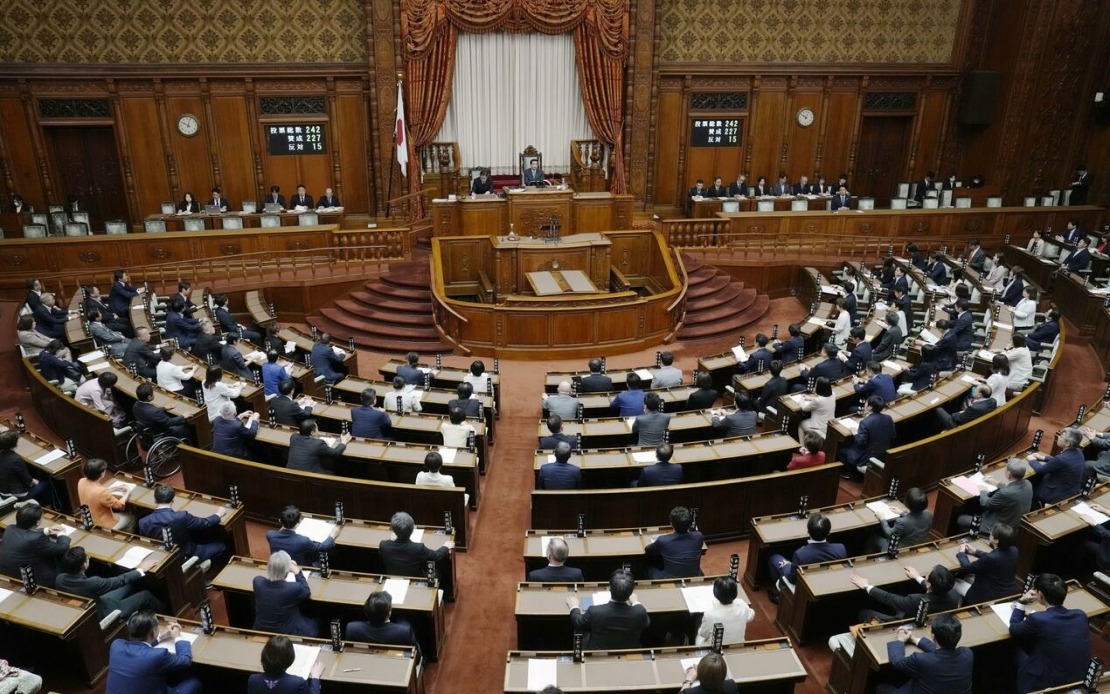
Japan's parliament has passed significant defence legislation that marks a fundamental shift in how the nation approaches military capabilities in the 21st century. The House of Councillors enacted reorganisation measures on Friday that will formally integrate space defence into the Air Self-Defence Force's operational structure, reflecting Tokyo's acknowledgment that terrestrial and aerial security can no longer be separated from activities in orbit. The restructuring will take effect during the fiscal year concluding in March 2027, giving the defence ministry time to establish new command structures and training protocols.
The cornerstone of this restructuring involves creating a dedicated space operations group that will function under the leadership of a lieutenant general, a rank indicating Japan's seriousness in elevating space operations to strategic importance. This unit will focus specifically on enhancing the nation's situational awareness across orbital space and improving satellite reconnaissance and surveillance systems. For regional observers, the move signals Japan's intent to develop independent capabilities rather than relying exclusively on allies for space-based intelligence gathering, positioning itself as a more autonomous actor in the Indo-Pacific's evolving security architecture.
Defence Minister Shinjiro Koizumi articulated a vision that extends well beyond military considerations when discussing the legislative changes. His remarks emphasised that modern civilian infrastructure now depends fundamentally on space-based systems, a reality that transcends defence budgets and strategic planning. Satellite navigation technology underpins everything from smartphone mapping applications that millions use daily to weather forecasting systems that agricultural and maritime communities rely upon. This framing helps Japanese policymakers and the public understand that space defence is not an exotic military concern but rather a prerequisite for protecting everyday services that citizens have come to expect.
The structural changes represent only one dimension of Japan's defence evolution. The legislation also authorises the appointment of an additional senior vice minister position within the defence portfolio, addressing a longstanding concern about institutional capacity during crises. When contingencies arise or major natural disasters strike, having dual senior ministerial positions allows for more effective delegation and decision-making at the highest levels. This redundancy becomes particularly relevant given Japan's exposure to natural disasters and the need for rapid military-civilian coordination during emergencies. The additional minister will also facilitate expanded defence engagement with the United States and other security partners, creating bandwidth for high-level dialogues that increasingly demand ministerial-level attention.
Personnel challenges have emerged as a critical vulnerability for Japan's Self-Defence Forces, a reality the government is attempting to address through legislative incentives. The restructuring includes provisions to enhance retirement benefits for uniformed personnel, whose mandatory retirement ages typically arrive earlier than their civilian service counterparts. This creates a structural disadvantage when competing for talent in a labour market where skilled workers can pursue lucrative private sector careers. By improving post-retirement security, policymakers hope to make military service more attractive to qualified recruits and encourage experienced personnel to complete full careers rather than departing prematurely.
For Southeast Asian nations observing these developments, Japan's focus on strengthened southwestern defences carries particular significance. The legislation upgrades the Ground Self-Defence Force's 15th Brigade, stationed in Naha in Okinawa Prefecture, from brigade to divisional status, reflecting increased emphasis on protecting Japan's remote southwestern archipelago. This elevation of command status enables more sophisticated operational planning and greater autonomy in responding to emerging threats. China's growing maritime assertiveness throughout the region provides immediate context for this decision, as Beijing's expanded naval activities and claims have prompted Japan and its regional partners to reassess their defensive posture.
The timing of these changes reflects Japan's evolving strategic calculus as the regional security environment undergoes profound transformation. Unlike traditional defence upgrades that might focus exclusively on ship construction or advanced weapons systems, this legislation targets institutional architecture and capability gaps that Tokyo has identified as increasingly critical. Space-based surveillance provides persistent monitoring capabilities that human operators cannot match, while the institutional reorganisation reflects recognition that modern threats require modern command structures rather than hierarchies inherited from earlier eras.
For Malaysia and other ASEAN nations, Japan's space defence initiatives carry implications for regional stability and intelligence cooperation frameworks. As Japan develops independent space surveillance capacity, it may become a more capable partner for regional information sharing, potentially reducing ASEAN dependence on extra-regional powers for maritime awareness. The restructuring also demonstrates how wealthy, technologically advanced nations are adapting their defence postures to incorporate domains that developing military capabilities in Southeast Asia have only recently begun to address seriously.
The legislative package also underscores Japan's determination to position itself as a permanent security anchor in the Indo-Pacific rather than a nation whose defence priorities fluctuate with political winds. By embedding space operations within the Air Self-Defence Force rather than creating a separate service, Japan preserves institutional integration while signalling that space defence complements rather than replaces traditional air operations. This pragmatic approach contrasts with some other nations that have pursued more dramatic reorganisations, suggesting Tokyo's preference for evolutionary rather than revolutionary change.
Looking forward, the success of these reorganisation efforts will depend on implementation quality and sustained political commitment beyond the initial legislative phase. Defence restructuring frequently encounters delays and cost overruns, and Japan's compressed timeline to operationalise the space operations group by March 2027 leaves limited margin for complications. However, the passage of comprehensive legislation indicates broad political consensus supporting these changes, suggesting the reforms will likely proceed according to plan. For regional security analysts, the next critical period will involve monitoring how effectively Japan's space operations capabilities develop and how Tokyo chooses to integrate these assets into its broader alliance and partnership frameworks.

