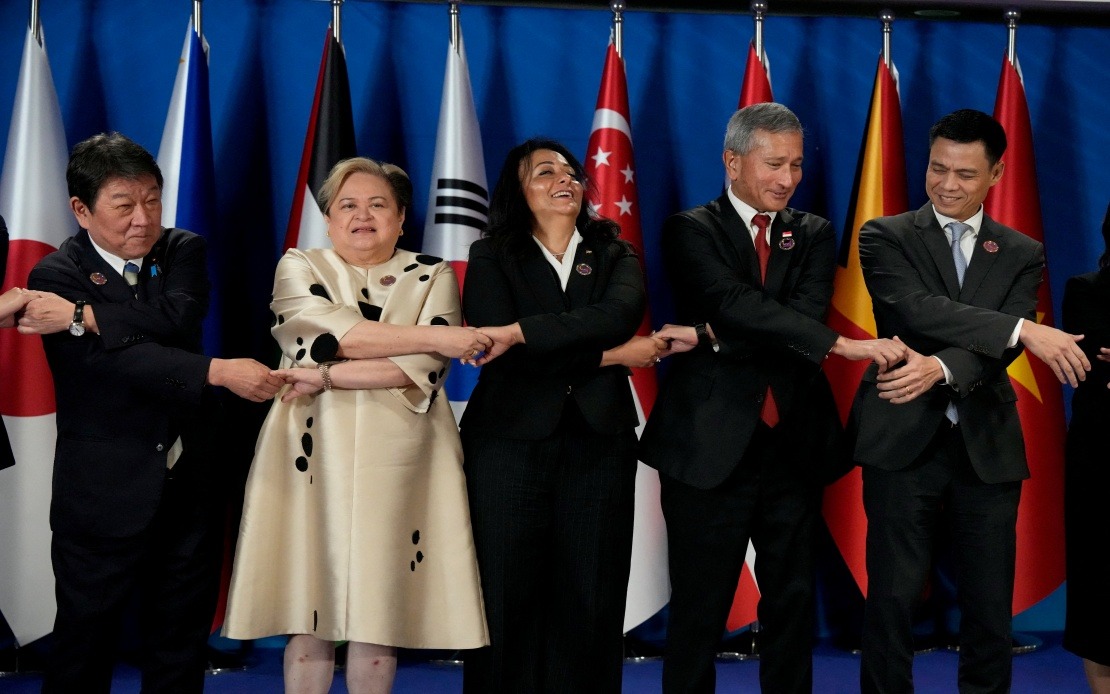
Four major Asia-Pacific powers have reinforced their commitment to Southeast Asian stability, using high-level diplomatic meetings in Manila to signal a consolidated approach toward managing regional challenges and fostering economic cooperation. The Post-Ministerial Conferences between Japan, South Korea, Australia, New Zealand and ASEAN represent a critical moment as tensions reshape global supply chains and geopolitical calculations across the Indo-Pacific.
Japanese Foreign Minister Toshimitsu Motegi framed Tokyo's engagement as fundamentally supportive of ASEAN's role as a neutral meeting point and decision-making hub. Rather than viewing regional partnerships through a competitive lens, Motegi emphasised Japan's desire to align its technological and economic priorities with Southeast Asian development trajectories. The Japanese vision encompasses three interconnected areas: digital infrastructure advancement, artificial intelligence deployment and environmental transformation—each representing sectors where Japanese expertise and capital could meaningfully contribute to regional progress while strengthening mutual economic interests.
South Korea's foreign policy establishment articulated a more complex regional diagnosis. Foreign Minister Cho Hyun identified three concurrent pressures destabilising the region: fragmentation of globally integrated manufacturing networks, escalating tensions in West Asia reverberating through energy and shipping corridors, and the unpredictable effects of rapid technological change on labour markets and social stability. Seoul's analytical framing suggests that technological disruption poses as significant a challenge to regional order as traditional security concerns. The South Korean government has translated this analysis into concrete initiatives, proposing an artificial intelligence companionship programme and supporting Southeast Asian creative industries—efforts designed to position South Korea as a technology-sharing partner rather than a purely economic competitor.
Australian Foreign Minister Penny Wong delivered perhaps the most candid assessment of current regional dynamics, describing the past twelve months as fundamentally destabilising. Her comments reflected Canberra's concern that multiple crises simultaneously—Middle Eastern volatility, regional competition intensification, and global supply chain disruptions—have created compounding vulnerabilities. Wong specifically highlighted how disruptions to fertiliser, fuel and food supplies now threaten the economic foundations that underpin regional prosperity and stability. By framing these challenges as interconnected rather than isolated incidents, Wong implicitly warned that piecemeal responses would prove inadequate.
New Zealand's Foreign Minister Winston Peters occupied a distinctive diplomatic position, presenting Wellington's concerns as emerging from a rules-based international order under strain. Peters identified renewed great power competition, challenges to multilateral institutions, artificial intelligence governance and climate change as defining challenges. His framing privileged institutional and systemic concerns over bilateral tensions, positioning New Zealand as a guardian of international frameworks that smaller nations depend upon for security and economic opportunity. This rhetorical stance carries particular weight given Wellington's geographic distance from immediate regional hotspots—Peters essentially argued that even distant democracies face profound stakes in maintaining Southeast Asian stability.
The convergence of these four nations' concerns reveals a shared diagnosis: the region faces not a single crisis but an overlapping series of pressures requiring coordinated rather than isolated responses. Supply chain fragmentation affects all four countries differently—Japan as an export-dependent manufacturing hub, South Korea as a technology leader, Australia as a resource exporter, and New Zealand as an agricultural producer—yet all recognised the necessity of regional economic resilience. This common interest transcends bilateral relationships and suggests that ASEAN's coordinating role has become increasingly valuable precisely when great power competition might otherwise splinter regional unity.
The concrete initiatives discussed—an ASEAN Power Grid linking regional electricity infrastructure, a Digital Economy Framework Agreement standardising digital trade rules—represent practical efforts to insulate Southeast Asia from the worst effects of global instability. These projects matter for Malaysian economic interests specifically. As a regional manufacturing and digital services hub, Malaysia benefits significantly from supply chain predictability and electrical grid stability. Power shortages or digital standards fragmentation would directly threaten Malaysian industrial competitiveness and investment attractiveness.
Wong's emphasis on ASEAN's centrality to regional architecture carries particular significance for Malaysian policymakers. She articulated a vision where ASEAN's role extends beyond traditional diplomacy into active resilience-building—shaping rules, brokering relationships and fostering shared security frameworks. This framing positions Southeast Asia as the region's indispensable mediating force rather than a peripheral actor caught between greater powers. For Malaysia, historically invested in ASEAN's institutional strengthening, this validation represents diplomatic vindication even as it places expectations on Malaysian leadership to help ASEAN deliver meaningful outcomes.
The absence of explicit discussion of great power rivalry between the United States and China represents a notable diplomatic omission. None of the four foreign ministers explicitly referenced these tensions, despite their pervasive influence on regional calculations. This careful language suggests a deliberate strategy: emphasising shared challenges and cooperative frameworks rather than divisive security competition. The approach implies that these nations believe forward movement requires reframing regional discourse away from zero-sum competition and toward mutual vulnerability and interdependence.
For Southeast Asian governments including Malaysia, these meetings signal that major powers remain committed to regional institutional engagement rather than resorting to unilateral approaches. The emphasis on concrete cooperation mechanisms—grids, frameworks, initiatives—suggests that dialogue will translate into actionable commitments. However, the meetings also reveal underlying fragility: multiple speakers emphasised how recent global shocks have demonstrated interconnectedness and mutual dependence, implying that this interdependence could just as easily become a source of contagion if coordination breaks down.
The timing of these conferences matters significantly. Occurring amid intensified geopolitical competition and economic uncertainty, they represent a conscious recommitment to partnership principles even when national interests might suggest protectionist responses. For Malaysia and other ASEAN members, the message from four prosperous, strategically important democracies is clear: their futures remain fundamentally bound to Southeast Asian stability and prosperity. This recognition, converted into concrete cooperation mechanisms, provides both opportunity and responsibility for regional governments to shape the frameworks that will determine their economic futures and security prospects across the coming decade.

