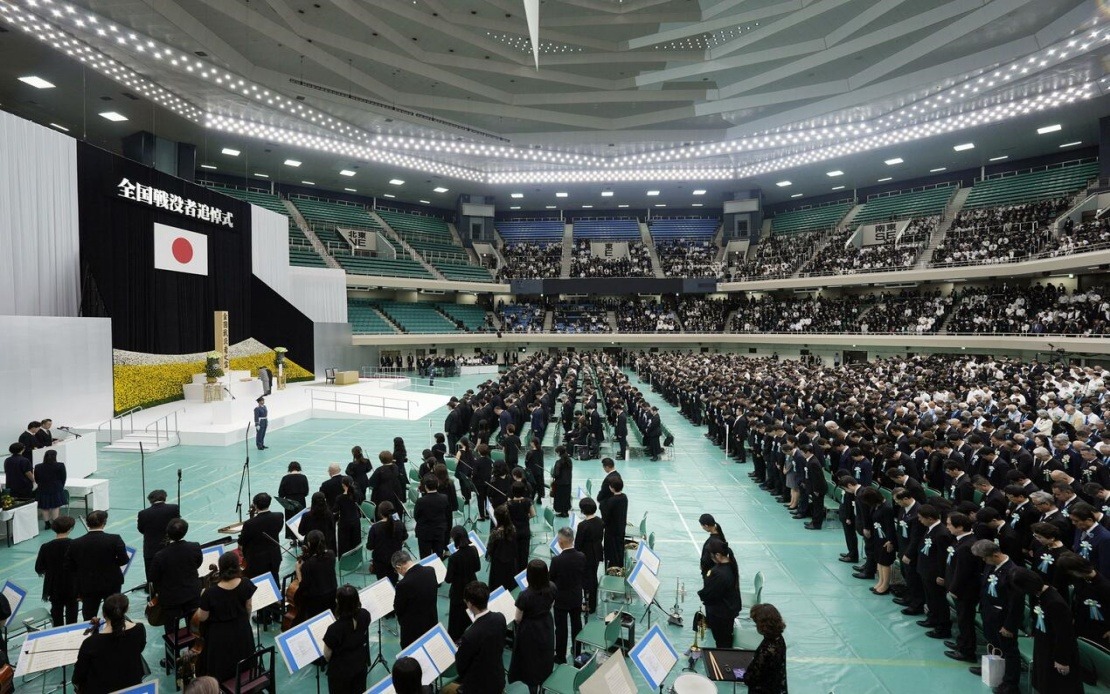
Japan commemorated the 81st anniversary of its World War II surrender on August 15, with a state ceremony in Tokyo that highlighted a subtle yet significant shift in how the nation's leadership frames its wartime history. Prime Minister Sanae Takaichi, who took office last October, made her first appearance at the annual memorial since her appointment, addressing the ceremony with remarks centred on Japan's dedication to peace. Yet her carefully chosen words—which omitted the explicit acknowledgement of "remorse" that her predecessor Shigeru Ishiba had introduced just the previous year—signal a perceptible pivot in how Tokyo's leadership discourse treats one of Asia's most sensitive historical junctures.
The government-sponsored event drew Emperor Naruhito and Empress Masako, who participated in solemn remembrance for approximately 2.3 million military personnel and roughly 800,000 civilians lost during the war that concluded in 1945. The emperor, maintaining his annual practice, expressed "deep remorse" in his own address, underscoring a distinction between the imperial institution's position and that of the prime minister. This divergence is not merely rhetorical; it reflects deeper currents within Japanese political leadership regarding how far the nation should go in publicly acknowledging its wartime conduct across Asia.
Takaichi's background as a politician known for assertive views on national security makes her linguistic restraint particularly noteworthy. In her remarks, she stated that Japan has "consistently walked the path of a nation that values peace and made all possible efforts for world peace and prosperity," framing the post-war decades as a straightforward commitment to pacifism rather than a reaction to past transgressions. This formulation differs markedly from Ishiba's language, which explicitly invoked Japan's need to keep "remorse" in mind and pledged resolute renunciation of war—terminology that resonated precisely because Ishiba was the first Japanese leader in thirteen years to articulate such sentiments at an August 15 ceremony.
The contrast between the current prime minister's remarks and those of her immediate predecessor reveals the fractured nature of consensus on how Japan should publicly reckon with its wartime past. Ishiba, perceived as a relatively moderate figure within the conservative Liberal Democratic Party that now stands under Takaichi's leadership, had broken a lengthy silence by reintroducing the language of remorse at the 2024 ceremony. By sidestepping such terminology this year, Takaichi has effectively reset the trajectory of prime ministerial statements at these commemorations, moving them away from explicit acknowledgement of aggression and towards a more generalised emphasis on peace commitments.
Historical precedent illuminates the stakes of this rhetorical choice. Prior to December 2012, when Shinzo Abe—Takaichi's political mentor—assumed the prime ministership for a second term, Japanese prime ministers had consistently referenced the nation's wartime aggression, particularly across China and the Korean Peninsula, and had routinely expressed remorse at the August 15 ceremonies. Abe's decision to depart from this pattern marked a watershed moment, one that Takaichi now appears to be consolidating. Her deliberate avoidance of direct references to Japan's wartime conduct in Asia represents not a lapse but a calculated continuance of a political approach that prioritises forward-looking narratives over historical reckoning.
The implications of this shift extend beyond Japan's borders and resonate throughout East Asia, where memories of Japanese military expansion remain contested and sensitive. China and South Korea, which bore the brunt of Japanese wartime aggression, have repeatedly emphasised the importance of Japanese political leaders acknowledging historical responsibility. When Japan's prime minister declines to explicitly reference such aggression or express remorse, it risks being interpreted as a retreat from the delicate equilibrium of historical acknowledgement that previous administrations, however reluctantly, had maintained. In the Malaysian and Southeast Asian context, where Japanese occupation during World War II left profound historical scars, such shifts in Tokyo's rhetorical positioning warrant careful attention.
Takaichi's focus instead on contemporary security concerns—her administration has presided over significant increases in defence spending and a relaxation of restrictions on defence equipment exports—suggests that her political priorities centre on Japan's present and future strategic posture rather than historical reconciliation. This orientation becomes particularly relevant given the heightened tensions currently affecting West Asia and the broader recalibration of Japan's defence policy. By emphasising peace as an ongoing commitment rather than as a response to past wrongs, Takaichi attempts to position Japan's militarisation as consistent with its pacifist identity, a rhetorical manoeuvre that conflates different historical narratives.
The ceremony itself maintained its solemn traditions, with a moment of silence observed at noon—the precise time when Emperor Hirohito announced Japan's surrender by radio broadcast in 1945. This temporal anchoring serves as a reminder that the anniversary is fundamentally about commemorating losses rather than debating historical interpretation, yet the language leaders employ when addressing those losses carries weight that reverberates across the region. Emperor Naruhito's steady reiteration of "deep remorse" and his call to "pass down the memories of the suffering endured during and after the war" provide a counterweight to the prime minister's more circumscribed remarks, preserving at least an institutional voice for historical accountability.
For observers in Malaysia and across Southeast Asia, Takaichi's rhetorical choices merit scrutiny not as isolated statements but as indicators of where Japan's leadership intends to position the nation's historical identity. The deliberate avoidance of language that Ishiba had reintroduced suggests a conscious effort to normalise a narrative in which Japan's role in World War II becomes increasingly backgrounded in favour of post-war achievements and contemporary security imperatives. This framing, while perhaps politically convenient domestically, risks eroding the foundations of historical understanding that many regional partners have viewed as essential to sustained regional reconciliation and stability.

