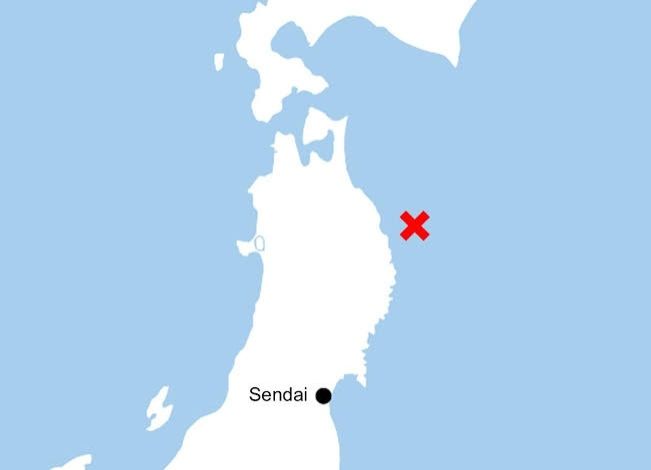
A forceful 7.2-magnitude earthquake rumbled beneath the waters off Iwate prefecture on Japan's main island of Honshu on Thursday morning, sending tremors across several hundred kilometres to Tokyo and beyond. The seismic event, which struck at 7:30 am local time with its epicentre positioned 44 kilometres below the ocean floor, resulted in scattered disruptions rather than the catastrophic damage that Japan's geography sometimes inflicts. Residents reported toppled kitchenware, wobbling fixtures, and suspended transport services, yet government officials confirmed no fatalities or serious structural damage had emerged from the initial impact.
The Japan Meteorological Agency initially assessed the tremor at 6.9 magnitude before revising the figure upward to 7.2, a distinction that underscores the precision required in seismic measurement and the evolving nature of data collection. The decision to forgo tsunami warnings reflected confidence in the earthquake's specific characteristics—its depth, location, and focal mechanism—suggesting minimal risk to coastal communities despite the substantial magnitude. This measured response demonstrates the sophistication of Japan's early warning systems, refined through decades of experience managing seismic hazards.
Personal accounts from residents painted a picture of momentary alarm rather than genuine peril. Mutsumi Shimohata, a 61-year-old food processing employee in Aomori prefecture's Hashikami district, described the experience with the equanimity of someone accustomed to Japan's frequent tremors. While her home suffered only a fallen picture frame, her workplace encountered more significant disruptions—the office's automatic door mechanism failed and ceiling sections collapsed, prompting management to send employees home as a precaution. Such varied impacts illustrate how earthquake damage depends heavily on building design, maintenance standards, and proximity to the epicentre rather than magnitude alone.
Television footage documented the characteristic chaos of a strong quake's immediate aftermath: kitchen cupboards disgorged their contents in shops and homes, merchandise spilled across store floors, and unsecured objects shifted violently. The Shindo intensity scale, Japan's indigenous measure of ground motion felt at specific locations, registered upper-six levels across Aomori prefecture. At this intensity, people typically cannot stand unassisted, furniture topples readily, and windows risk shattering—yet modern construction standards and reinforcement practices have significantly reduced the injury potential compared to previous generations.
Transportation networks experienced brief disruptions typical of major seismic events in Japan. Several shinkansen bullet train services suspended operations as a precautionary measure, though service resumed following standard safety protocols. A primary school in Hashikami temporarily closed, and emergency responders fielded calls reporting people trapped in lifts and stuck doors throughout affected areas. A tanker truck overturned, highlighting the risks posed to vehicles and cargo during strong seismic motion. These incidents, while concerning, remained isolated and manageable within Japan's well-established emergency response framework.
Government officials moved swiftly to assess the situation and communicate with the public. Chief Cabinet Secretary Minoru Kihara stated that no human casualties had been identified, though authorities would continue monitoring for emerging damage reports. Prime Minister Sanae Takaichi issued directives for ministries and government agencies to coordinate with local authorities and specifically cautioned residents to remain vigilant for potential aftershocks of comparable strength. Such official warnings carry particular weight in a nation where secondary seismic events sometimes cause additional casualties and damage.
Nuclear safety authorities confirmed no anomalies at regional power stations, a reassurance that carries outsized significance in Japan given the nation's traumatic experience with the 2011 Fukushima disaster. That catastrophic sequence—a 9.0-magnitude offshore quake followed by a devastating tsunami that killed approximately 18,500 people and crippled a major nuclear facility—remains seared into collective memory and fundamentally shapes how Japanese society approaches seismic hazards. Every strong earthquake triggers careful scrutiny of reactor status and cooling systems, reflecting hard-won lessons about the compounding risks posed by natural disasters striking critical infrastructure.
Japan's position along the Pacific Ring of Fire relegates such powerful earthquakes to the realm of routine hazard management. The island nation straddles four major tectonic plates and experiences roughly one-fifth of all global earthquake activity annually, with hundreds of tremors recorded each year. Most prove harmless, their energy dissipating harmlessly in the deep crust or dispersing across lightly populated areas. The challenge facing Japan lies not in preventing earthquakes—an impossible task—but in maintaining preparedness infrastructure, updating building codes, and ensuring public awareness of response protocols.
This latest event follows an April tremor of 7.7 magnitude that had prompted a rare special advisory warning of elevated probability for earthquakes exceeding 8.0 magnitude. That advisory, issued after an event that injured at least ten people, lasted one week before authorities lifted it, suggesting confidence that seismic activity had stabilised into normal patterns. The frequency of major seismic events highlights the continuous vigilance required—April's earthquake had jarred even Tokyo's well-engineered structures, serving as a potent reminder that Japan's earthquake resilience, while advanced, remains perpetually tested by the dynamic geology underlying the archipelago.
For Malaysia and Southeast Asian observers, Japan's response to this earthquake offers instructive lessons in disaster management and institutional preparedness. While the region faces different seismic risks—Malaysia lies outside major plate boundaries and experiences relatively modest earthquake activity—the principles underlying Japan's approach remain universally relevant. Public education, early warning systems, building code enforcement, and coordination between government agencies and local authorities represent transferable best practices. Japan's experience demonstrates that investment in seismic resilience, though substantial, ultimately proves far more economical than managing the consequences of inadequate preparation.

