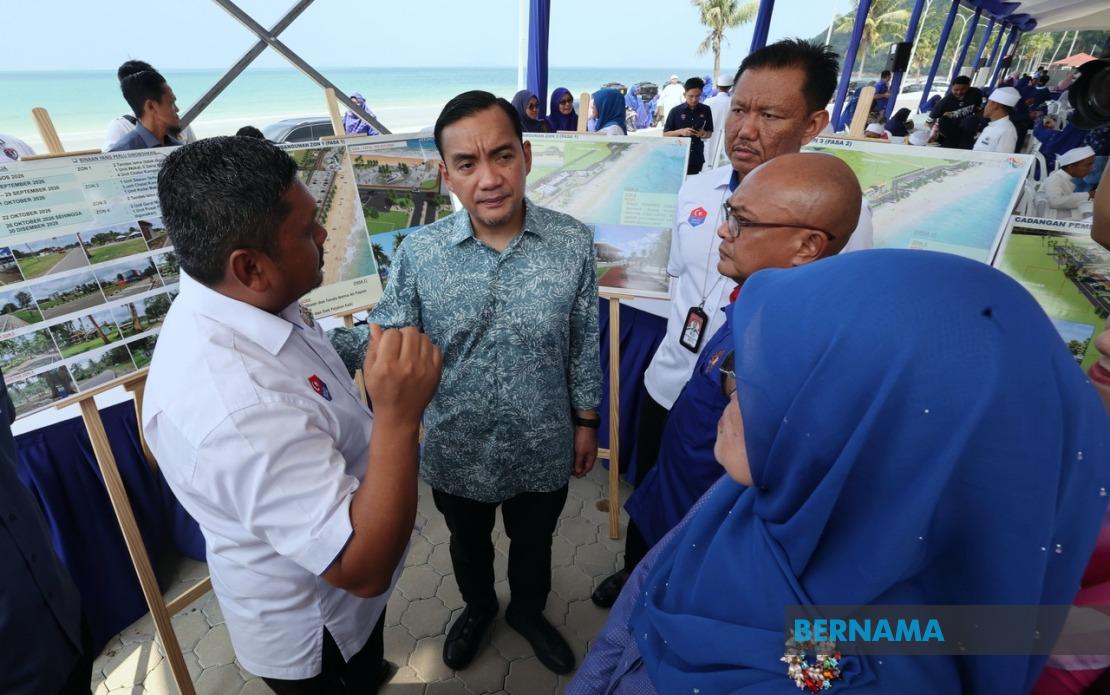
Johor's state government has committed RM1.5 million towards a comprehensive development initiative in Mersing district, channelling investments into infrastructure, sports facilities, healthcare services, and public utilities. The move reflects an official commitment to distributing the benefits of the state's economic expansion beyond major urban centres, with Menteri Besar Datuk Onn Hafiz Ghazi emphasising that regional prosperity must extend to communities across all districts.
The funding framework is anchored in the Johor Economic Transformation Plan (JETP), a structured development roadmap that encompasses short-, medium-, and long-term objectives. Beyond merely stimulating economic activity, the plan prioritises tangible improvements to residents' living standards and expanded employment pathways, particularly for younger demographics who face limited career opportunities in smaller districts. This multi-layered approach reflects growing regional recognition that economic development divorced from social benefit risks fuelling resentment and demographic drift.
Onn Hafiz articulated a critical concern during his address to Mersing residents: tourism infrastructure and commercial opportunities hold little value if the district's 80,000-strong population cannot participate meaningfully in wealth generation. This framing recontextualises development spending from symbolic gestures into necessity, particularly relevant as Mersing has positioned itself as an emerging tourism destination. The allocation thus serves dual purposes—enhancing visitor-facing amenities while simultaneously creating employment avenues for locals through expanded service sectors.
Healthcare infrastructure represents the largest single expenditure component, with RM500,000 allocated to upgrade the Mersing Hospital Haemodialysis Unit. This focus on dialysis facilities addresses a critical gap in specialist medical services for patients requiring regular treatment, a population segment that often faces transport burdens and access inequities in district-level healthcare systems. The investment signals acknowledgement that health equity constitutes a prerequisite for meaningful development.
Community and recreational facilities receive substantial support through the allocation. RM200,000 each addresses carpet replacement at Kampung Sri Lalang Mosque and construction of a new futsal court at Taman Sri Mersing, while another RM200,000 targets repairs to the existing futsal court in Felda Nitar. These expenditures, seemingly modest individually, reflect deliberate investment in civic gathering spaces and youth engagement infrastructure—categories often deprioritised in resource-constrained local administrations yet critical for community cohesion and preventive social programming.
Infrastructure improvements targeting marginalised communities feature prominently in the allocation's social justice dimension. RM100,000 each will install solar-powered streetlighting in the Orang Asli villages of Kampung Peta and Kampung Tanjung Tuan, directly addressing electricity access disparities that have historically characterised indigenous settlements. Solar technology selection suggests environmental consciousness alongside equity considerations, reducing operational costs while promoting energy independence for these communities.
Federal Land Development Authority (Felda) communities receive targeted support through multiple initiatives. A RM100,000 allocation will upgrade the Kami Anak Felda Malaysia (KAF) building in Felda Tenggaroh Timur, while RM80,000 finances a sepak takraw court in Felda Tenggaroh 6. These investments acknowledge Felda settlements' particular vulnerabilities—communities historically dependent on palm oil commodity cycles now facing economic transition pressures as global agricultural patterns shift. Recreational and community facilities serve stabilising functions during economic transitions, providing social anchors and youth engagement opportunities.
Beyond immediate capital projects, the announcement encompasses strategic infrastructure proposals requiring inter-agency coordination. A proposed petrol station at Camp Iskandar, intended to serve Special Forces Group (GGK) personnel, represents infrastructure likely to generate ancillary employment and commercial activity. The project's assignment to local assemblyman and district officials for coordination suggests genuine devolution of implementation authority rather than top-down imposition.
Two long-term institutional developments warrant particular attention for their structural implications. Plans to establish a Religious Affairs Office address Mersing's administrative gaps in Islamic affairs management, while proposed Technical and Vocational Education and Training (TVET) campus development targets critical skill gaps in the local workforce. TVET facilities carry particular significance for Southeast Asian labour markets, where technical qualifications increasingly outweigh general secondary education in determining employability and earning trajectories, particularly for youth unable to access or afford university pathways.
The Johor government's replication model—adapting successful Johor Bahru development strategies to district-level contexts—acknowledges that economic transformation requires locally contextualised implementation rather than uniform templates. Johor Bahru's development trajectory, while impressive, emerged from distinct advantages including metropolitan status, port infrastructure, and industrial clustering. Adapting these lessons to Mersing's tourism-oriented, agrarian-heritage economy necessitates creativity and flexibility that the current allocation's breadth suggests the administration recognises.
For Malaysian development discourse, the Mersing initiative embodies emerging state-level sophistication in regional equity considerations. Rather than concentrating public investment in already-advantaged centres, this allocation acknowledges that sustainable development requires deliberate inclusion mechanisms. The funding's dispersion across healthcare, youth engagement, indigenous community services, and skill-building infrastructure suggests holistic thinking increasingly evident in state administrations throughout the region.
The initiative's implications extend beyond Mersing itself, establishing potential precedent for regional policymaking across Southeast Asia. As urbanisation pressures intensify and rural-urban inequality drives political instability across the region, Johor's explicit commitment to sharing economic gains with peripheral districts offers both practical alternatives to purely market-driven development and political messaging emphasising inclusive governance. The success or failure of this allocation in translating to measurable community benefit will influence regional development policy discussions for years ahead.

