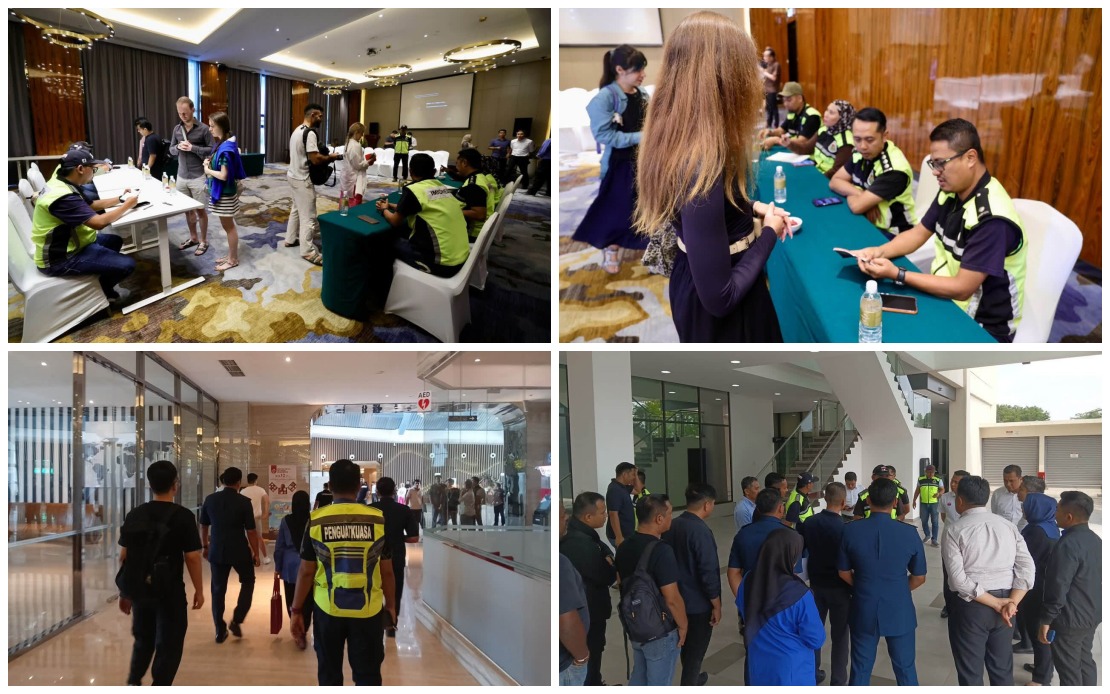
The Iskandar Puteri City Council (MBIP) has moved decisively to shut down operations at Network School in Forest City, citing serious violations of local business regulations and licensing requirements. Johor Menteri Besar Datuk Onn Hafiz Ghazi announced the enforcement action following investigations that revealed the educational institution had fundamentally misused premises licensed for office purposes, converting them into active classroom and teaching spaces without the necessary approvals or permits.
The investigation uncovered a two-pronged breach of regulatory conditions. The school was operating from multiple locations, with one site holding a valid office business licence while a second premises operated entirely without MBIP authorisation despite being owned by a Malaysian citizen. This distinction is significant under Malaysian local government law, which strictly regulates the permitted use of commercial and office spaces. The conversion of office-licensed premises into educational facilities represents a material change in the nature of operations that requires explicit municipal approval and a different category of business licensing.
Beyond the unlicensed operation, MBIP investigators found that Network School had contravened the specific permitted business category attached to its licensed office space. The company had established classroom activities and conducted business promotions from premises that were expressly authorised only for office functions. This represents not merely administrative oversight but deliberate operational activity outside the scope of approved use, triggering formal enforcement measures under the Local Government Act 1976.
In response to these violations, MBIP formally issued Stop-Business Notice IP012N260714001 targeting the unlicensed premises. Simultaneously, the council served an Advertisement Licence Notice (6103) under Section 107(2) of the Local Government Act 1976, addressing unauthorised signboards and promotional materials that failed to comply with licensing standards and deviated from permitted advertising parameters. These concurrent notices represent a comprehensive regulatory response addressing both core operational breaches and ancillary advertising violations.
Menteri Besar Onn Hafiz emphasised that the Johor state government treats such regulatory breaches with considerable seriousness and that MBIP intends to maintain investigative scrutiny across all matters falling within its administrative jurisdiction. He signalled that additional enforcement action would follow if further violations of applicable laws, licence conditions, or regulations came to light. This statement suggests the council's investigation remains ongoing and that other potential breaches may yet be uncovered during the examination process.
A particularly noteworthy dimension of the case involves questions surrounding foreign nationals associated with the school's management and operations. Rather than MBIP handling this aspect, Onn Hafiz clarified that immigration and residency matters fall entirely under the purview of the Home Ministry. The state government has formally requested that the ministry make urgent and definitive decisions regarding the immigration status of individuals involved and the school's capacity to continue operations under current circumstances. This jurisdictional boundary indicates that while local authorities can enforce business licensing regulations, questions of foreign worker permits and visa compliance require federal immigration authorities.
The enforcement action gained momentum following viral social media allegations concerning the school, though these posts lacked official substantiation. The unverified claims circulating online suggested connections between Network School and purported Israeli interests in establishing a presence within Malaysia through investment and currency-related activities. While such allegations prompted public attention and likely triggered the local authority investigation, the official enforcement notice issued by MBIP focused narrowly on verifiable breaches of municipal licensing and premises-use regulations rather than the speculative claims circulating on digital platforms.
For Malaysian readers and business operators, this case underscores the importance of strict compliance with local government licensing requirements and the permitted uses specified in business licences. Converting office-licensed premises into educational facilities or other substantially different commercial activities without obtaining updated approvals exposes businesses to enforcement action and operational shutdowns. The MBIP action demonstrates that local authorities maintain active investigative capacity and will enforce regulations regardless of the commercial profile or international dimensions of the operation in question.
The case also highlights the multilayered regulatory framework governing commercial operations in Malaysia. Business licensing at the municipal level, advertising standards, premises-use classifications, and immigration compliance for foreign nationals all intersect in complex ways. Operators establishing international schools or educational institutions must navigate not only municipal business licensing but also immigration regulations, educational licensing from the Education Ministry if applicable, and advertising compliance standards. The closure of Network School illustrates the consequences when these various regulatory requirements are treated casually or circumvented.
Looking forward, the case raises broader questions about oversight of educational facilities operating within commercial precincts like Forest City. Integrated townships and business parks often attract educational ventures, but ensuring that such operators obtain appropriate licensing and that their premises are properly designated and approved remains essential for maintaining regulatory integrity. The MBIP enforcement action sends a clear signal that local authorities will not tolerate unlicensed educational operations or misrepresentation of premises use, regardless of whether the operators are domestic or foreign entities.
The resolution of the immigration dimension remains pending, with the Home Ministry expected to provide clarity on the status of foreign nationals involved and the school's operational future. This interdepartmental coordination between MBIP and federal immigration authorities reflects the systemic approach required to address complex cases involving licensing breaches and potential immigration irregularities. Malaysian authorities have demonstrated they can coordinate effectively when regulatory violations span multiple jurisdictional domains.

